6.89%
Expected Return

20 min read

Investors today face more choices than ever as public and private markets continue to expand and overlap. This abundance offers potential opportunity but also new layers of complexity and risk.
If you're involved in private investing or considering it, you need answers to key questions like what are you trying to achieve, how much should be allocated, through which vehicles, and at what additional cost or risk?
The answers, of course, depend on a range of considerations, and vary across investors, advisors, institutions, and retirement plan sponsors—each with different objectives, capabilities, and constraints. Morningstar has the breadth and depth of data, research, tools, and insights to help guide your journey, whatever path you’re on.
Here are key factors for each audience to consider, with the goal of getting the right investors in the right investments for the right reasons.
Historically, many private market vehicles were available only to institutions or the ultra-wealthy. Now, a growing set of investment offerings is making private markets more accessible to individual investors. While this group has likely heard about the potential benefits, their time or resources may be limited given priorities such as career demands, family responsibilities, savings goals, taxes, and retirement planning.
Still, the rise of private markets introduces questions like:
Morningstar provides transparency into private markets, including the potential benefits, risks, and considerations that matter when evaluating these investments as part of a long-term strategy.
Semiliquid funds can play a role in portfolios, but only when investors are clear-eyed about both their benefits and their trade-offs.

Chris Tate
Senior Analyst, Equity Strategies
Private assets reward patience. Semiliquid funds, which permit periodic redemptions, are built for investors who can leave money in place across a full market cycle. As a result, allocations should be matched to goals that don’t require funding for at least seven to 10+ years.
Semiliquid funds offer limited redemption windows, often quarterly, capped at a small share of fund assets and sometimes subject to board discretion. During periods of stress, these limits stop being theoretical.
Liquidity, therefore, should be treated as a privilege that can be paused rather than a guarantee of access, with careful consideration to the alignment between the vehicle structure and its underlying assets.

The lower volatility of private assets isn't necessarily what it appears. Because private funds are valued quarterly using a variety of nonpublic methodologies—rather than real-time market prices—reported volatility, commonly measured by standard deviation, is often understated and reflects more about how private assets are priced than about their underlying risks.
This effect is visible in the chart below. Private equity and private debt benchmarks cluster at lower volatility levels, despite similar public asset classes showing significantly higher variation.
During market downturns, this can appear reassuring as public portfolios are marked down daily, but it largely reflects a valuation lag rather than genuine resilience. The more pressing question for investors is whether recent returns have justified the illiquidity trade-off. Over the period shown, several private asset categories, as measured by the Morningstar PitchBook indexes, have delivered returns broadly in line with or below comparable public market benchmarks, without the benefit of daily liquidity.
For long-term investors, private assets can still play a role in a diversified portfolio, but the case rests on selecting managers who can generate return premiums over time, not simply smoother-looking volatility figures.
The fundamental case for private assets in a portfolio rests on a simple premise: Investors who accept illiquidity, locking away their capital for years without a limited ability to sell, should be rewarded with returns that exceed what public markets offer. The S&P 500 has proven an exceptionally difficult benchmark to beat over this period, outpacing most asset classes, both public and private, and that context matters.
Within private assets, direct lending has made a compelling case, delivering steady, income-driven returns that have benefitted from the higher rates over the period below.
But the broader takeaway for investors is straightforward—the illiquidity premium over public assets should be the starting point for evaluating private assets, as pointed out in guidance on how to assess semiliquid performance. If a strategy isn't clearing that bar over a full market cycle, especially net of fees, the trade-off warrants serious scrutiny.
Private market funds charge fees in layers—a management fee and performance fee along with administrative costs that build on each other references in a recent piece on private market fund fees. According to Morningstar, Inc. research, the average semiliquid fund charges more than eight times the average annual cost of a passive fund. The gap between the least and most expensive interval fund is also wider than in passive exchange-traded funds, so investors must pay closer attention to the cost of interval funds than other vehicles.
Fund-of-funds structures can increase costs even further by adding another layer of fees from the underlying funds. Each layer reduces the return that ultimately reaches an investor, making it important to look beyond the headline returns to what number lands in an account.
Private market funds require more research than a typical stock or bond fund. Tax reporting can also be more complicated—some funds send a K-1 instead of a standard 1099, which can add cost and complexity to filing. The funds themselves may be hard to evaluate with layered structures, assets that aren’t priced daily, and fee arrangements that take careful reading to fully understand.
None of this is a reason to avoid private markets entirely, but it does mean the need for due diligence is real. If you cannot clearly explain what you own, how it’s valued, and what it costs, that’s a sign to slow down and possibly work with a trusted advisor before committing capital.
Although financial advisors have seen growing interest in private market vehicles, their competing priorities—such as wealth forecasting, estate planning, and tax management—have limited the time available to consider utilizing them inside clients’ investment portfolios. Further, clients typically have not had enough wealth to qualify for traditional private market vehicles.
As access evolves, key questions emerge like:
Morningstar delivers data, research, and insights to support advisors in evaluating these questions and navigating a growing set of investment offerings in the private market space.
At Morningstar, we don’t rely solely on historical market returns, we also forecast future private market long-term returns. While forecasting can be challenging for any asset class, there are unique considerations when assessing private markets.
The universe is deal-dependent and evolving, making broad benchmarking difficult, and data is often harder to obtain. This increases the importance of manager selection and risk management, as outcomes can vary more widely than in typical public markets.
Nonetheless, we find that the potential to improve risk-adjusted returns exists. Using our capital market assumptions, including de-smoothing private market return streams to better assess volatility, the analysis suggests that portfolios can achieve higher expected returns with lower volatility.

Some of this is due to the diversification benefit of adding private markets to portfolios. Private market diversification comes in two forms.
First, there’s the traditional benefit of including assets that behave differently within a portfolio. Second, retail investors have been missing out on a growing part of the market. From pre-IPO companies and businesses undergoing private transformation to debt from those bypassing traditional lenders, gaining exposure to sectors and strategies underrepresented in public markets is a potential benefit.
Expected Return
Expected Volatility
Source: Morningstar Investment Management, data as of 12/31/2025. Portfolio is made up of the asset classes illustrated in the "Traditional 60/40 Portfolio above". Past performance is no guarantee of future results. This information is hypothetical in nature and for illustrative purposes only. The portfolio values do not represent actual performance information. Gross returns are performance results before the deduction of all fees and expenses an investor paid or would have paid in connection with advisory services for their account. If included, these fees would reduce the gross performance shown.
Expected Return
Expected Volatility
Source: Morningstar Investment Management, data as of 12/31/2025. Portfolio is made up of the asset classes illustrated in the "Portfolio with Private Markets above". Past performance is no guarantee of future results. This information is hypothetical in nature and for illustrative purposes only. The portfolio values do not represent actual performance information. Gross returns are performance results before the deduction of all fees and expenses an investor paid or would have paid in connection with advisory services for their account. If included, these fees would reduce the gross performance shown.
Semiliquid and private vehicles have limitations on investors’ ability to withdraw funds. With traditional stocks, bonds, mutual funds, and ETFs, advisors are accustomed to daily liquidity to help meet their clients’ cash flow needs. As the comparison chart below shows, private market vehicles range from quarterly cash liquidity to multiyear lockups.
Advisors should consider the timing and urgency of their clients’ liquidity needs when evaluating private investment options for portfolios. For clients with immediate liquidity needs, like funding retirement spending, understanding restrictions on raising cash from private market vehicles is essential.
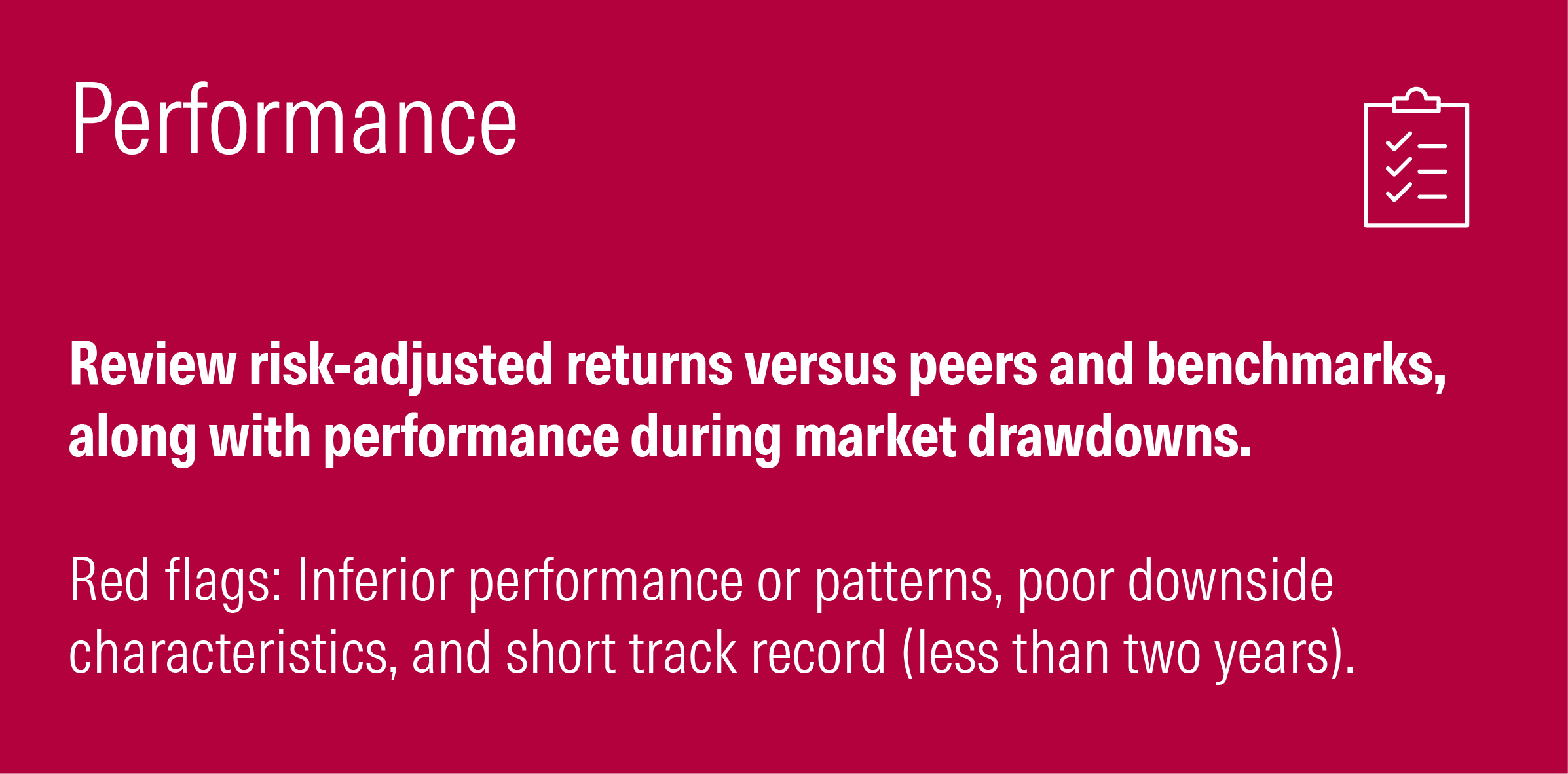
Advisors should apply the same rigorous standards to private market vehicles as they would to any other prospective investment. Key considerations include experienced management teams, a clear investment edge, strong portfolio fit, consistent performance, investor-friendly practices, and fees.
Private market strategies also introduce challenges to standard due diligence like evolving track records, limited asset manager experience, reduced liquidity, lower transparency and valuation, and higher fees. These factors increase the importance of manager selection but don’t eliminate the case for private investments, particularly given their potential for risk-adjusted returns and diversification via lower-correlated assets.
Key areas of assessment:




Once it’s determined that a client is a good fit, the next step is incorporating private markets into the existing portfolio. We suggest determining a comparative public asset class to guide asset allocation decisions, allowing funds to be sourced from existing targets while maintaining diversification. For example, leveraged buyout funds tend to resemble smaller-cap stocks. This step is fundamental in determining where within the lineup the private market fund allocation could be sourced.
After sizing and sourcing are established, due diligence and manager selection become crucial. As outlined earlier, Morningstar suggests evaluating a range of factors when assessing private market managers to ensure meeting clients’ goals.
Fees and liquidity expectations should also remain a focus throughout the due diligence process.

The potential for a more robust portfolio notwithstanding, there is no proverbial free lunch. Many products available to investors include some cash drag to support liquidity, which can impact future returns. Greater price discovery may also lead investors to see more volatility than a pure private investment partnership. Lastly, these products are complex, carry higher fees, and exhibit a wide dispersion of returns, making manager selection critical.
Review questions to ask include:
Private markets have long been a cornerstone of institutional return targets—but the landscape is shifting fast. For chief investment officers of large public pensions, this means that private markets remain central yet complex to manage.
Institutional investors should consider questions such as:
PitchBook and Morningstar deliver comprehensive data on funds, managers, deals, and performance benchmarks across public and private markets to help institutional investors work through these questions with data and independent analysis.
The case for private markets tends to rest on two claims that are difficult to evaluate in practice: that illiquidity deserves a premium and that private market exposures provide diversification that public markets cannot. PitchBook’s Allocator Solutions research models the marginal impact of a private markets sleeve within a traditional 60/40 portfolio.
Whether a private markets allocation improves portfolio outcomes depends on a range of factors. The mix of fund strategy, leverage, vintage timing, manager selection, and how performance is benchmarked against public alternatives all contribute to whether the added complexity and illiquidity are justified.
For institutional investors, the choice between drawdown and evergreen funds involves clear trade-offs. Drawdown funds offer GPs full control over investment timing and portfolio management, an advantage for long-term, illiquid strategies like private equity and venture capital, but they burden limited partners with unpredictable capital calls, irregular distributions, and the ongoing challenge of pacing commitments to meet allocation targets.
Evergreen funds simplify this process. Investors buy in at NAV, gain immediate exposure to a seasoned portfolio, and benefit from compounding returns over time. But simplicity comes with caveats. Evergreen structures can carry cash drag, valuation uncertainty, and liquidity constraints—including redemption gates and early exit fees—that investors must fully understand before investing.
Manager selection is one of the most consequential decisions in private markets, and one of the hardest to get right. Performance dispersion between top and bottom quartile managers can exceed 10–20% in internal rate of return, or IRR, yet past returns offer little predictive value at the time LPs make commitment decisions.
Effective due diligence requires a deeper qualitative lens, including evaluation of team composition, investment philosophy, process consistency, and incentive alignment to identify risks and opportunities that historical data may not capture.
In the evergreen space, fund evaluation introduces new challenges. Short track records, reliance on secondaries, layered fees, and manager-determined valuations create risks not present in drawdown funds.
Skilled manager selection can improve outcomes, but it requires data-driven frameworks to assess fund family track records across strategies and structures.
The long-term nature of private markets and unique liquidity aspects of evergreen funds necessitate due diligence principles that address issues like liquidity management, alignment and conflicts of interest, and valuation policies for illiquid assets.

Hilary Wiek, CFA, CAIA
Principal Analyst, Fund Strategies, PitchBook
Private market portfolios don’t run on a predictable schedule. Capital calls arrive at the GP's discretion, distributions depend on exit conditions, and the gap between the two has widened as deal activity slowed and exits remained muted. PitchBook's cash flow research tracks these dynamics across strategies, highlighting what that means for LP liquidity planning.
Effective commitment pacing requires modeling both sides of the ledger. Forecasting capital calls and distributions at the fund level, then aggregating across vintages, gives allocators a clearer view of when the portfolio is likely to be a net consumer of cash versus a net generator.
Benchmarking is the essential lens through which institutional investors evaluate every decision, from total portfolio asset allocation to individual fund performance, with different decisions requiring different benchmarks.
Private markets make this deceptively difficult: Drawdown funds are typically best measured by IRRs and multiples, while evergreen funds report time-weighted returns, making direct comparisons difficult.
Establishing a strong measurement framework is the foundation for holding managers accountable and making informed allocation decisions. PitchBook and Morningstar, Inc. offer transparent benchmarks and indexes across drawdown and evergreen structures in private credit, real estate, and private equity, helping investors assess whether these strategies are delivering worthwhile risk-adjusted return potential.
Over the past few years, retirement plan sponsors and recordkeepers have seen increased focus on private markets, driven in part by the Department of Labor’s June 2020 Partners/Pantheon Ventures letter. This release affirmed that private equity can fall within the Employee Retirement Income Security Act law when mediated by an advisor, with the DOL’s March 2026 proposal on fiduciary duties in selecting investment alternatives further reinforcing this view.
From a regulatory perspective, little has changed. Private assets were never prohibited under ERISA, though recent guidance may give fiduciaries greater comfort. The questions of what to include and how remain unsettled.
Beyond fees and manager quality, fiduciaries must assess how private strategies complement the existing lineup and fit within an advisor’s model. For example, a plan without real estate investment trust exposure may benefit from a direct property fund, while one concentrated in core fixed income could look to private credit.
At this stage, plan sponsors must ask relevant questions, such as:
Portfolio implementation is equally important. Private market funds designed for retirement use are semiliquid—perpetual structures with a liquidity sleeve alongside private holdings—and limit redemptions at set intervals. Plan sponsors, recordkeepers, and advisors need to understand how these features affect rebalancing and onboarding, as well as how redemption terms affect a fund’s removal from a plan, whether by choice or due to the plan sponsor changing recordkeepers.
The operational risk profile for privates is not symmetrical. If successful, privates could improve retirement outcomes for many investors. If not, the entire proposition may disappear.

Hal Ratner
Head of Research, Investment Management
For the foreseeable future, private markets are not expected to be among a plan’s core offerings. The 2020 Partners/Pantheon Ventures letter and subsequent government communications have consistently emphasized this point.
Fiduciaries should consider how their advisor will allocate to privates. As the chart below illustrates, private equity is phased out as investors approach retirement, while some allocation to credit is maintained throughout the glide path. This implies that for many plans, most assets will likely be in credit, which can introduce scaling problems for the asset manager.
Implementing semiliquid funds within a discretionarily managed target date fund—where investment decisions are overseen by a manager and not strictly programmatic—is relatively straightforward. Managers understand liquidity constraints, including gating, and are able to handle illiquidity. They also can allow positions to “float” and may source and direct net cashflows to maintain the overall allocations.
In a fully automated setting, however, the end investor holds the position in their account and cash flows must follow a routine process. This often increases the need for liquidity and gating may not be feasible in practice for plan sponsors or recordkeepers. In these cases, the semiliquid fund may need to be housed within a “public/private” collective investment trust—with a significant allocation to public securities sized to complement the advisor’s model. For example, a private equity semiliquid housed within a CIT that includes a meaningful allocation to low-cost index funds.

The 2026 DOL proposal outlines six safe harbor pillars—factors fiduciaries should consider when selecting designated investment alternatives for a plan:
Among these, valuation and complexity stand out. Valuation requires the fiduciary to understand how the asset manager prices the portfolio—including valuation frequency, underlying assumptions, and the impact of third-party pricing—within net asset value. The considerations align closely with Morningstar Investment Management LLC’s fiduciary framework for evaluating private investments in defined contribution plans.
Benchmarking, while straightforward for public funds, is often less clear in private markets. Index coverage is limited, particularly for semiliquid strategies, which may require combining existing public and private benchmarks.
The final pillar—complexity—may be the most interesting. It asks the fiduciary to know thyself well enough to determine if they have the expertise to evaluate a given vehicle or whether due diligence should be delegated to a consultant. Fiduciaries can allocate but not abdicate.
Given the nature of private markets, manager selection plays a larger role in outcomes. Performance dispersion is far wider than in public markets, and top managers have tended to outperform over long periods of time.
This is largely due to the size of the market—there are fewer participants in any given deal and information is available to only a limited set of capital providers and seekers. As a result, established managers often have repeat relationships with capital seekers, giving them early access to attractive deals.
Understanding how managers source deals and whether they have a first-refusal advantage is critical.
Private markets allocation isn’t a one-size-fits-all decision. Across individuals, advisors, institutions, and retirement plan sponsors, considerations depend on factors like investment objectives, liquidity needs, manager selection, and more. When you know what to focus on, it can be easier to make decisions with confidence.
Want additional insights? See our growing collection of analyst research exploring risk-return profiles along with fee structures of public and private investments. Discover tools that can help manage risk, educate clients, and build portfolios.
Disclosure for Individual Investor
©2026 Morningstar, Inc. All Rights Reserved. The Morningstar name and logo are registered marks of Morningstar, Inc.
Private market investments are not publicly traded and may be subject to restrictions on withdrawals or redemptions. As a result, you may not be able to access your money when you want or may only be able to do so under limited circumstances. In some cases, redemption requests may be delayed, reduced, or suspended, particularly during periods of market volatility. These investments carry higher risk and are not appropriate for all investors. You should consider your financial situation and ability to tolerate limited access to your funds before investing.
Actual index allocations may vary. Please note that references to specific securities or other investment options within this piece should not be considered an offer (as defined by the Securities and Exchange Act) to purchase or sell that specific investment.
Indexes shown are unmanaged and not available for direct investment.
The tax information provided is for informational purposes only and should not be considered tax or financial planning advice. Please consult a tax and/or financial professional for advice specific to your individual circumstance.
Diversification is an investment method used to help manage risk, it does not ensure a profit or protect against a loss.
All investments involve risk, including the loss of principal. There can be no assurance that any financial strategy will be successful. Customers should seriously consider if an investment is suitable for them by referencing their own financial position, investment objectives, and risk profile before making any investment decision. This is for informational purposes only and should not be construed as advice, recommendations, or objectives of a strategy.
Disclosure for Financial Advisors
©2026 Morningstar, Inc. All Rights Reserved. The Morningstar name and logo are registered marks of Morningstar, Inc.
Financial professionals are responsible for determining whether private market investments are suitable for their clients, considering factors such as liquidity needs, investment horizon, and risk tolerance. These strategies involve additional due diligence considerations, including manager selection, fee structures, and valuation methodologies, and should be clearly communicated to retail investors.
Actual index allocations may vary. Please note that references to specific securities or other investment options within this piece should not be considered an offer (as defined by the Securities and Exchange Act) to purchase or sell that specific investment.
Diversification is an investment method used to help manage risk, it does not ensure a profit or protect against a loss.
All investments involve risk, including the loss of principal. There can be no assurance that any financial strategy will be successful. This is for informational purposes only and should not be construed as advice, recommendations, or objectives of a strategy.
Hypothetical performance is investment performance returns not actually achieved by any portfolio of an investment adviser. Hypothetical performance may include, but is not limited to, model performance returns, back-tested performance returns, targeted or projected performance returns, and/or pre-inception returns.
Hypothetical performance returns are theoretical, for illustrative purposes only, and are not reflective of an investor’s actual experience. Hypothetical performance returns are based on historic economic, market, investment, and/or planning assumptions. Actual performance returns will vary.
Hypothetical performance returns do not reflect actual trading and may not reflect the impact that material economic and market factors had on the decision-making process for this portfolio. For example, the ability to withstand losses or adhere to a particular investment strategy in spite of losses are material points which can also adversely affect markets in general or the implementation of any specific investment or investment strategy.
In no way should the performance shown herein be considered indicative of or a guarantee of the future performance of an individual client’s account invested in accordance with the same strategy, considered indicative of the actual performance achieved by an individual accounts invested in accordance with the same strategy, or viewed as a substitute for the actual portfolio recommended to individuals.
Disclosure for Institutional Investors
©2026 Morningstar, Inc. All Rights Reserved. The Morningstar name and logo are registered marks of Morningstar, Inc.
Private market investments are long-term, illiquid strategies requiring active commitment pacing and liquidity management. Performance is highly dependent on manager selection and the timing of investments, with significant dispersion across strategies. Investors should consider the impact of capital calls, delayed cash flows, and the potential for J-curve effects when incorporating private markets into a portfolio.
Private market investments may experience a “J-curve” effect, where returns are typically negative or subdued in the early years due to fees, expenses, and the timing of capital deployment, followed by potential return acceleration as investments mature and are realized.
Actual index allocations may vary. Please note that references to specific securities or other investment options within this piece should not be considered an offer (as defined by the Securities and Exchange Act) to purchase or sell that specific investment.
Diversification is an investment method used to help manage risk, it does not ensure a profit or protect against a loss.
All investments involve risk, including the loss of principal. There can be no assurance that any financial strategy will be successful. This is for informational purposes only and should not be construed as advice, recommendations, or objectives of a strategy.
Disclosure for Plan Sponsors & Record Keepers
©2026 Morningstar, Inc. All Rights Reserved. The Morningstar name and logo are registered marks of Morningstar, Inc.
Morningstar Investment Management LLC is a registered investment adviser and subsidiary of Morningstar, Inc.
Private market strategies may enhance long-term return potential and diversification; however, they involve additional risks, including limited liquidity, less frequent valuation, and higher costs. Plan fiduciaries should carefully evaluate whether such investments are appropriate within a defined contribution structure, including considerations related to participant access, fairness, and operational feasibility.
Actual index allocations may vary. Please note that references to specific securities or other investment options within this piece should not be considered an offer (as defined by the Securities and Exchange Act) to purchase or sell that specific investment.
Diversification is an investment method used to help manage risk, it does not ensure a profit or protect against a loss.