
7 min read
What Are the Key US Auto Market Trends for 2026?
How regulation fights, tariffs, and affordability issues are affecting automotive stocks.

We see US automotive sales growing, but not this year.
Morningstar forecasts US light-vehicle sales will dip roughly 2% in 2026, settling in the 15.8–16.0-million-unit range. A return to 17 million annual units isn't expected before 2029.
However, we don't see auto sales falling as much as they normally would in a recession. In our view, sales levels have been in recession territory since spring 2020. With incentives still well below pre-pandemic norms, automakers retain meaningful room to stimulate demand without eroding margins.
For financial advisors with clients holding automotive exposure, we see buying opportunities for patient investors willing to put up with volatility. To get a broader view of the structural forces at work, see our US Auto Industry Challenges overview report.
2026 Auto Demand Trends and Sales Forecasts
Electric vehicle sales slow without federal tax credit
Battery electric vehicles' share of US new light-vehicle sales slipped 9 basis points in 2025 to 7.75%, the first annual decline since 2019. The federal EV tax credit expired Oct. 1, 2025, and the impact was immediate.
BEV’s monthly market share collapsed to the low-to-mid 5% range in the fourth quarter of 2025 and is running around 6.3% through the first two months of 2026. With no tax credit in place, a return to 7% to 8% share in 2026 is unlikely.
Meanwhile, traditional hybrids have surged. HEV share rose to over 12% of US new-vehicle sales, up 250 basis points year over year. Detroit Three automakers are reconsidering reentering the sedan segment with hybrid offerings.
The Trump administration has effectively dismantled the regulatory architecture underpinning the Biden EV push.
- The EPA rescinded the Endangerment Finding in February 2026, eliminating the legal basis for vehicle greenhouse gas emissions standards.
- Corporate Average Fuel Economy noncompliance penalties were reset to $0.
- California's Advanced Clean Cars II waiver was revoked via the Congressional Review Act, though litigation is ongoing.
The net result: legacy automakers, particularly the Detroit Three, whose US sales mixes are nearly 100% light trucks, no longer face financial penalties for not selling EVs at scale.
To grow, the electric vehicle market desperately needs more affordable models and more charging infrastructure. There's a lot of infrastructure yet to be installed in both single-family and multifamily residences, as well as across the nation's roads.
Over time, we expect battery costs to keep declining and more EV infrastructure additions, which should create higher demand long-term regardless of state and federal requirements.
Stocks to consider: Toyota TM for hybrids; Ford F and General Motors GM for internal combustion.
Light-truck sales mix increased for the 13th straight year, but the streak is in jeopardy
Americans love their large vehicles. Light trucks reached 83% of US new light-vehicle sales in 2025, their 13th consecutive year of share gains.
Pickups and SUVs drove the 2025 gains, but rising gas prices related to the Iran conflict could slow light-truck momentum.
The continued move to light trucks helps all automakers as they make more money on them versus passenger cars. However, the Detroit Three may be having second thoughts on leaving most car segments, especially in light of spiking gas prices.
Notably, crossovers lost share for the first time in over a decade. That’s partly due to the Nexperia chip shortage, which hurt Honda production.
Stocks to consider: Toyota and Honda HMC lead the crossover recovery; crossover share gains benefit the broader industry.
Falling auto loan rates could boost demand
New-vehicle loan rates peaked at 7.18% in the fourth quarter of 2023 and have declined meaningfully since. Experian puts the fourth-quarter 2025 average at 6.37% for new vehicles. Better affordability would benefit our entire auto coverage.
Since peaking at 7.18% in the fourth quarter of 2023, new-vehicle loan rates have declined meaningfully. Experian puts the fourth-quarter 2025 average at 6.37% for new vehicles. And with a new Federal Reserve chair likely to be appointed by a president who favors lower rates, further relief is possible.
A 100-basis-point rate reduction raises the average monthly new-vehicle payment by roughly $20, meaning consumers can absorb modest rate moves without significant disruption to demand.
Annual miles driven extends growth streak, fueling demand for new vehicles
US miles driven reached 3.32 trillion in 2025, up 0.9% year over year and 1.9% above 2019 pre-pandemic levels. More miles driven means more accidents, more wear, and ultimately more demand for both new vehicles and dealer service departments.
Stocks to consider: Copart CPRT benefits from more accidents; all six publicly traded US franchise dealers have lucrative service segments.
How Will Tariffs Impact the US Auto Industry in 2026?
A February 2026 Supreme Court ruling invalidated tariffs levied under the International Emergency Economic Powers Act but left the automotive tariffs intact, as those were issued under Section 232 of the Trade Expansion Act of 1962 on national security grounds.
As of early 2026, we believe tariff rates on light vehicles imported into the US are:
- 25% from Canada and Mexico
- 15% from the EU, Japan, and South Korea
- 37.5% from China
Automakers largely absorbed 2025 tariff costs through margin compression rather than price increases, but that may change in 2026. GM projects $3–$4 billion in gross tariff exposure, or just under $2 billion net after supply chain adjustments and partial MSRP rebates. Ford estimates net tariff costs of about $1 billion.
The rebate structure is key. An April 2025 proclamation, extended through 2030, provides a 3.75% MSRP credit for US-assembled vehicles to offset tariffs on imported parts. Even with that relief, no automaker fully avoids tariff exposure.
Which car models are likely to see the biggest price increases?
Not all vehicles and automakers carry equal tariff risk. The exposure depends on where the vehicle is assembled and how much of its content comes from outside the US.
GM and Stellantis use Mexico and Canada production more than Ford; the VW and Audi brands heavily use Mexico, and Toyota and Honda favor Canada for non-US production on the continent.
Even with the US assembly, there’s no escape from tariffs. The chart below shows which Ford and Lincoln models are sold in the US and how much non-US content they contain, based on NHTSA’s annual American Automobile Labeling Act Report. To see all other major US brands, view the full report.
Assembling a Vehicle in America Does Not Keep an Automaker Immune From Tariffs Due to Sourcing of Parts Content
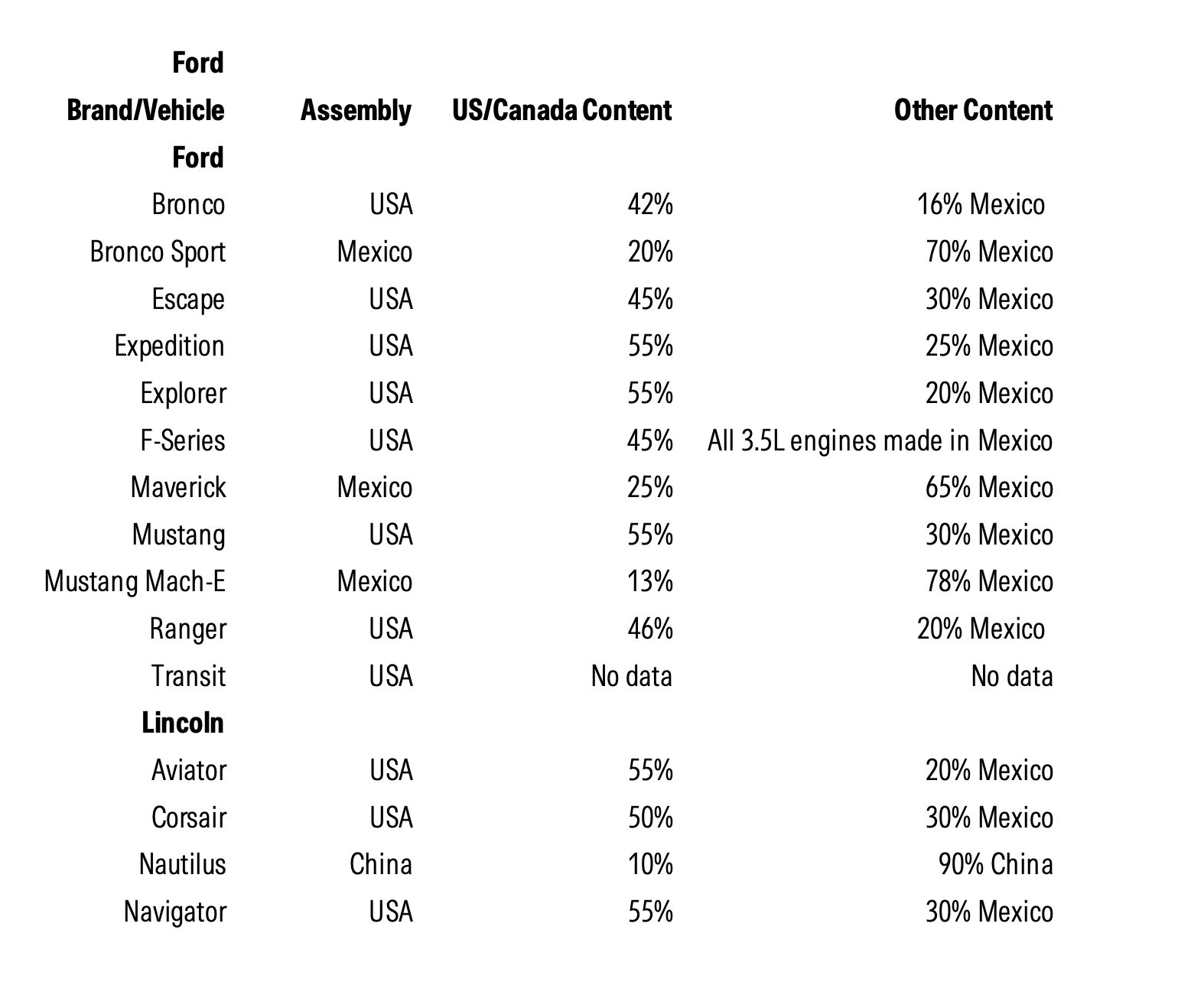
Source: Automotive News, NHTSA's American Automobile Labeling Act Report, Morningstar.
Stocks to consider: Ford has the highest US production mix of the Detroit Three and faces lower net tariff exposure.
What Are the Key Challenges Facing the US Auto Industry in 2026?
Vehicle affordability issues are impacting sales
New-vehicle average transaction prices are up roughly 30% since the pandemic, hovering near $50,000. Rising rates compounded the pain. Average monthly loan payments hit $767 in the fourth quarter of 2025, with nearly 21% of new loans carrying payments of $1,000 or more, a record.
Consumers are responding in three ways:
- Stretching loan durations—averaging nearly 69 months in the fourth quarter of 2025
- Shopping used—though rates averaged 11.3% in the fourth quarter of 2025, nearly 500 basis points above new-vehicle rates, and late-model supply won't normalize until 2027–28
- Exiting the market entirely
We expect leasing penetration to rise gradually in 2026 and for used-vehicle pricing to begin easing in the second half of the year.
Stocks to consider: More leasing benefits all automakers and dealers; CarMax KMX stands to gain from more affordable used-vehicle pricing.
Credit stress is building but not breaking
Credit is the lifeblood of the US auto industry, and we don't see it being withdrawn. However, 90-day delinquencies are on a troubling trend.
The 90-day auto loan delinquency rate reached 5.21% in the fourth quarter of 2025, the highest since. But total delinquencies, defined as those 30 days or more past due, declined sequentially across all four quarters of 2025.
Still, we've seen nothing from lenders or dealers indicating things are at a crisis level or that credit needs to be curtailed.
Subprime originations remain well below pre-Great Recession levels. Automaker captive finance arms, which primarily serve prime borrowers, show far lower delinquency rates than the overall market.
For more on global credit pressure in automotive, see the Morningstar DBRS Global Automotive Outlook 2026.
Stocks to consider: Ford Credit has the least subprime exposure among Detroit Three captives.
New-vehicle production and inventory down in 2026
North American light-vehicle production fell 4% in 2025, weighed down by the Novelis aluminum plant fire affecting Ford's F-Series output, the Nexperia chip shortage crimping Honda's output, and Stellantis pausing production due to tariff uncertainty.
We expect another low-single-digit production decline in 2026. GM's announced US production investments, including the move of Equinox and Blazer assembly to Kansas and Tennessee by 2027-28, offer a medium-term lift.
Light-vehicle inventory remains low, but there’s potential in 2026
The US light-vehicle inventory has not reached 3 million units since April 2020. The industry finished 2025 at 2.58 million units, down 8.5% year over year. Low inventory has kept pricing elevated and incentives in check.
As supply chain issues from Nexperia and Novelis resolve, we expect year-end 2026 inventory to finish higher than 2025, which will likely push incentives modestly higher as a percentage of average transaction prices.
Stocks to consider: Suppliers like Gentex GNTX and Adient ADNT benefit if production rises on genuine demand.
Go Deeper on the US Auto Industry
The US auto market faces a few roadblocks. Sales may stay flat, but margins, production footprint, and powertrain mix will determine winners. For investors, the question is not if the industry recovers, but who is best positioned when it does.
The full report goes into more depth on:
- Sales forecasts and historical data
- The impact of auto regulations
- Tariff impact by automaker
- Leasing trends