
6 min read
Strong Brands Will Drive Packaged Food Growth Through 2030
Strong brands, supported by innovation and disciplined marketing, are helping packaged-food companies maintain pricing power and profitability amid changing consumer behavior.

The US packaged food industry remains a mature but resilient sector characterized by strong brands, stable demand, and durable competitive advantages.
Morningstar’s latest research highlights how leading manufacturers are leveraging brand equity, retail relationships, innovation, and disciplined marketing investments to maintain pricing power and support growth despite inflation, changing consumer preferences, and increasing competition. The report also examines the continued expansion of ecommerce, the growing importance of health and wellness trends, the impact of demographic shifts, and expectations for margin recovery as cost pressures ease.
Looking ahead, we expect packaged-food companies to deliver modest but steady growth supported by a balanced contribution from pricing and volume gains, because of investments in brand building and product development.
Download the full US Packaged Food Industry Landscape report for deeper insights, data, forecasts, and a comprehensive analysis of the forces shaping the industry.
Strong Brands Are the Foundation of Competitive Advantage
Competitive advantages are common in the packaged food market, especially for companies with well-known brands and strong relationships with retailers.
Digital channels, such as ecommerce and social media, have enabled smaller brands to gain traction with less upfront investment, but scale, retailer partnerships, and brand strength still differentiate industry leaders. Within our packaged food coverage, 77% of companies carry either a narrow or wide economic moat, exceeding the average across all sectors.
Strong brands help manufacturers secure retailer support and shelf space because they drive consumer traffic, while continued innovation helps those brands remain relevant as consumer preferences evolve.
Brand Strength and Product Innovation Support Pricing Power
Demand across many packaged-food categories remains relatively inelastic, allowing manufacturers to pass through inflationary increases with limited long-term disruption to volumes. Categories such as rice, pasta, and noodles are particularly resilient because of their frequency of consumption and importance within household meals.
Taste, safety, product innovation, and brand perception also influence purchasing decisions. Consumers are often more willing to pay for products they perceive as higher quality, safer, more dependable, or meaningfully differentiated through product innovation.
These factors are especially important in categories such as confectionery, baby food, pet food, and savory snacks, where strong brand equity and ongoing product innovation help companies maintain consumer preference and support pricing power.
For investors and advisors, companies with demonstrated pricing power may be better positioned to protect margins during periods of inflation. Advisors can use Economic Moat Ratings in Direct Advisory Suite to help identify packaged-food companies with the competitive advantages, innovation capabilities, and brand strength that may support long-term resilience.
Impact of Private Labels
Private-label competition remains an important dynamic within the packaged food market, but its impact varies significantly by category. Consumers generally become more receptive to private-label offerings when economic conditions weaken or if innovation is lacking.
Private labels have gained the greatest traction in commoditized categories, including processed fruit and vegetables, dairy products, and edible oils. These categories tend to offer fewer opportunities for differentiation and innovation.
By contrast, branded categories such as confectionery, baby food, pet food, and savory snacks remain relatively insulated from private-label competition. These segments benefit from stronger consumer loyalty and greater differentiation through branding, quality, and product innovation.
As a result, private-label exposure remains an important indicator of brand strength and competitive positioning across the industry.
Ecommerce Is Growing, but Physical Retail Still Dominates
Online food sales increased from just over 10% of food purchases in 2020 to approximately 19% in 2025. As consumers increasingly reorder familiar products online, established brands appear well positioned to benefit from repeat purchasing behavior.
Despite this growth, physical retail remains the dominant distribution channel for packaged-food companies.
Grocery stores, mass retailers, discount chains, and club stores continue to play a vital role in product visibility and sales. Demand for delivery, pickup, and ship-to-home services also remains significantly above prepandemic levels.
Companies that successfully balance ecommerce capabilities with a strong retail shelf presence may be best positioned to capture future growth opportunities. Advisors should consider which packaged-food companies are best positioned to benefit from ecommerce growth while maintaining strong retailer relationships and share of shelf across traditional channels.
Retail Trends Are Reshaping How Consumers Buy Food
By 2025, the top 20 US grocery retailers controlled nearly 70% of the market, reflecting ongoing consolidation. This concentration can strengthen retailer negotiating leverage while increasing the importance of strategic partnerships between manufacturers and retailers.
At the same time, consumer spending patterns are shifting. Food consumed away from home now accounts for approximately 51% of food purchases, up from roughly 44% two decades ago. This trend reflects growing demand for convenience and changing lifestyles.
For packaged-food manufacturers, foodservice channels offer opportunities to expand distribution, introduce products to new consumers, and test innovations before broader retail rollouts.
Health and Wellness Drive New Growth Opportunities
Health and wellness trends are increasingly influencing consumer demand and product innovation. Many consumers seek products with fewer artificial ingredients and stronger nutritional profiles.
Manufacturers face growing scrutiny regarding nutrition and ingredients as obesity rates rise and adoption of GLP-1 weight-loss drugs increases. In response, companies are investing in innovation to align products more closely with evolving consumer preferences.
Organic food sales surpassed $70 billion in 2025, up from roughly $40 billion a decade earlier, highlighting demand for healthier alternatives.
However, companies must carefully balance nutritional improvements with flavor expectations. Healthier products can sometimes be perceived as less flavorful, making product development, branding, and marketing critical for success.
Innovation is also extending beyond ingredients to packaging materials, pack sizes, texture enhancements, and new product formats that help manufacturers stay relevant in a changing marketplace.
Industry Growth Is Expected to Remain Steady Through 2030
Historically, packaged-food sales have grown at a low- to mid-single-digit rate outside of pandemic-related disruptions. We expect similar performance through 2030, reflecting the industry's mature but stable nature.
With the Pandemic’s Heady Growth Firmly in the Rearview, We Surmise Packaged-Food Sales Growth Will Hold in the Low- to Midsingle Digits Through 2030
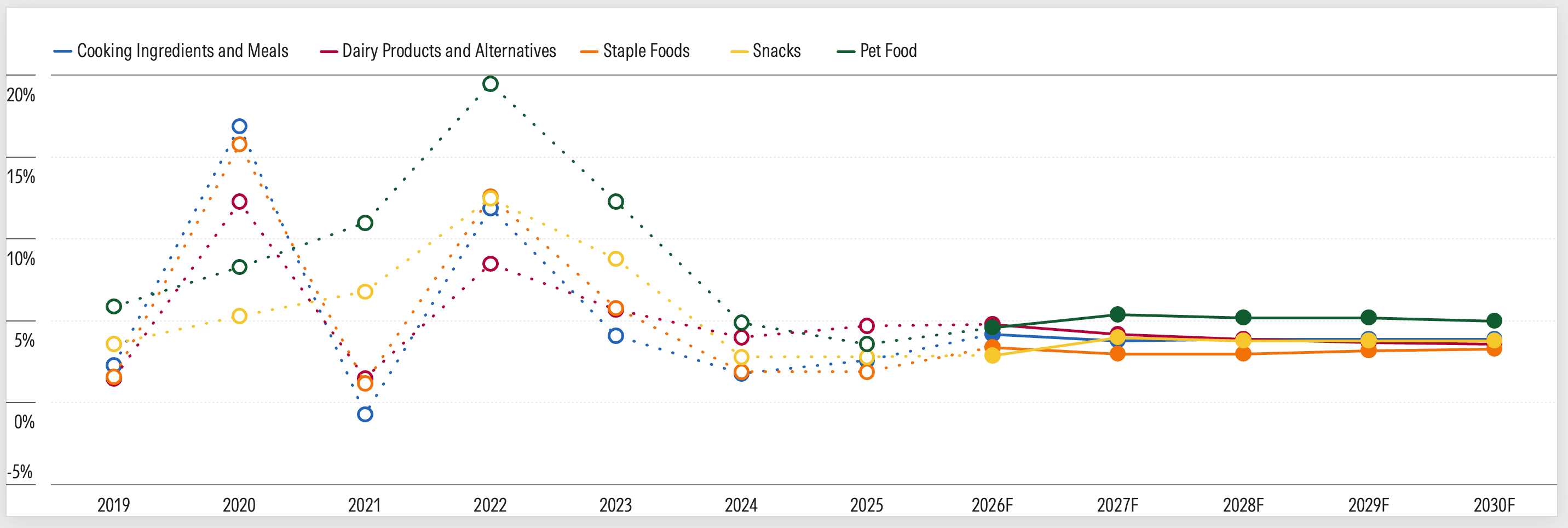
Source: Euromonitor, Morningstar. Data as of June 2026.
Long-term growth is expected to be supported by both pricing and volume gains of approximately 1% to 2% annually. These categories including snacks, cooking ingredients and meals, dairy products, and pet food are expected to contribute to overall industry expansion. Pet food in particular remains a notable growth opportunity, supported by premiumization trends, pet humanization, and aging pet populations.
Margin Recovery Is Becoming a Key Industry Theme
Recent sales growth has been fueled largely by price increases designed to offset higher costs for ingredients, raw materials, logistics, and labor. These pressures weighed on profitability across the industry in recent years.
However, margin recovery is already underway. Gross margins improved to just over 34% in 2025 after reaching a low point in 2022. Morningstar forecasts an additional 180 basis points of gross margin expansion by 2030, supported by operational efficiencies and pricing benefits.
Durable Brands Support Long-Term Growth
The packaged food market continues to demonstrate resilience through durable brands, pricing power, innovation, and strong retailer relationships. Competitive advantages rooted in brand strength, consumer trust, and scale remain critical differentiators across the industry.
While manufacturers face evolving consumer preferences, retail consolidation, inflationary pressures, and increasing focus on nutritional quality and ingredients, Morningstar expects steady growth and expanding margins through 2030. Companies that continue investing in innovation, packaging materials, product development, and brand building may be best positioned to navigate these challenges and capitalize on emerging opportunities.
For advisors, firms with strong brands, demonstrated pricing power, and ongoing investment in innovation may offer the earnings resilience and long-term growth characteristics often associated with this mature but durable sector.
Download the full US Packaged Food Landscape Q2 2026 report for detailed market data, forecasts, competitive analysis, and Morningstar’s complete outlook on the sector.