
7 min read
SFDR Article 8 and 9 Funds: Why Article 8 Funds Continue to Attract Inflows

Under the Sustainable Finance Disclosure Regulation, EU asset managers must provide more information on sustainability risks and the impact of investment products. The level of disclosure depends on a product's classification as an Article 8 or Article 9 fund.
This report provides an update on the landscape of SFDR Article 8 and Article 9 funds (excluding money market funds, funds of funds, and feeder funds) as of the end of September 2026, examining aspects such as flows, assets, launches, product development, and regulation. Our researchers also analyzed sustainability-related characteristics across Article 6, Article 8, and Article 9 funds.
Our researchers dissected SFDR Article 8 and Article 9 funds with Morningstar’s climate data. For a more in-depth analysis, download the free SFDR funds report.
What Are the SFDR Article 8 Fund Requirements?
Article 8 funds promote environmental or social characteristics. Holdings should generally help attain the environmental or social characteristics promoted. In comparison, Article 9 funds have an explicit sustainable-investment objective.
Funds that promote an environmental characteristic must additionally disclose alignment with the EU Taxonomy of Sustainable Activities. These funds also must indicate if they invest a proportion in environmentally sustainable investments.
All Article 8 and Article 9 products must disclose if they consider Principal Adverse Impact indicators. These capture the potential negative impact of financial products on:
- Environmental, social, and employee matters
- Respect for human rights
- Anticorruption and antibribery matters
The Sustainable Finance Disclosure Regulation outlines 64 indicators. Of these, 14 are currently mandatory (on a comply-or-explain basis) for corporate investments:
- Greenhouse gas emissions
- Carbon footprint
- Greenhouse gas intensity of investee companies
- Exposure to companies active in the fossil fuel sector
- Share of nonrenewable energy consumption production
- Energy consumption intensity per high impact climate sector
- Activities negatively affecting biodiversity-sensitive areas
- Emissions to water
- Hazardous waste ratio
- Violations of the UN Global Compact principles and Organisation for Economic Co-operation and Development Guidelines for Multinational Enterprises
- Lack of processes and compliance mechanisms to monitor compliance
- Unadjusted gender pay gap
- Board gender diversity
- Exposure to controversial weapons
Two are mandatory for sovereign and supranational issuers:
- Greenhouse gas intensity of investee countries
- Number of investee countries subject to social violations
And two are mandatory for real estate assets:
- Exposure to real estate assets involved in the extraction, storage, and transport of fossil fuels
- Exposure to energy-inefficient real estate assets
Article 8 Funds Continue to Attract Inflows, While Article 9 Funds Return to Outflows
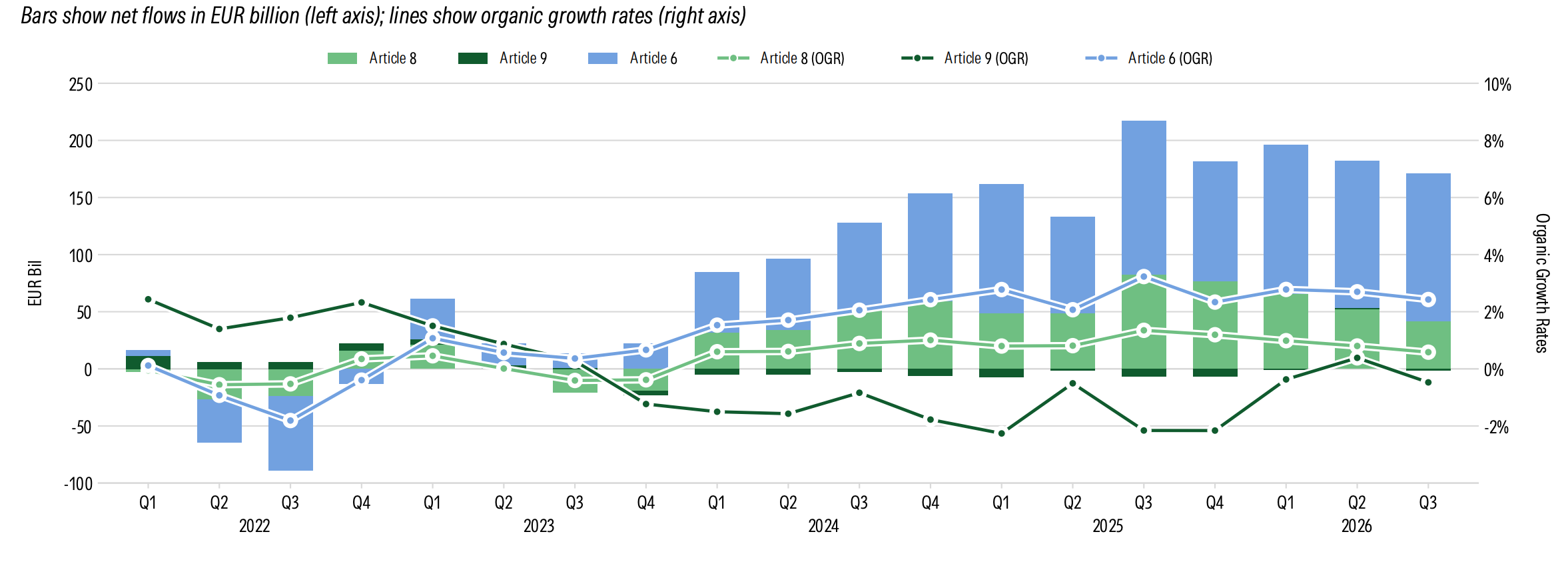
Article 8 funds attracted an estimated EUR 41.9 billion of net new money in the third quarter of 2026. Although inflows remained positive, they slowed from EUR 52.5 billion in the previous quarter and EUR 82.5 billion a year earlier. Over the 12 months through September 2026, Article 8 funds gathered approximately EUR 236 billion in net inflows.
Article 9 funds, meanwhile, returned to outflows, losing EUR 1.6 billion during the quarter after attracting new money in the prior quarter for the first time in nearly three years. Over the previous 12 months, Article 9 funds experienced estimated net outflows of EUR 8.4 billion.
By contrast, Article 6 funds attracted approximately EUR 129 billion in the third quarter, despite representing a smaller share of assets than Article 8 funds. The category accounted for roughly three quarters of net inflows across all SFDR classifications during the period.
Passive strategies continued to gain market share within both the Article 8 and Article 9 universes. While actively managed Article 8 funds still attracted more money in absolute terms, active Article 9 funds experienced net outflows while passive Article 9 funds recorded positive inflows.
Quarterly Net Flows and Organic Growth by SFDR Article
Source: Morningstar Direct. Data as of September 30, 2026.
What Proportion of Assets Are in Article 8 Funds?
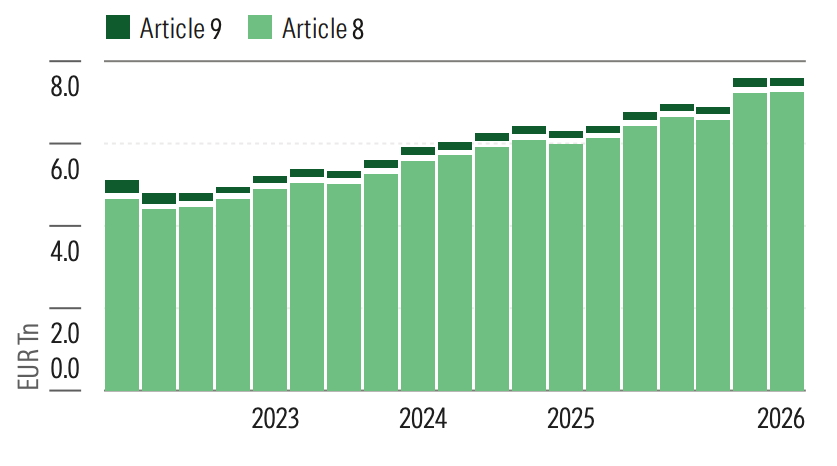
Article 8 funds accounted for 55.5% of assets in the EU fund universe covered by Morningstar's analysis at the end of September 2026. Article 6 funds represented 41.9% of assets, while Article 9 funds accounted for 2.6%.
Article 8 assets reached approximately EUR 7.2 trillion by the end of the third quarter, increasing by more than EUR 800 billion over the preceding year. Article 9 assets remained relatively stable at around EUR 330 billion. Together, Article 8 and Article 9 funds represented 58% of EU fund assets.
Although Article 8 funds remain the dominant sustainable-fund category in Europe, the gap between Article 8 and Article 9 has continued to widen as Article 8 funds attracted sustained inflows while Article 9 funds experienced continued investor withdrawals.
Asset Dynamics, by Quarter
Source: Morningstar Direct. Data as of September 30, 2026.
How Many New Article 8 Funds Launched Lately?
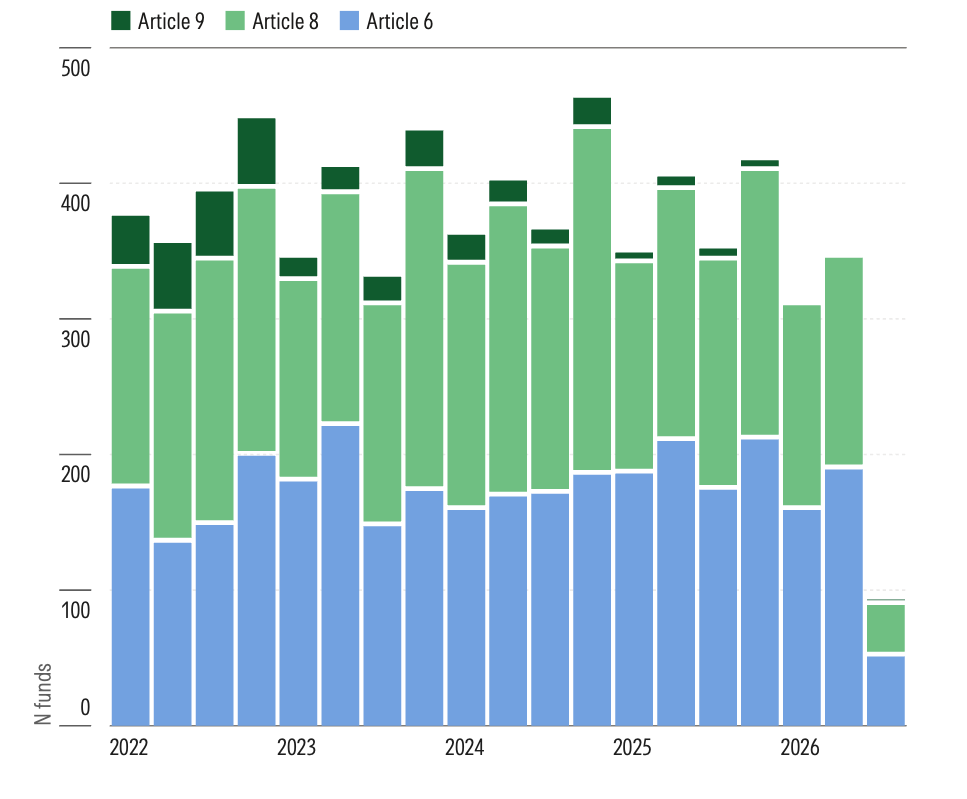
The pace of new Article 8 and Article 9 fund launches slowed over the past year. A total of 558 new products were launched during the 12 months through September 2026, down from 814 in the previous 12-month period. In the third quarter alone, 42 new Article 8 and Article 9 funds came to market, although the final figure may be revised upward as additional launches are identified.
Sustainable products also represented a smaller share of overall fund development activity. Article 8 and Article 9 funds accounted for 48% of all EU fund launches over the previous year, down from 52% a year earlier. During the third quarter, their share fell to 45%.
Article 9 fund launches remained particularly limited. Only 15 new Article 9 products launched during the previous 12 months, reflecting continued weak investor demand for the category.
Quarterly Breakdown of Fund Launches
Source: Morningstar Direct. Data as of September 30, 2026.
Fixed Income Continue to Dominate Article 8 Fund Inflows
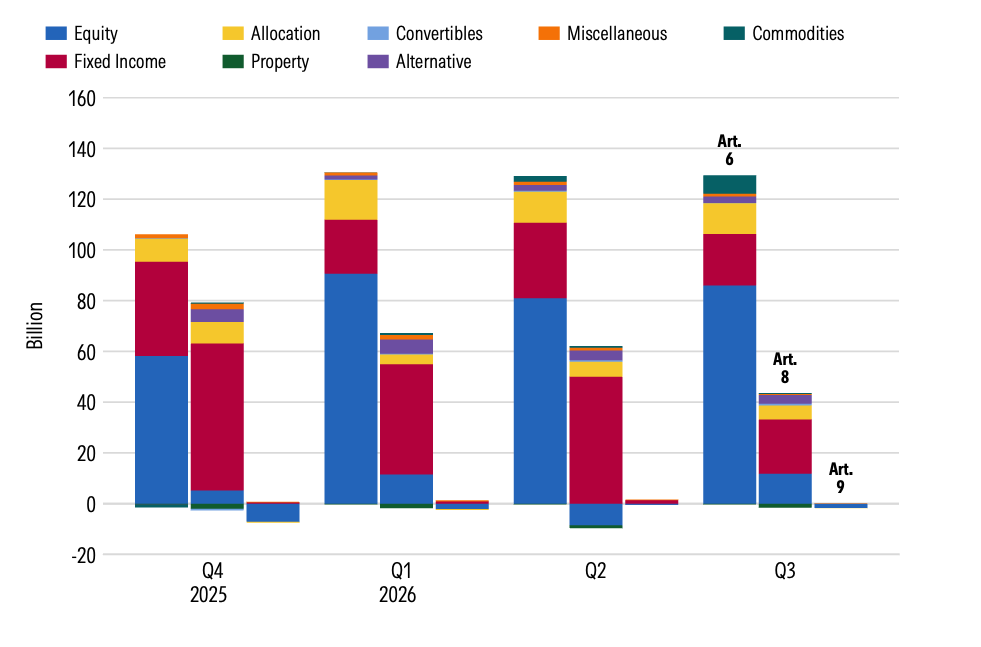
Fixed-income strategies remained the primary driver of Article 8 inflows during the third quarter of 2026, attracting EUR 21.9 billion of net new money. Over the previous 12 months, Article 8 fixed-income funds gathered EUR 173 billion, making them the strongest-selling sustainable-fund segment despite equity remaining the largest asset class by assets under management.
Article 8 equity funds attracted EUR 11.2 billion during the quarter after experiencing outflows in the second quarter. By comparison, Article 6 equity funds gathered approximately EUR 86 billion. Article 9 equity funds continued to struggle, posting net outflows over the previous 12 months.
Within fixed income, diversified bond strategies continued to dominate both assets and flows among sustainable funds, accounting for nearly half of fixed-income assets across Article 8 and Article 9 classifications. Article 8 diversified bond funds alone attracted EUR 10.5 billion during the quarter and EUR 87 billion over the previous 12 months.
For additional context on sustainable-fund demand globally, see Morningstar's Global Sustainable Fund Flows research.
Net Flows per Article and Asset Class
Source: Morningstar Direct. Data as of September 30, 2026.
Renaming Activity Slows Following ESMA Fund-Naming Guidelines Deadline
Fund renaming activity has largely returned to normal levels following implementation of the European Securities and Markets Authority's fund-naming guidelines. Asset managers had until May 2025 to comply with the rules governing the use of ESG- and sustainability-related terms in fund names.
In the third quarter of 2026, only 17 Article 8 funds changed ESG-related terms in their names, compared with 109 a year earlier and hundreds more during the implementation period leading up to the deadline. Among the funds still being renamed, most are removing ESG-related terms rather than replacing them. Over the previous 12 months, 80 of 116 renamed Article 8 funds dropped ESG-related terminology. Article 9 renaming activity also remained limited.
The amended MiFID II directive continues to require distributors and advisers to consider investors' sustainability preferences when assessing product suitability. The European ESG Template, or EET, supports that process by standardizing sustainability disclosures across funds.
Morningstar Direct covers key European ESG Template data points, including:
- SFDR minimum or planned sustainable investments, representing the minimum percentage of portfolio investments deemed sustainable but not taxonomy-aligned.
- SFDR minimum or planned taxonomy-aligned sustainable investments, representing the minimum percentage of a portfolio aligned with the EU Taxonomy.
- Principal Adverse Impact (PAI) consideration, indicating whether a product considers principal adverse impacts in its investment process.
Renaming activity has fallen back toward levels seen before implementation of the ESMA guidelines, suggesting that much of the industry's adjustment process is complete.