
7 min read
Global Beer’s Next Growth Phase Will Be Fueled by Premiumization, Emerging Markets, and Diversification
Although beer remains the world’s most consumed alcoholic beverage, brewers must adapt to changing consumer preferences.

Key Takeaways
Premium beer continues to take market share from midrange and economy segments, making premiumization the industry's most important value-growth driver.
Emerging markets are expected to generate the strongest beer volume growth over the next five years as incomes rise and urbanization increases.
Brewers are increasingly diversifying into adjacent categories such as ready-to-drink beverages, spirits-based drinks, soft drinks, and energy drinks to offset slower growth in developed beer markets.
Beer remains the most consumed alcoholic beverage globally, but growth is increasingly coming from consumers trading up rather than simply drinking more. According to Morningstar’s research, premium beer volumes have grown at a 4% five-year compound annual growth rate, while economy beer volumes have declined by 2% over the same period.
This premiumization trend reflects consumers' willingness to pay more for brands perceived as higher quality, more aspirational, or imported. Premium brands have steadily taken share from both midrange and economy offerings across markets. As a result, brewers are directing more marketing investment toward premium labels and using their distribution networks to expand premium portfolios into new regions Morningstar expects premium beer to account for 29% of global beer consumption by 2035, up from approximately 25% today.
The appeal of premiumization for brewers is straightforward: selling more premium products enables them to generate higher revenue per hectoliter without materially increasing production costs. Even in a mature industry, premiumization gives leading brewers a pathway to grow value faster than volumes. Morningstar projects global beer industry growth of 3.7% annually over the next five years, supported by both volume growth and sustained pricing gains.
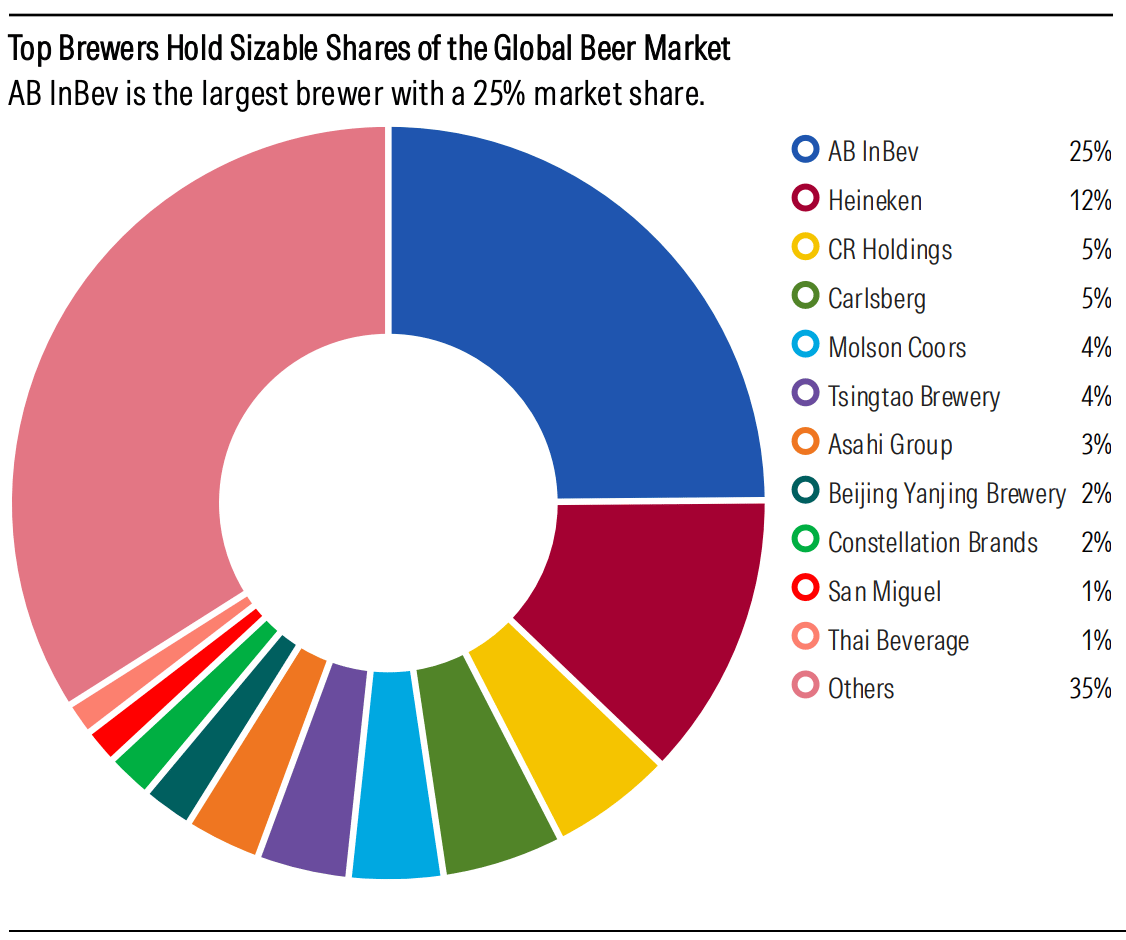
Premium beer continues to gain share globally, while emerging markets are expected to drive most industry volume growth through 2030.
Emerging markets are becoming beer’s growth engine
While developed markets face headwinds from health-conscious consumer behavior, slowing demand in economy beer segments, and increasing competition from spirits, emerging markets offer a much longer runway for growth. Morningstar expects global beer volume growth of 1.5% annually over the next five years, with most of that expansion coming from Asia-Pacific, Latin America, and the Middle East and Africa.
Several structural factors support this outlook. Rising incomes, urbanization, young populations, and relatively low per-capita beer consumption create opportunities for both higher participation and premiumization. Developing markets have relatively low but rising beer consumption levels, while many developed markets have experienced declining per-capita consumption.
The opportunity extends beyond volume growth alone. Emerging markets also provide a value-growth runway, allowing brewers to introduce premium products as consumer purchasing power improves. Major brewers including AB InBev, Heineken, and Carlsberg continue to invest heavily in these regions to strengthen or defend market positions.
Morningstar identifies success in emerging-market investment as one of the most important determinants of future industry winners and losers. However, these markets can bring challenges, including foreign exchange volatility, inflation, political instability, and regulatory changes that can negatively affect near-term performance.
Diversification is expanding the definition of a brewer
Even as beer maintains its dominant position in global alcohol consumption, growth in adjacent beverage categories has been stronger. Morningstar notes that ready-to-drink products, energy drinks, and carbonated beverages are gaining share, while beer's volume growth is expected to lag some of these categories.
To respond, brewers are broadening their portfolios beyond traditional beer. The report highlights investments across spirits-based ready-to-drink beverages, hard seltzers, energy drinks, soft drinks, and other nonbeer categories.
Diversification offers several advantages. Brewers can leverage established production capabilities, distribution networks, retailer relationships, and route-to-market infrastructure to scale new brands efficiently. Depending on the category, diversification can also improve profitability, particularly when expanding into higher-margin products such as spirits.
Changing consumer behavior reinforces the rationale. Younger consumers show stronger preferences for ready-to-drink spirits than previous generations, while health and wellness trends are encouraging investment in low- and no-alcohol offerings. At the same time, consumption occasions continue to evolve, with more alcohol being consumed through off-trade and direct-to-consumer channels. For leading brewers, diversification is not a departure from beer. Rather, it is an extension of existing capabilities designed to capture growth wherever consumer demand is shifting.
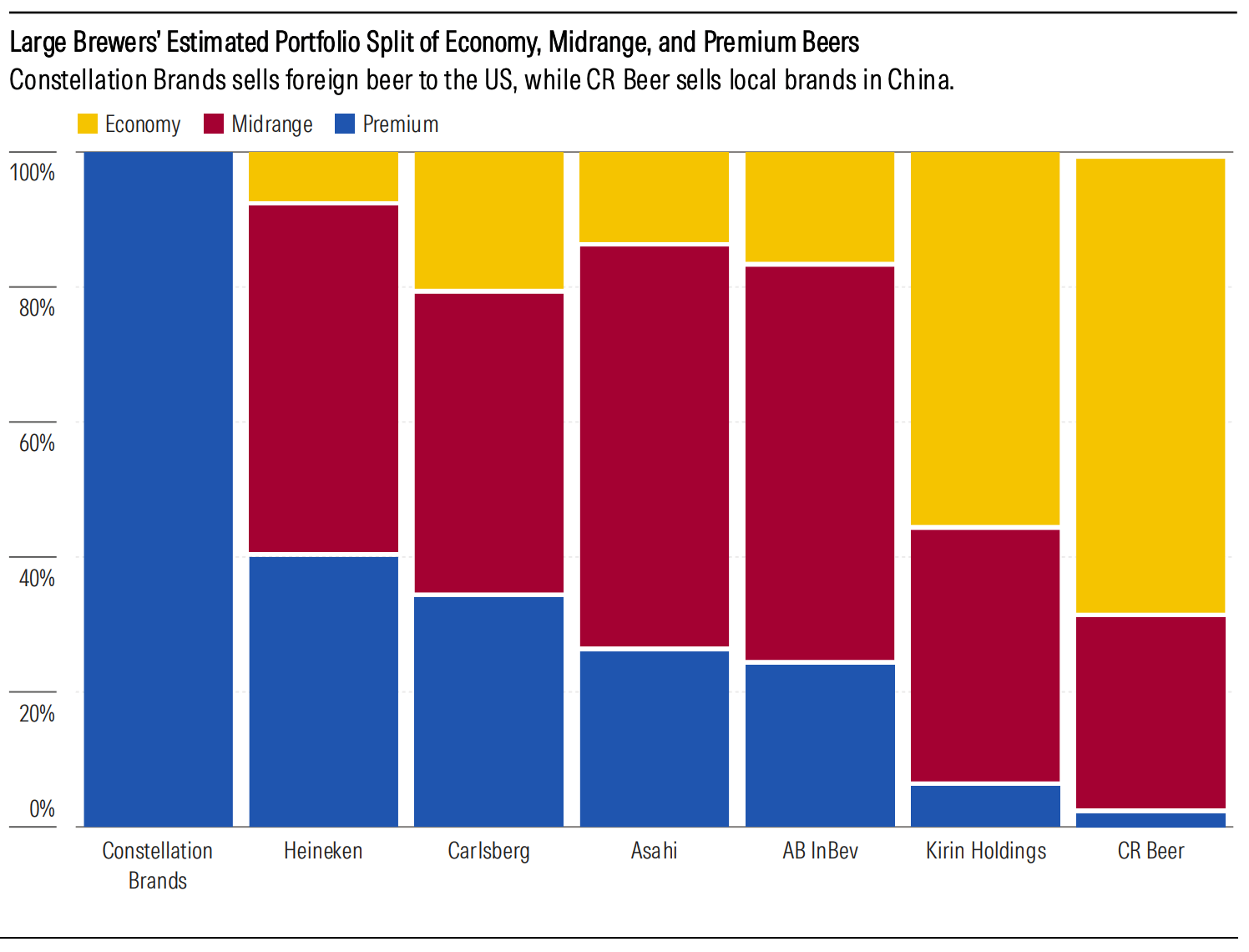
Premium beer volumes have grown faster than both midrange and economy beer over the past decade, highlighting the industry's long-term premiumization trend.
Read more about the global beer landscape
The global beer industry remains resilient, supported by the enduring popularity of beer and the competitive advantages held by many of the world's largest brewers. For deeper analysis of market concentration, economic moats, regional growth opportunities, premiumization trends, ESG considerations, and Morningstar's outlook for the global brewing industry, download the full Global Beer Industry Landscape report.