
7 min read
AI Music is Disruptive—But Not in the Way Investors Fear
Why record labels and streaming platforms remain resilient despite rapid advances in artificial intelligence.

Key Takeaways
AI-generated music is most likely to coexist with human-created music rather than replace it, limiting disruption risk.
Pure AI music currently represents a negligible share of listening time and lacks key elements that drive consumer engagement.
Record companies and streaming platforms retain strong competitive advantages and can unlock new revenue opportunities through AI integration.
Artificial intelligence is transforming the music industry at a rapid pace, raising concerns among investors about the long-term viability of record companies and streaming platforms. Yet, our latest report concerning the impact of AI on the music industry concludes these fears are largely overstated. The research suggests that while AI will meaningfully reshape music creation and distribution, incumbent players are well positioned to adapt—and in many cases, benefit.
AI and human music will coexist, not compete head-on
The most probable outcome for the music industry is not displacement but coexistence. AI-generated content is expected to live alongside traditional music, often monetized through niche platforms or premium subscription tiers within existing streaming ecosystems. Rather than creating a binary “AI vs. human” dynamic, a spectrum of use cases is more likely. AI can generate entirely new songs, assist musicians as a creative tool, or produce derivatives such as remixes and covers.
From a business perspective, this blended approach introduces opportunities. Streaming platforms can integrate AI capabilities into their offerings more easily than standalone AI competitors can replicate full music libraries. Critically, the scenario in which AI fully replaces human-created music is considered “extraordinarily unlikely.” This reinforces the resilience of existing industry structures.
Pure AI music faces structural limits to adoption
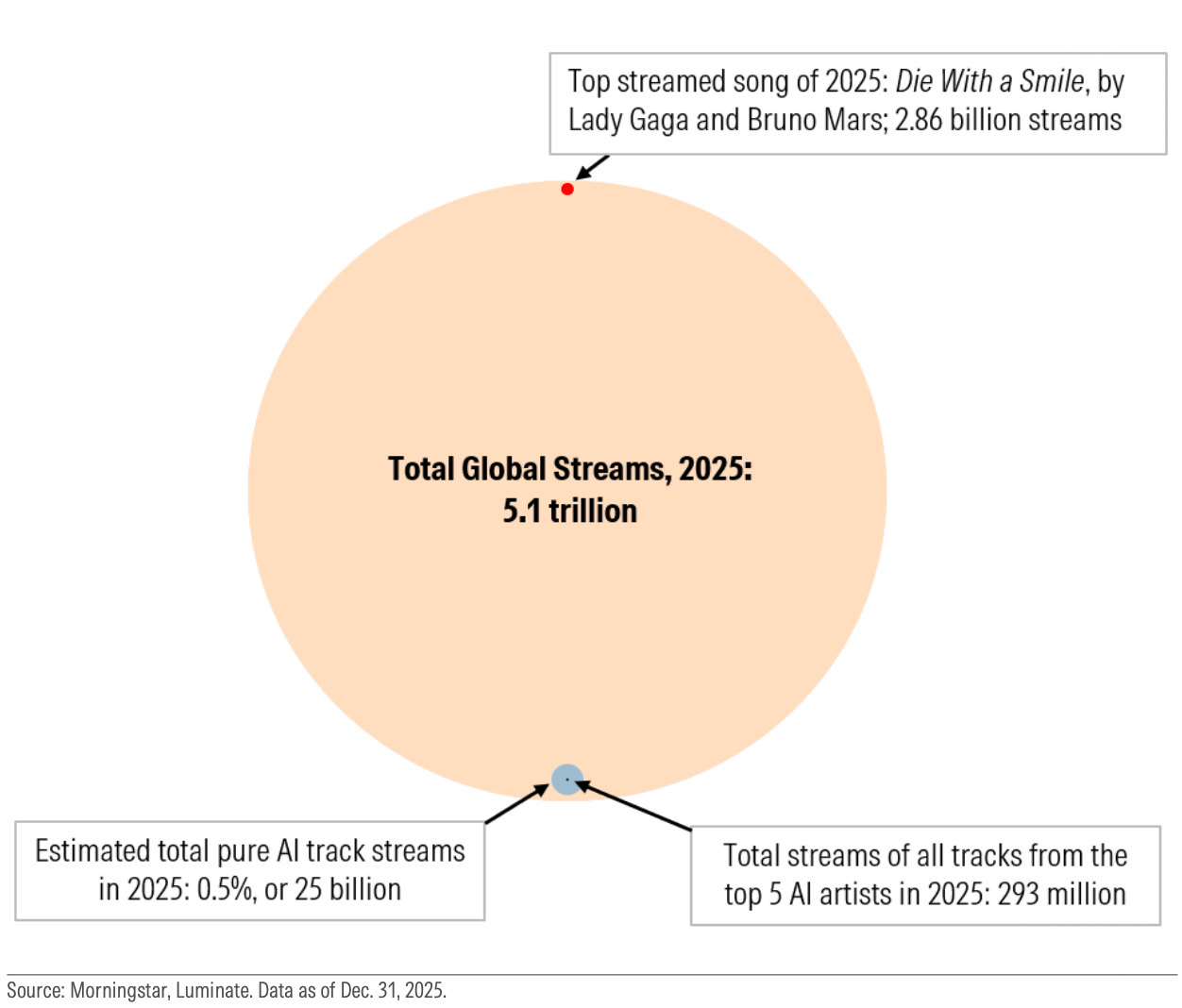
While AI-generated songs are increasing in supply, they have yet to gain meaningful traction with listeners. Even though platforms report a growing volume of AI-generated uploads, these tracks account for less than 0.5% of total streams. The gap between availability and consumption highlights a central issue: demand. AI-generated music struggles to replicate what listeners value most—connection to artists, cultural relevance, and emotional authenticity.
Even the most successful AI artists have achieved only a fraction of the engagement seen by human performers. In 2025, the top five AI artists combined accounted for less than 0.01% of global streams—far below even a single popular human track. Consumer behavior further reinforces this trend. Listening habits skew heavily toward existing catalogs, with older music accounting for roughly 73% of global streams in 2024. This deep attachment to familiar music makes widespread abandonment of human-created content unlikely for at least a generation.
Beyond data, the limitations of AI music are qualitative. AI lacks the “human element”—the storytelling, identity, and cultural context that draw fans into music experiences. Without these dimensions, AI tracks risk being technically proficient but emotionally forgettable.
In 2025, a single human song streamed 10 times more than all songs from the top 5 AI artists combined.
Incumbents retain power and gain new revenue opportunities
Record companies and digital service providers (DSPs) remain strongly positioned in an AI-enhanced landscape. Their advantages stem from control over music catalogs, established licensing agreements, and entrenched consumer relationships. Record labels, in particular, act as gatekeepers to most human-created music. As long as demand for human music persists, their bargaining power remains intact. Major labels account for the majority of streaming activity and can leverage this dominance in negotiations with both DSPs and AI platforms.
Recent licensing agreements already reflect this leverage. Provisions such as anti-dilution measures prevent AI-generated content from reducing royalty pools, while new pricing tiers create pathways to monetize AI features. Meanwhile, streaming platforms benefit from scale. Their large subscriber bases and existing infrastructure make it easier to integrate AI tools—from personalized playlists to AI-generated song derivatives—than it is for new entrants to build full-service competitors.
AI also creates new revenue streams. Record companies can license their catalogs for model training, earn royalties on derivative works, and potentially take equity stakes in AI platforms. Importantly, AI-enhanced creativity by human artists is expected to become widespread. However, this shift is unlikely to alter the core economics of the industry, as human creators remain central to monetization.
AI is music industry evolution, not disruption
The rise of AI in music is undeniably transformative, but it does not signal the collapse of existing industry models. Instead, it represents an evolution—one in which human creativity remains at the center while technology enhances production, personalization, and monetization. For investors, the key insight is clear: the structural advantages of record companies and streaming platforms remain intact. In many cases, AI may strengthen rather than weaken their long-term outlook.
Download the full Morningstar report to explore detailed scenarios, financial implications, and company-level analysis shaping the future of AI in music.