
4 min read
What Investors Are Really Choosing in Europe’s Fund-of-Funds Market

Key Takeaways
- Multi-asset funds are back in demand, driving the majority of assets and leading a strong rebound in investor inflows.
- Fees are reshaping competition, with lower-cost funds consistently winning flows and setting new expectations across the market.
- Scale is becoming a defining advantage, as larger providers and passive strategies continue to capture a growing share of assets.
Overview of the Fund-of-Funds Universe
Allocation funds rebound sharply in 2025
Allocation funds dominate the European fund-of-funds market in 2026, accounting for about 75% of the market, reflecting strong demand for diversified, multi-asset solutions.
Fund-of-fund flows have been volatile in recent years. Allocation funds attracted EUR 30.8 billion in net inflows in 2025, a dramatic turnaround from the EUR 20.9 billion outflows in 2023. This resurgence underscores renewed investor confidence in multi-asset strategies, likely driven by improved market sentiment and demand for diversification amid shifting macro conditions.
The UK stands apart
Nearly a third of total fund-of-funds assets under management are held in UK-domiciled funds, at EUR 409.2 billion. This highlights the historical popularity of this type of fund in the UK market.
The UK fund-of-funds market has maintained a consistently strong trajectory, with steady inflows throughout the period and a marked acceleration in 2024-25. In contrast, the broader European market—particularly Luxembourg and other domiciles—has been more volatile, with significant outflows in 2023-24 before stabilizing and partially recovering in 2025.
Fees across euro-allocation categories continue to decline, reflecting ongoing cost compression. As of early 2026, averages range from 1.3% for cautious funds, 1.4%-1.5% for moderate, and to 1.6%–1.9% for aggressive- and flexible-allocation funds. Higher risk categories continue to command a premium, reflecting their greater complexity and active management.
Fee compression has been more pronounced in the UK fund-of-funds market, with average fees across allocation categories now broadly in the 0.55% to 0.90% range. This sustained decline reflects strong competitive pressure, regulatory scrutiny, and a high degree of cost sensitivity among UK investors, particularly in lower-risk and core allocation strategies.
Fees Are No Longer Just a Footnote
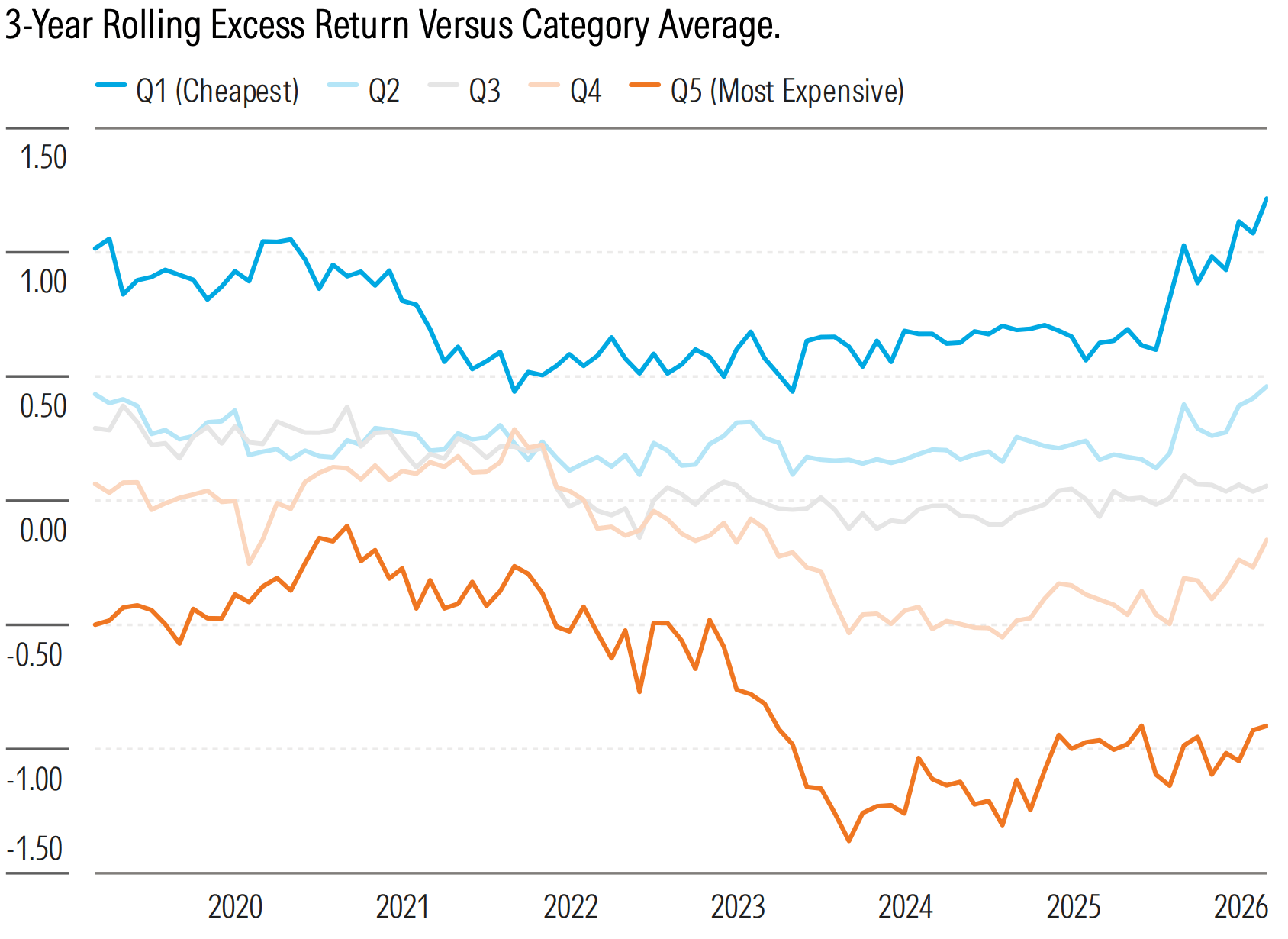
The impact of fees on investment outcomes is clear. The cheapest quintile (Q1) with average fees of 0.6% delivered a return of 1.22% over three years, significantly outpacing the most expensive quintile (Q5), with average fees of 1.2%, which lagged at -0.91%. This highlights the structural headwind that high fees impose on performance.
Over three years (2023-25), the cheapest quintile (Q1) attracted EUR 96.4 billion in net inflows, accounting for the majority of positive flows, while the most expensive quintile (Q5) saw outflows of EUR 28.8 billion. This underscores the ongoing investor preference for lower-cost funds, pressuring high-fee offerings to justify their value.
Excess Return by Fee Quintile Across All Asset Classes
Source: Morningstar Direct. Data as of March 31, 2026. Fee quintile classification is based on the representative cost ex. transaction fee (annualized) data point.
Rising closures and falling costs reshape the market
In recent years, the market has moved decisively into contraction. Since 2023, closures have consistently exceeded launches, resulting in increasingly negative net figures and signaling a structural shift away from product expansion.
Launch activity has fallen sharply, down 70% from its 2017 peak of 414 funds, while closures have continued to outpace new offerings. The trend intensified in 2025, when launches dropped to just 110, the lowest level in a decade, while closures rose to 288. This divergence highlights mounting cost pressures and a more challenging environment for new product development.
At the same time, median launch costs declined from 1.6% in 2016 to 0.7% in 2025, pointing to ongoing fee compression. New funds are being introduced at lower cost levels, while higher-cost legacy products are increasingly being rationalized.
Market Concentration Intensifies
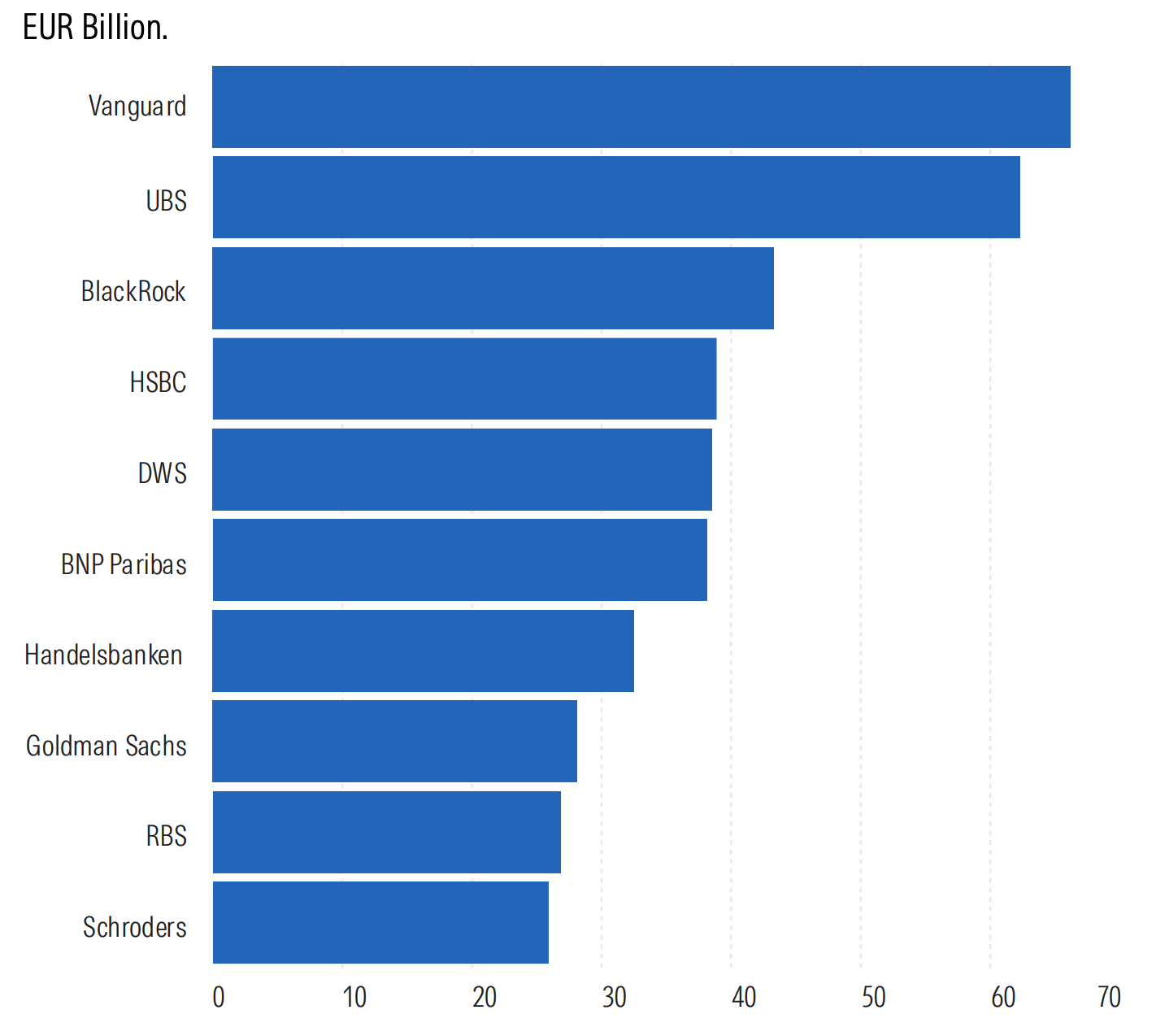
The top 10 fund companies collectively managed approximately EUR 401 billion at the end of the first quarter of 2026, representing around 31% of the total European fund-of-funds market.
Vanguard strengthened its leadership position, growing assets from EUR 58 billion to EUR 66 billion over the year to the end of March 2026 (15%), reflecting its global reach, strong brand recognition, and cost-efficient product offerings.
Overall, passive and solutions-based providers appear to be gaining disproportionate influence. The widening gap between the largest firms and smaller competitors suggests that scale, operational efficiency, and brand trust are increasingly critical competitive advantages.
Total Net Assets by Asset Manager
Source: Morningstar Direct. Data as of March 31, 2026.
Low-cost and systematic strategies win
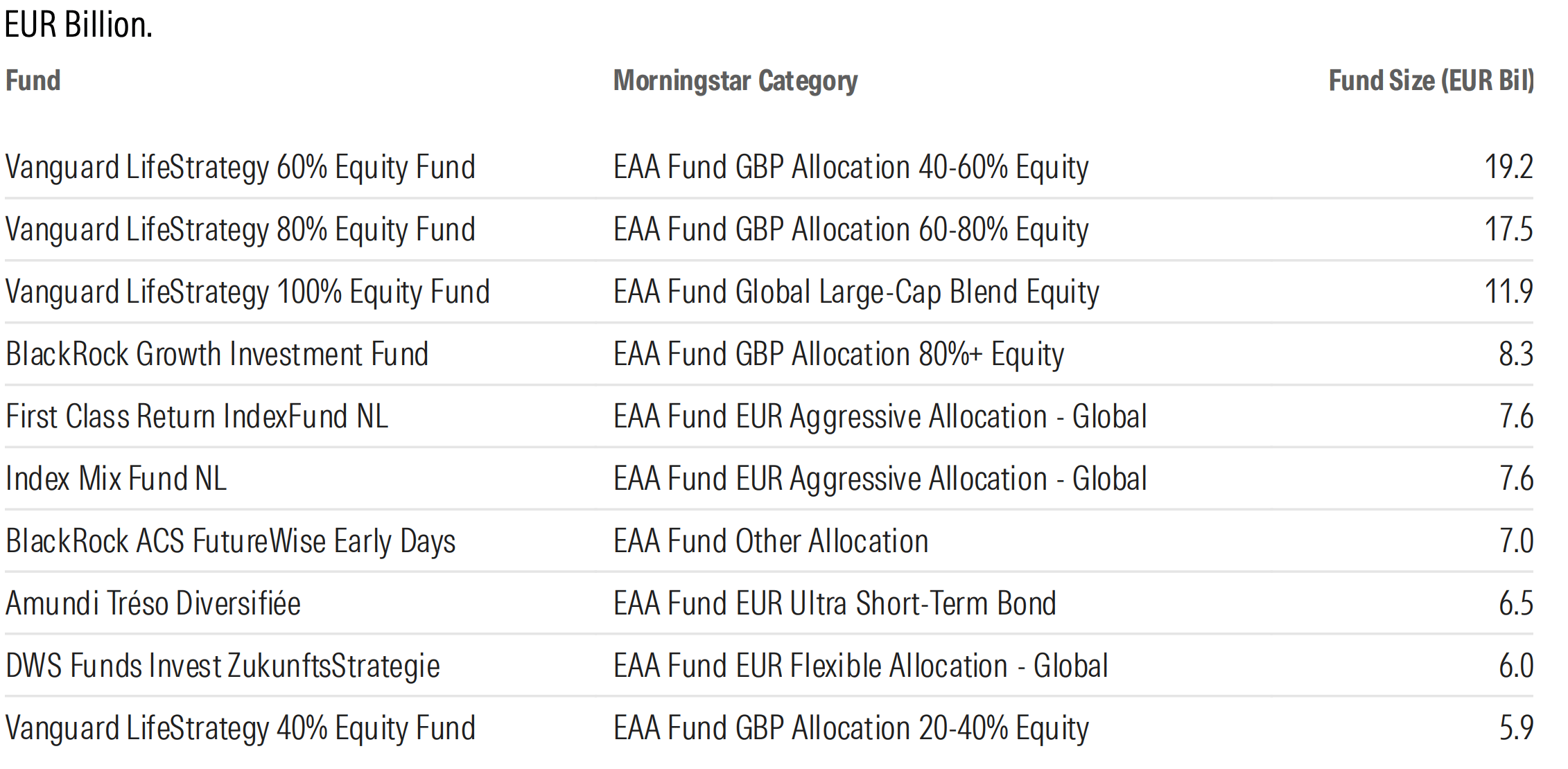
Vanguard continues to show the strongest and most consistent growth profile, led by its LifeStrategy range. BlackRock is seeing its strongest momentum in retirement-focused strategies, particularly the FutureWise target-date range, which offers low-cost, systematic multi-asset solutions designed for institutional investors.
By contrast, several traditional multi-asset funds have experienced weaker flows or net redemptions. UBS has seen its strongest growth in Swiss real estate and passive sustainable allocation products, notably UBS IF3 Real Estate and the Vitainvest Passive range, while demand across its broader active multi-asset offering remains more subdued.
Top 10 Fund-of-Funds by AUM
Source: Morningstar Direct. Data as of March 31, 2026.
Rising passive flows as active flows stabilize
While all three fund-of-funds segments have expanded, predominantly index funds of funds (with more than 75% passive holdings) have seen the strongest growth, more than doubling over the past five years.
Predominantly index funds of funds continued to attract strong inflows in 2025, gathering EUR 8 billion, while active funds of funds rebounded with EUR 14 billion after two years of outflows. The recovery in active strategies was mostly driven by a small number of BlackRock UK pension platform vehicles. The broader active recovery was more modest than headline figures indicate.
Portfolio Trends
Active ETFs: Rapid and broad adoption
Active ETFs are moving out of niche status, but they are not yet core holdings. Average exposure has increased from 0.45% to 1.40%, and while that growth is significant in relative terms, it remains modest in absolute terms. Most investors are testing the space rather than making meaningful allocations.
The pattern from 2024 to 2025 suggests that early adopters are beginning to scale allocations, which is a positive sign of growing confidence. A true breakout, however, will come when growth is driven less by new entrants and more by existing investors meaningfully increasing their allocations.
ELTIFs and LTAFs: From zero to pilot
As of 2025, exposure to ELTIFs and LTAFs across fund-of-funds portfolios is minimal, with only five funds in the universe allocating to these vehicles. It’s still a very early stage of adoption despite ongoing regulatory efforts to expand access to private markets.
The shift from zero exposure marks an initial entry point, supported by the introduction of ELTIF 2.0—the revised European regulatory framework effective from 2024. ELTIF 2.0 was designed to make these structures more accessible and usable.
However, allocations remain small and exploratory rather than conviction-driven. This reflects persistent constraints around liquidity, operational complexity, and regulatory considerations, particularly within daily-dealing fund-of-funds structures.
European equity: Conviction grows as allocators rebuild regional exposure
European equity exposure within the fund-of-funds universe increased significantly in 2025, following two years of largely unchanged positioning.
Average exposure rose to 5.44% across an expanded universe of 1,582 funds of funds, representing an increase of almost 19% year over year. The simultaneous rise in both allocations and fund count suggests the trend reflects a broad-based shift in investor positioning rather than isolated manager activity.
Emerging markets are back on the radar
Emerging-market exposure within the fund-of-funds universe increased notably in 2025, rising by approximately 11% year over year—the strongest annual increase in the past three years—reflecting a clear improvement in investor sentiment.
The increase was likely driven by improving growth expectations across emerging economies, expectations of a weaker US dollar, as well as increased diversification away from concentrated US equity exposure, with investors seeking broader geographic exposure and access to structural growth themes in emerging markets.