
AdvisorTech vs. WealthTech: What's the Difference?

Before there was WealthTech and AdvisorTech, there was FinTech.
FinTech is the umbrella term for any technology applied to financial services — payments, lending, banking, insurance, investing, crypto, and others. Everything else sits inside it.
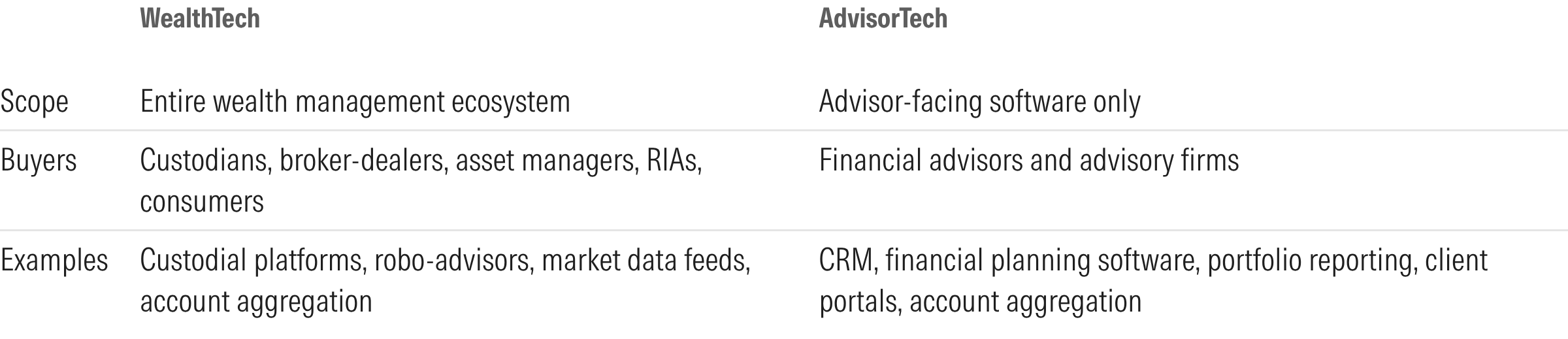
Under FinTech, WealthTech covers all technology used across the wealth management industry. AdvisorTech is the smaller slice built specifically for the technology financial advisors use to run their day-to-day practice.
Every AdvisorTech tool is WealthTech, but not every WealthTech tool is AdvisorTech. Broader WealthTech also includes tools for custodians, broker-dealers, and asset managers. It also includes consumer investing apps that advisors may never use directly.
If you've seen the two terms used interchangeably, you're not imagining it. The confusion is common, and it matters when you're evaluating vendors, budgeting a tech stack, or trying to find the right research to follow.
What Is WealthTech?
WealthTech is the broad category of digital tools that power the wealth management industry. It spans:
- Custodian and broker-dealer infrastructure — trading, clearing, custody platforms
- Asset management technology — portfolio construction, model delivery, indexing
- Consumer-facing tools — robo-advisors, budgeting apps, direct-to-investor platforms
- Advisor-facing software — everything in the AdvisorTech category below
- Data infrastructure — account aggregation, custodial data feeds, market data
In short, WealthTech describes who the industry serves and how technology touches any part of that value chain — investors, advisors, custodians, and institutions alike. FinTech Global’s WealthTech100 is an annual review spotlighting the industry’s most innovative WealthTech companies, and this year’s list points to AI as one of the biggest forces reshaping the space.
What Is AdvisorTech?
AdvisorTech is the subset of WealthTech built specifically for financial advisors and the firms that employ them — RIAs, financial planners, wealth managers, and independent broker-dealers. It covers portfolio management and reporting, financial planning, CRM, client portals, compliance, billing, account aggregation, and increasingly AI tools for meeting notes and prospecting.
Michael Kitces' widely referenced Financial AdvisorTech Solutions Map is the industry's de facto taxonomy for this category, and it has grown from a handful of core categories to dozens as niche point solutions have multiplied alongside broader platforms. The Oasis Group publishes the AI WealthTech Map, shining a spotlight on technology firms with a strategic and foundational commitment to AI innovation.
AdvisorTech vs. WealthTech: Key Differences
Where Financial Data Aggregation Fits
Account aggregation is one of the clearest examples of why the AdvisorTech/WealthTech line blurs — because it legitimately sits in both, depending on how it's delivered.
As WealthTech infrastructure, aggregation is the plumbing: gathering and normalizing data from custodians, broker-dealers, and held-away accounts, then feeding it to other software as an embedded API or network layer. CB Insights' market maps classify account aggregation as its own infrastructure category, separate from advisor-facing applications.
As AdvisorTech, aggregation's value shows up inside the tools an advisor actually uses on a day-to-day basis — a CRM that displays a client's full financial picture (held and held-away accounts), a financial plan built on complete account data, or an AI tool that's only as good as the data behind it. Kitces' AdvisorTech Map has long tracked "Account Aggregation" as its own category, scored on advisor satisfaction the same way a CRM would be.
The most accurate way to think about it: delivery model, not the underlying technology, determines the category. Selected directly by an advisor as part of their stack, it's AdvisorTech. Delivered as an integrated feature to power a CRM, planning tool, or TAMP, it's WealthTech infrastructure.
Not All Aggregated Data Is Advisor-Grade
This is where the categories genuinely diverge, and it's worth digging into. Most data aggregation was built for consumer use cases — budgeting apps, digital banking, payments, and lending. That world mainly needs to answer one question: what is this account worth right now? A balance covers it.
AdvisorTech asks a harder question — not just what an account is worth, but exactly what's inside it, down to the individual holding. That's what "advisor-grade" data means in practice:
- Positions, not just balances. Every holding by ticker, share count, and price, not a single lump sum.
- Open and closed tax lots. Which shares were bought when and at what price, so an advisor can manage taxes and harvest losses precisely.
- Cost basis. Needed for accurate tax reporting and to separate real performance from unrealized gains.
- Security-level analytics. Sector exposure, asset allocation, and style-box detail down to the fund or stock, which portfolio construction and rebalancing tools depend on.
- Trade and settlement data, plus principal-and-income breakdowns for trusts and other complex account structures.
Without this level of detail, a dashboard can show an advisor a client’s “worth.” But the nearby rebalancing, tax optimization, or compliance tools have nothing to use. Consumer-grade balance feeds simply weren't built to carry this level of detail — and that gap is exactly what separates infrastructure that happens to serve wealth management from infrastructure purpose-built for it.
ByAllAccounts is the financial data network built specifically for wealth management, delivering both custodial feeds and held-away account aggregation at the position, security, tax-lot (custodial data only) level. That's the difference between data that merely displays and data that powers performance reporting, portfolio analytics, rebalancing, and compliance.
FAQ: AdvisorTech vs. WealthTech
Is AdvisorTech a type of WealthTech?
Yes. AdvisorTech is a subcategory of WealthTech focused on software built for financial advisors, while WealthTech also includes custodial, institutional, and consumer-facing technology advisors don't typically use directly.
What are examples of WealthTech that are not AdvisorTech?
Robo-advisors aimed at consumers, custodian trading and clearing infrastructure, and portfolio-manager tools are all WealthTech but not AdvisorTech, since advisors don't use them in daily practice.
Does account aggregation count as AdvisorTech or WealthTech?
Both, depending on delivery model. Kitces' map treats it as an advisor-facing category; other taxonomies classify it as WealthTech infrastructure when it's embedded inside other platforms.
Why does it matter whether aggregated data includes positions and tax lots, not just balances?
Because most AdvisorTech workflows — rebalancing, tax management, performance reporting, compliance — need to know exactly what's held, when it was bought, and at what price. A balance alone can't support any of that.