
5 min read
Advisors Are Using AI Everywhere. Is It Actually Creating Value?
With new AI tools emerging almost daily, advisors need a framework for separating meaningful business benefits from costly distractions.

Key Takeaways
- Advisors generally did not agree on which AI use cases create the most value, suggesting the technology is still in a state of flux in financial planning.
The biggest benefits advisors reported are saving time, boosting productivity, reducing the chance that tasks fall through the cracks, and freeing up time to focus on clients.
- Most advisors don’t see generative AI adding much value to their core competencies, including goals-based planning, holistic advice, and behavioral coaching.
It seems like every week brings another AI tool aimed at financial advisors. Whether it's a meeting assistant, content generator, planning tool, or client communication platform, the options keep growing.
Like any technology investment, AI needs to earn its place in an advisor's tech stack. The challenge is that generative AI is still relatively new, and both the tools and their capabilities continue to evolve. So how can advisors tell the difference between a genuinely valuable use case and the latest shiny object?
Barriers to Adoption
Generative AI holds promise for many industries, and financial planning is no exception. Some advisors see it as a way to scale their business without increasing headcount. Others are interested in reclaiming time that can be redirected toward deeper client relationships. Regardless of what promise intrigues an advisor, they must grapple with barriers to implementation.
Easier Said Than Done
Before an advisor sees any value from AI, they first have to identify a use case worth pursuing. Then comes the process of finding the right tool, making sure it meets compliance and regulatory requirements, and determining if and how it will integrate into existing workflows—making the whole endeavor time-intensive and costly.
A Threat to the Human Touch
Advisors also face another challenge: how AI might affect the way clients perceive their value.
Some AI platforms are marketed as alternatives to working with a financial advisor altogether, promising personalized recommendations and even support for planning decisions. But concerns about value perception don't stop there.
Morningstar research found that investors expect to pay less for a service when an advisor was assisted by AI than when they worked alone. In other words, the same technology that helps advisors become more efficient may also lead some investors to believe an advisor’s time is less valuable.
Research Overview
To better understand where advisors are actually finding value from generative AI, we surveyed members of the Morningstar Behavioral Research Circle, a global panel of financial advisors who are passionate about helping investors succeed and who recognize the important role behavioral science plays in that success.
Participants were asked about their use of generative AI across 13 different financial-planning activities. These use cases were developed based on industry research and designed to represent different stages of the CFP’s seven-step financial planning process.
Potential Use Cases of Generative AI in Financial Planning
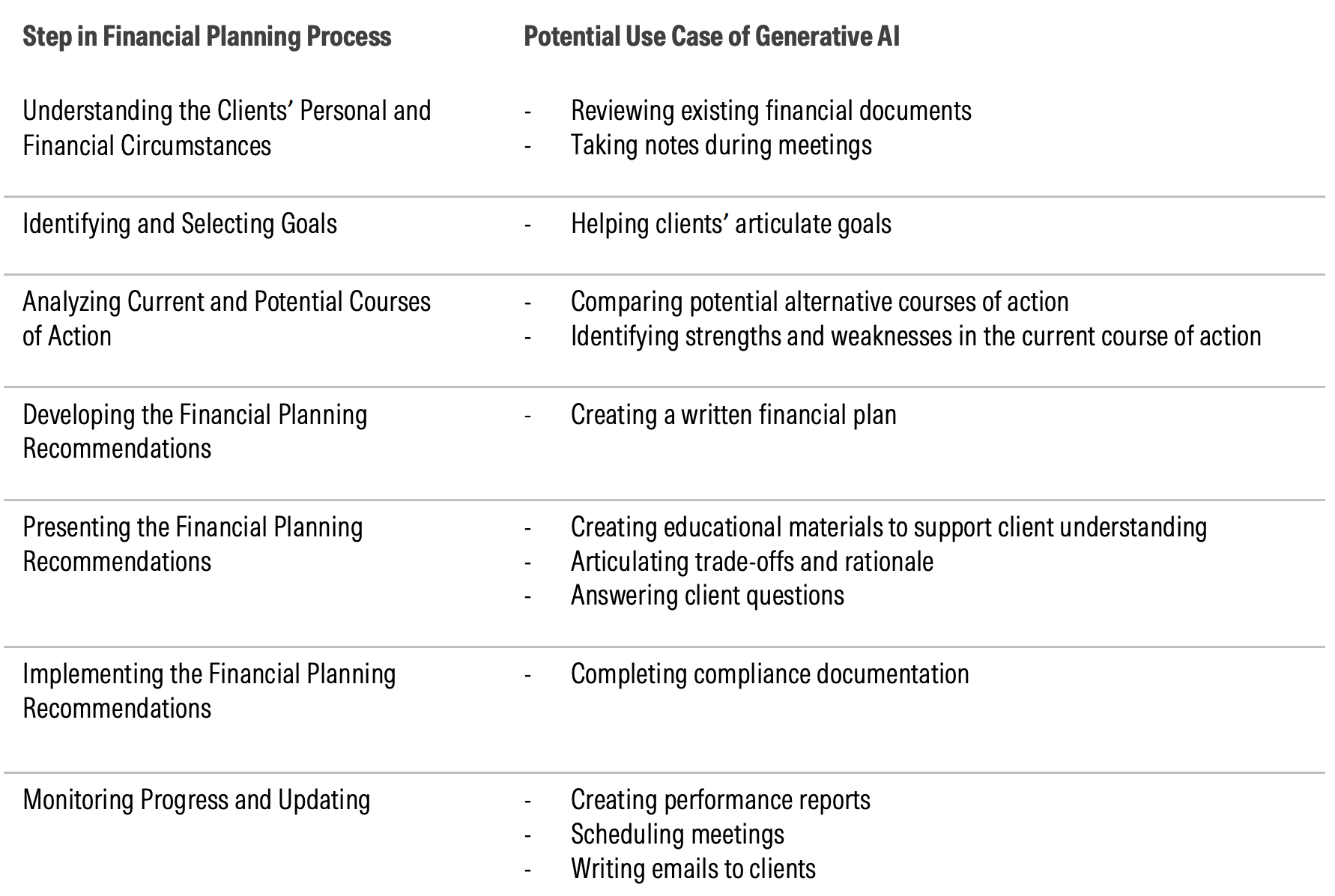
Source: Morningstar Behavioral Insights Group
Most advisors reported using generative AI in some capacity, but adoption varied significantly. Some used it for just one task, while others reported applying it across as many as 11 different activities.
Where Is Value Being Added?
Just because advisors are using AI doesn’t necessarily mean they’re getting equal value from it.
If every AI use case created roughly the same benefit, we'd expect advisors to rank them similarly. Instead, we saw meaningful differences in how advisors evaluated various uses of generative AI. And perhaps more notably, advisors often disagreed with one another about what was most valuable.
The only exception was note-taking, which was consistently rated as the most valuable use of AI. Outside of note-taking, there was relatively little consensus. A tool that one advisor found indispensable might provide only marginal value to another.
Average Ranking of Use Cases
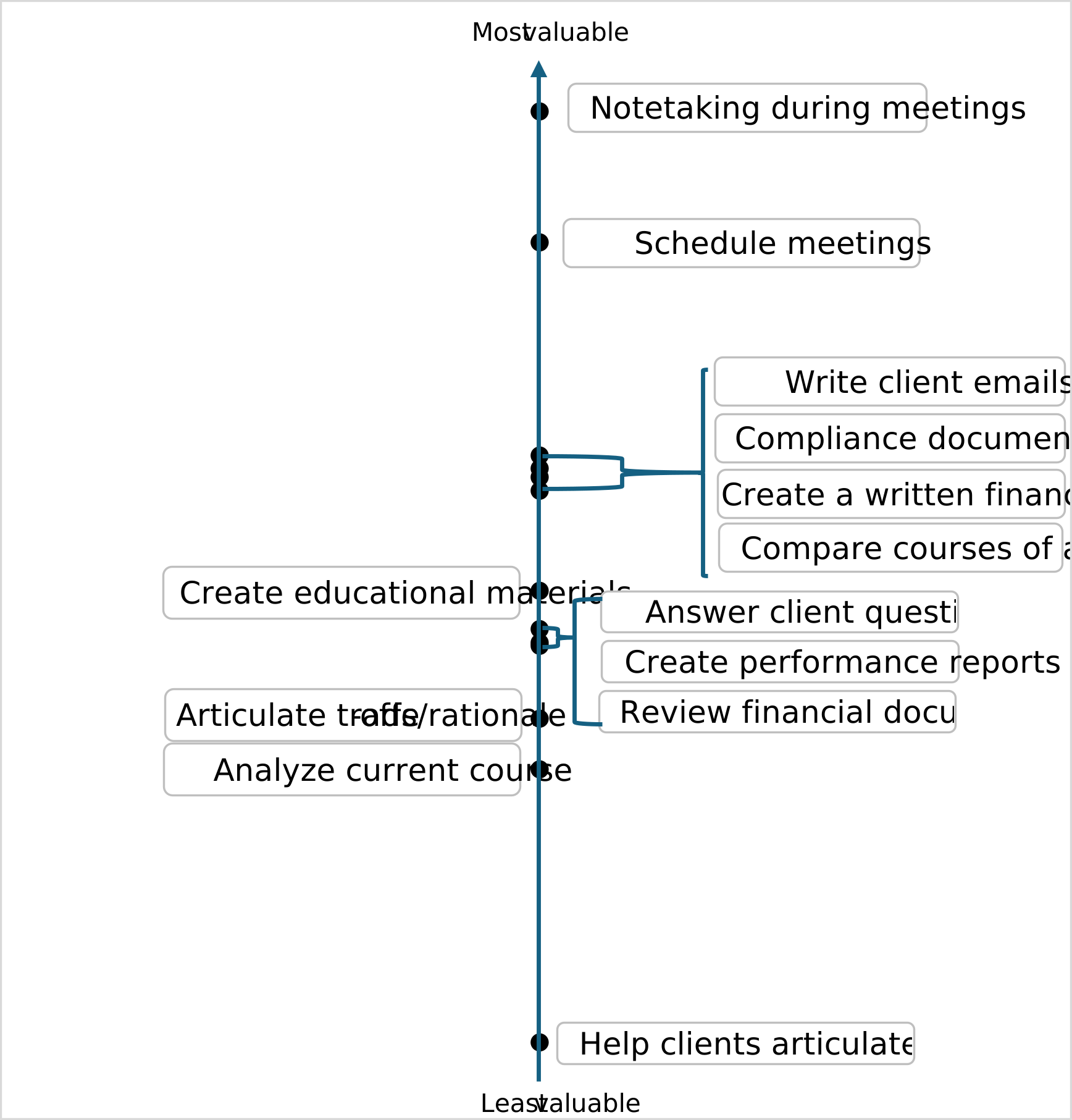
Source: Morningstar.
We also looked at whether certain categories of work benefited more than others. The use cases included financial analysis, client-facing tasks, and administrative tasks. However, there was no clear pattern where one activity category rose to the top or bottom.
The takeaway is that there doesn’t appear to be a universal formula for AI success in financial planning. Rather than copying how another advisor uses AI, firms may need to experiment and determine which applications align best with their own workflows, client base, and business goals.
That said, advisors who haven't yet explored AI-powered note-taking may want to start there, given how consistently valuable it was rated by their peers.
How Is Value Being Added?
We also asked advisors to take a closer look at the AI application they found most valuable and explain where that value was coming from.
By and large, the benefits centered on general efficiency gains rather than strengthening the core elements of financial advice. Advisors reported value in areas such as productivity, time savings, and organization.
Potential Sources of Value in Generative AI Use
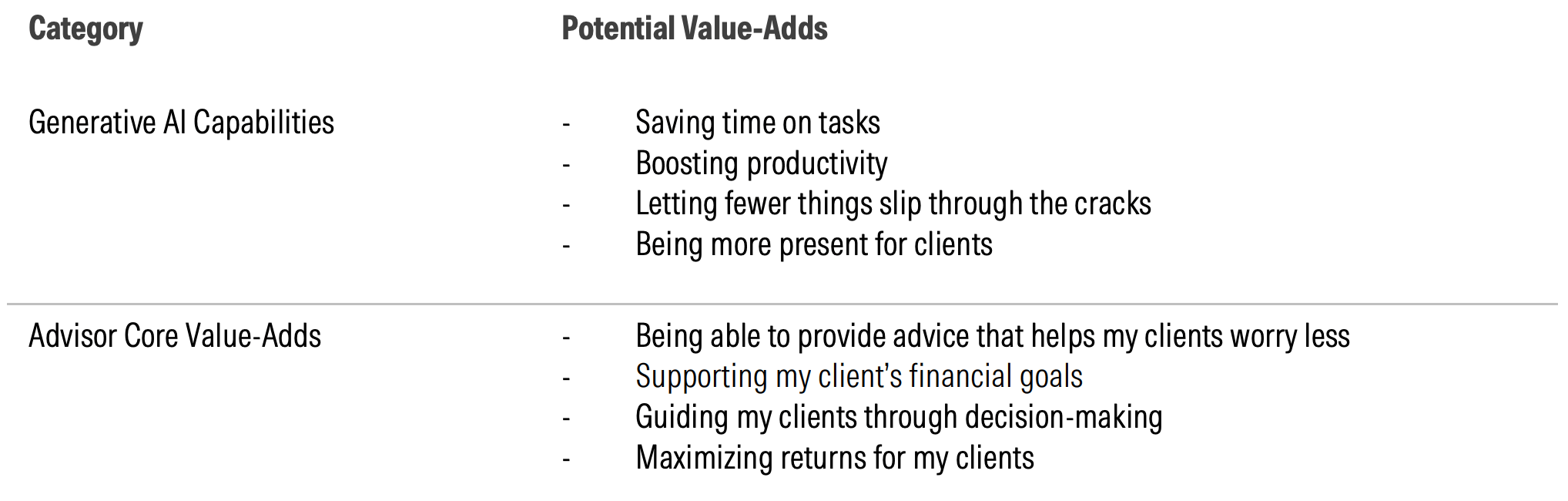
Source: Morningstar
It may be for the best that advisors do not find much value aligned with advisor core competencies from generative AI, as it maintains the value of working with an advisor over just using generative AI alone. These are the areas where human advisors create the most meaningful value, and where relationships, empathy, context, and judgment matter most. The fact that AI isn't replacing these capabilities helps reinforce why clients continue to seek advice from people rather than software alone.
That doesn’t mean AI has no role to play. It can certainly support advisors and help create space for more meaningful client interactions. But advisors should be careful not to let AI interfere with the personal connection, deep understanding, and tailored recommendations that define great advice.
One related question is what advisors do with the time they gain from AI. Some may reinvest those hours into serving clients more deeply. Others may use the efficiency gains to grow their client base. Interestingly, we found no evidence that advisors using AI more extensively were spending significantly more time with clients than advisors using AI less often.
This may mean a few things:
- Advisors may be redirecting time savings toward business growth rather than client interactions.
- Advisors may not be gaining much time back from their use of AI at this stage.
Either way, advisors would be wise to track their efficiency gains and make deliberate decisions on how they will redistribute their recovered time.
Potential Hidden Costs
Understanding where AI creates value is only half the equation. Advisors also need to consider where it creates costs.
On one level, these costs can be tangible. Generative AI isn’t free, and usage expenses can add up quickly. They also need to consider the time required for human review, compliance oversight, and quality control. Saving time is only valuable if the final process is actually more efficient.
Other costs are harder to measure. Our research on investors’ attitudes toward AI suggests that certain uses, particularly those involving highly personal client interactions, can weaken the advisor-client relationship. We also found that investors generally expect to pay less for work completed with AI assistance.
Those perceptions may not affect a firm’s pricing immediately. But it only takes one advisor who offers the same AI-assisted work at a lower price to begin potentially cutting into a client base.
Additionally, growing public skepticism about AI in relationship-driven professions means that advisors should consider how clients perceive their use of these tools.
Given these concerns, advisors need to be adept at not just identifying whether the use of AI could be valuable to their practice but also at balancing that value with its tangible and intangible costs.
A Framework for Weighing Gen AI’s Value in Your Practice
As with anything in an advisor’s tech stack, generative AI tools need to prove their value to win and retain a spot.
Our framework helps advisors examine how the value of a generative AI tool stacks up against its costs. Advisors should use this process to evaluate each use of generative AI in their practice and revisit it periodically to ensure the use is still valuable. Download the framework here, located at the end of the PDF.