
5 min read
Asia Equity Outlook Q3 2026: Where to Invest After Tech's Q2 Surge
Asian equities gained 32% last quarter, but outside of technology, valuations remain attractive. Here's where our analysts see opportunity in China, Japan, and beyond.

Key Takeaways
- Technology drove nearly all of Asia's second-quarter gains, surging almost 93%, and now accounts for about half of the region's market cap, alongside financials.
Buying opportunities remain across most sectors as attractive valuations persist. China's discount to fair value widened to 13%, with the best opportunities in select banks, biotech, and internet names. Japan's tech sector, by contrast, swung from undervalued to a 24% premium.
A weaker Japanese yen is expected to support export-oriented companies.
Asian equities posted strong gains in the second quarter of 2026, but technology stocks did nearly all of the work, reshaping the region's market makeup along the way. So where does that leave the rest of the market heading into the third quarter?
Morningstar’s Q3 2026 Asia Equity Market Outlook analyzes our Asian equity research coverage by sector performance and valuations, global and regional policy impacts, equity market outlooks in China, Japan, and the Asian regions, and more. Get the full report.
Asian Stocks in Q2 2026: Technology Outpaces Every Other Sector
The broad Asian market gained around 32% in the second quarter as Iran war risks abated and positive outlooks for artificial intelligence spending drove exceptional gains in the technology sector. Asian tech companies have gained almost 93% in the second quarter. Other sectors saw more pedestrian returns.
The consumer defensive sector continued to fall due to Iran war risks to input costs, while the pullback in healthcare may reflect profit-taking after strong gains in 2025
Hong Kong/China: We Prefer Select Undervalued Banks, Biotech, and Internet Companies
Retail sales are softening, and higher input costs from Iran war-related supply chain disruptions have investors worried about profit growth for consumer companies.
But we think much of that headline weakness comes from a narrower source: declining consumer electronics and EV sales as government purchase subsidies wind down.
Beyond that, we see signs of stability and some growth, especially in services, though we expect that growth to stay slow as excess capacity remains a concern.
Discount to Intrinsic Value Is Driven by Banks, Consumer, Internet, and Healthcare Companies
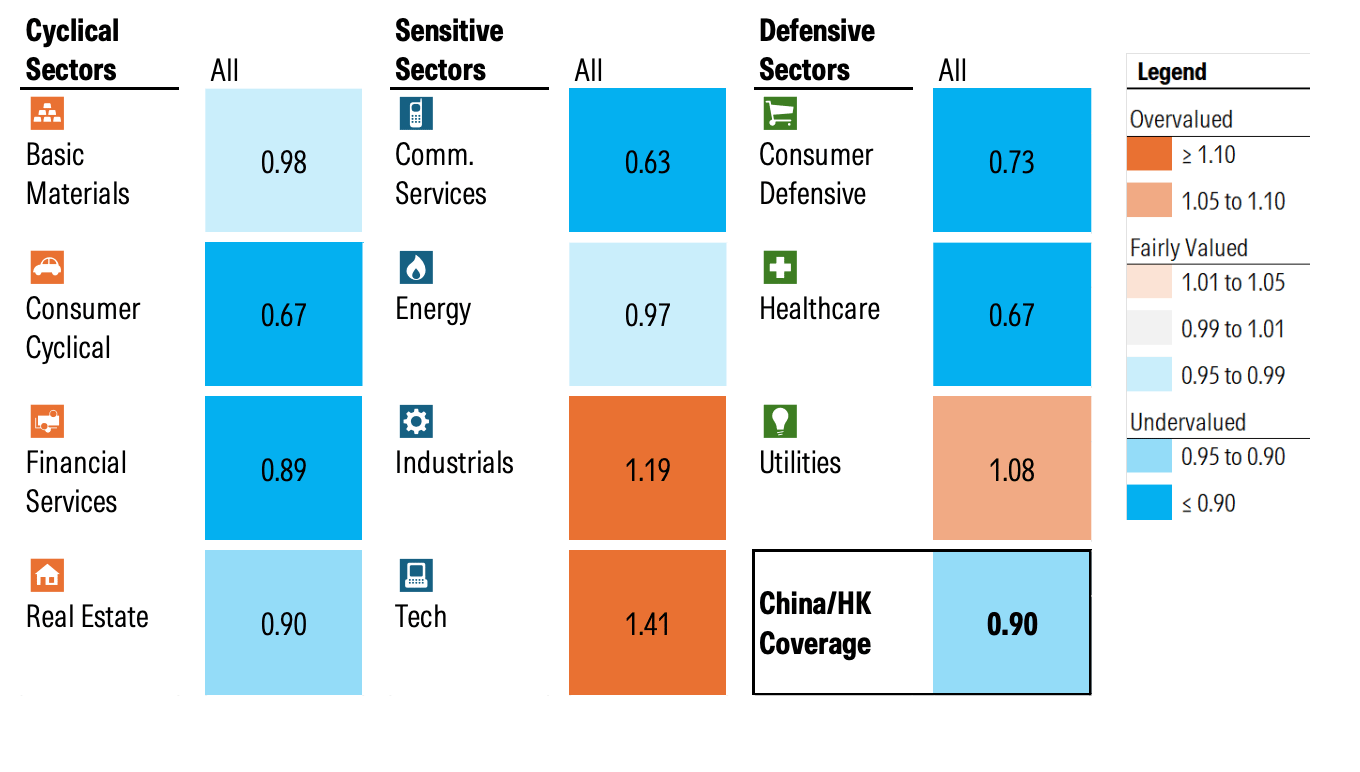
China/Hong Kong coverage average price/fair value. Source: Morningstar. Data as of June 18, 2026.
At this stage, we refer to select China's banks’ H-shares, biotech firms, and internet companies, given their attractive discounts to our fair value estimates.
• We expect margin pressure to ease for the banks over the next 12 months. As such, the earnings decline is ending.
• Biotech companies with drugs in the growth stage and promising pipelines have pulled back to attractive levels from 2025 gains.
• AI disruption concerns for wide-moat-rated internet companies are overblown.
Most Undervalued China and Hong Kong Stocks Are in Communication Services, Consumer, and Healthcare
Across our China/Hong Kong coverage, 78% of names, including dual listings, now carry a 4- or 5-star rating, up from 62% in the first quarter.
That jump reflects further share price declines in e-commerce, travel, consumer defensive, and healthcare companies, pushing more names into outperform territory.
In technology, most of the undervalued names are solar panel-related, with excess capacity remaining a near-term risk.
Where to Find Buying Opportunities in the Japanese Equity Market
Despite the broad Japan market gaining 23% in the second quarter, the percentage of 4- and 5-star-rated companies in our Japanese coverage is largely stable at 38%.
Positive earnings guidance following the March-quarter results has led to raised valuations, and we continued to find buying opportunities across most sectors. The weakness in the Japanese yen is anticipated to provide some support to the exporters.
Economically Sensitive Sectors: Preferred Stock Picks
The technology sector's stellar gains in the second quarter continue to leave us with limited buying opportunities. We still prefer the laggards, which include wide-moat leader TSMC and Sino American Silicon.
Semiconductor equipment manufacturer Advantest is on the cusp of being an outperform call and will benefit from improved revenue visibility driven by AI-related spending.
The internet and media companies on our list were sold down on AI-disruption risks, which we think are overdone. High memory chip costs may also weigh on Nintendo's fiscal 2026 earnings, but current discounts to gaming companies' intrinsic values are attractive.
Economically Sensitive Sectors Top Picks

Source: Morningstar. Data as of July 1, 2026.
What Advisors Should Know
Chip valuations are stretched, but not uniformly. Memory makers look overvalued, while our analysts still favor select names like TSMC despite their relative laggard status.
China's discount has widened. The market now trades 13% below fair value, with banks, biotech, and internet names standing out.
Rate policy still favors patience. We expect the Fed to hold off on cuts until 2027, shaping relative appeal across the region's financials and REITs.
To explore how these themes translate into individual stocks and sectors, investors can dive deeper into Morningstar’s Asia equity research, including fair value estimates, Morningstar Ratings, and analyst insights across regional markets.