
Alternative Asset Managers: Trends to Watch in 2026
Market volatility, private credit concerns and consolidation are reshaping the industry.

Alternative asset managers have enjoyed a golden era of growth over the past decade. Institutional and high-net-worth investors increased their allocations to alternatives in pursuit of diversified returns and better yields.
However, the pathway to democratization of the private-capital markets will be long, with plenty of hurdles. Alternative asset allocations typically come with less-transparent disclosures and valuation, higher fees, and lower liquidity than the public markets.
That means financial advisors need to conduct a more thorough due diligence process before recommending private-market investments.
Here, we analyze the seven largest alternative asset managers, explore trends shaping today’s industry, and cover key due-diligence factors advisors should evaluate when considering alternative investments.
Alternative Asset Managers Continue to Benefit from Strong Demand
Alternative asset managers faced a challenging first half of 2026 as uncertainty over the direction of short-term rates, shifting fiscal and tariff policy, and renewed geopolitical tensions have increased volatility across the sector. Several high-profile bankruptcies, concerns about loans to the technology sector, and a mismatch between funds' illiquid assets and increased investor redemption requests in the private-credit market have only added pressure. As a result, the shares of most alternative managers were down more than 25% during the first half of the year.
Despite these headwinds, our latest report on alternative asset managers suggests that the risks associated with the private markets are concentrated within the funds of these firms as opposed to representing a systemic risk. While firms differ in their exposure to some of the higher-risk parts of the private–credit market, a reviving IPO and M&A market is beginning to unlock exit activity on the private equity side of the business, and the seven largest managers keep expanding their share of a fee-earning assets in the industry.
The Growing Market for Alternative Assets
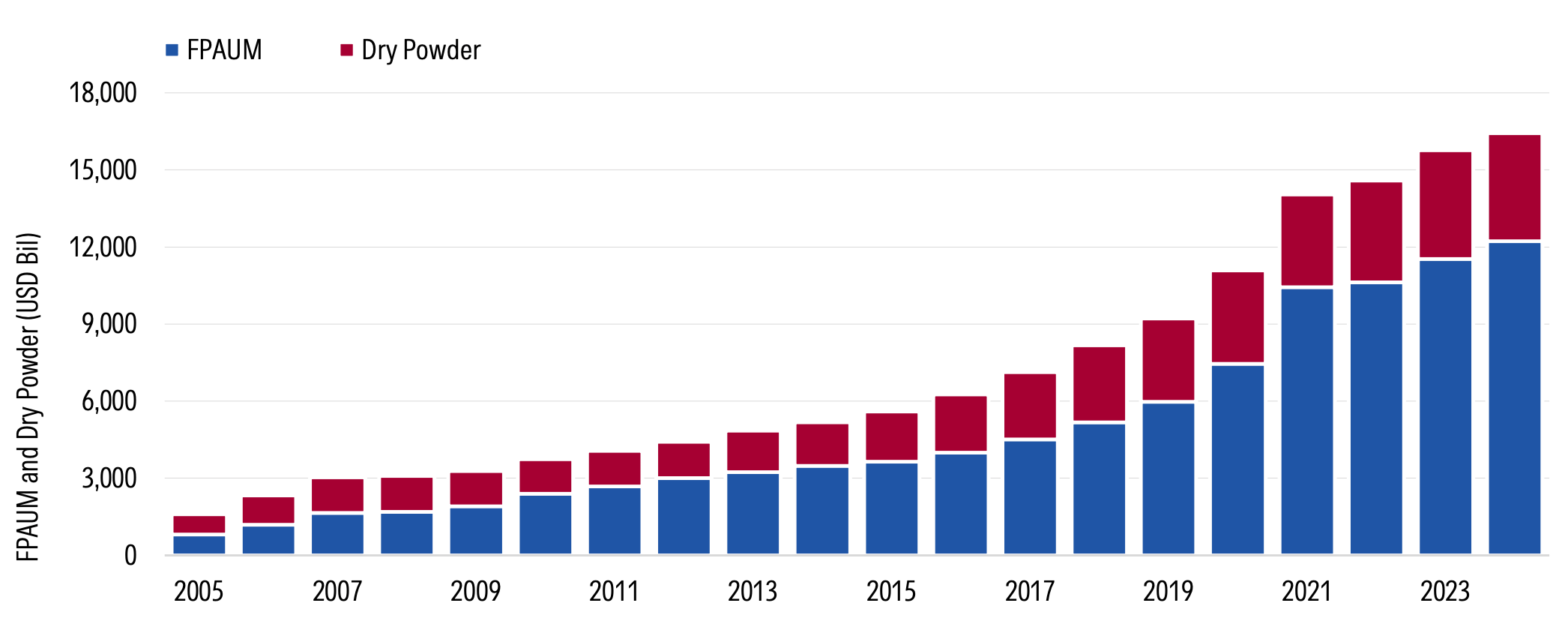
According to our Financial Services Observer report, the alternative asset market accounted for 13% of the broader asset management services market at the end of 2024. Investors had at that time committed $16.434 trillion in capital to alternative investments, based on PitchBook data.
Of that total, $12.220 trillion was invested in funds—generally referred to as fee-earning assets under management, or fee-earning AUM. Another $4.214 was trillion available for deployment but not yet earning fees, generally referred to as "dry powder."
The private capital market has generally been broken down into four main categories:
- Private equity
- Real estate/real assets
- Private credit
- Other alternative product offerings, such as hedge funds, secondary funds, co-investment funds, and structured products
Private credit platforms—made up of private unlisted loans and credit extended to governments, businesses, and consumers—have benefited all the large firms in our coverage. These seven firms hold sway over more than three-quarters of the segment’s fee-earning AUM.
Private equity, which includes growth equity funds and company buyout funds as well as venture capital funds, remained the largest fee-earning alternatives category by a wide margin in 2025. It's also highly fragmented. The firms in our coverage—among the top 10 largest alternative-asset providers—accounted for less than 10% of private equity fee-earning AUM during the past decade.
In real estate/real assets, though, the seven firms we cover have accounted for 35%-40% of fee-earning AUM. Brookfield dominates the segment with funds dedicated to real estate, infrastructure, and renewable energy and energy transition.
The Alternative Assets Market Has Reached $16.434 Trillion
Source: PitchBook, company reports, and Morningstar data and estimates. Data as of Nov. 21, 2025.
Largest Alternative Asset Managers by Fee-Earning AUM
The publicly traded alternative asset managers are global institutions with decades of experience investing in nontraditional asset classes. The largest firms continue to capture a larger share of fee-earning AUM in the private capital markets.
Here’s where the seven we cover stood as of September 2025.
- Blackstone
- Apollo Global Managemen
- KKR & Company
- Brookfield Asset Management
- Ares Management
- Carlyle Group
- Blue Owl Capital
Asset Managers' Fee-Paying AUM by Alternative Strategy
The chart below compares the fee-paying AUM by category of the largest firms.
In terms of fee-paying AUM, Apollo focuses most heavily on private credit strategies.
Blackstone is the most diversified of the group. At the end of September 2025, the firm garnered 34% of its fee-earning AUM from private credit strategies, 31% from real estate/real asset strategies, 26% from private equity strategies, and 9% from other alternative strategies.
Blue Owl, KKR, and Brookfield each enjoy some diversification but not as much as others in the group.
Largest Traditional Asset Managers in the Alternatives Market
Traditional asset managers have started to build and/or acquire capabilities in the private capital markets, with a handful having sizable amounts of alternative-fee-earning AUM at the end of September 2025.
- BlackRock, $526 billion
- AMG, $353 billion
- Franklin Resources, $270 billion
- Invesco, $180 billion
- T. Rowe Price, $56 billion
BlackRock continues to expand beyond traditional assets with its private capital capabilities. The firm added another $118 billion to its fee-earning AUM during the third quarter of 2025 with the closing of its HPS Investment Partners acquisition.
This deal allowed BlackRock to leapfrog pure-play alternative asset manager Ares in terms of fee-earning AUM, putting it more on par with Brookfield and KKR. We believe BlackRock will continue to use a combination of organic and inorganic growth to climb the leader’s table.
What Trends Are Affecting Alternative Asset Managers?
Fundraising rebounded in 2025, led by institutional and high-net-worth investors
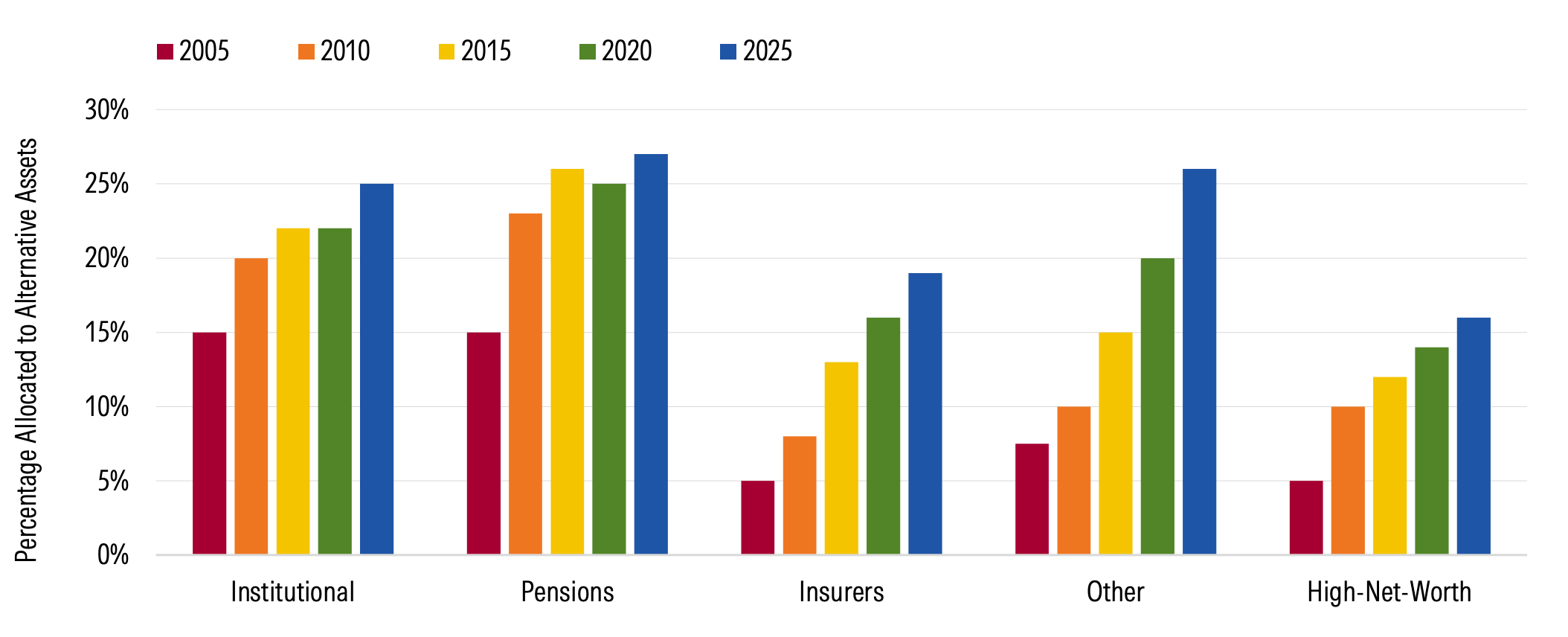
Fundraising levels reflect investor interest and confidence in alternative products. Alternative asset managers should continue to see solid levels of fundraising in the near-to-medium term as institutional investors tweak their allocations, while high-net-worth investors expand their allocations to the segment.
We expect that as more products geared toward retail investors get approved, we’re likely to see the allocation levels for high-net-worth investors rise.
That said, we don’t expect to see much more expansion in the allocation that institutional investors have made to alternatives, which will serve to make future fundraising efforts more competitive in that channel.
Blackstone generated 30% of the capital raised by the seven firms in our coverage between 2020 and 2024. Apollo Global Management generated 21%, with most of that dedicated to the alternative credit markets.
Meanwhile, Carlyle Group and Blue Owl trailed the rest of the firms in our coverage, with just 6% and 4% of group capital raised, respectively.
Allocations to Alternative Assets Have Increased in the Past Two Decades
Source: PitchBook, company reports, and Morningstar data and estimates. Data as of Nov. 21, 2025.
Private capital in retirement accounts could provide the next big leg of growth
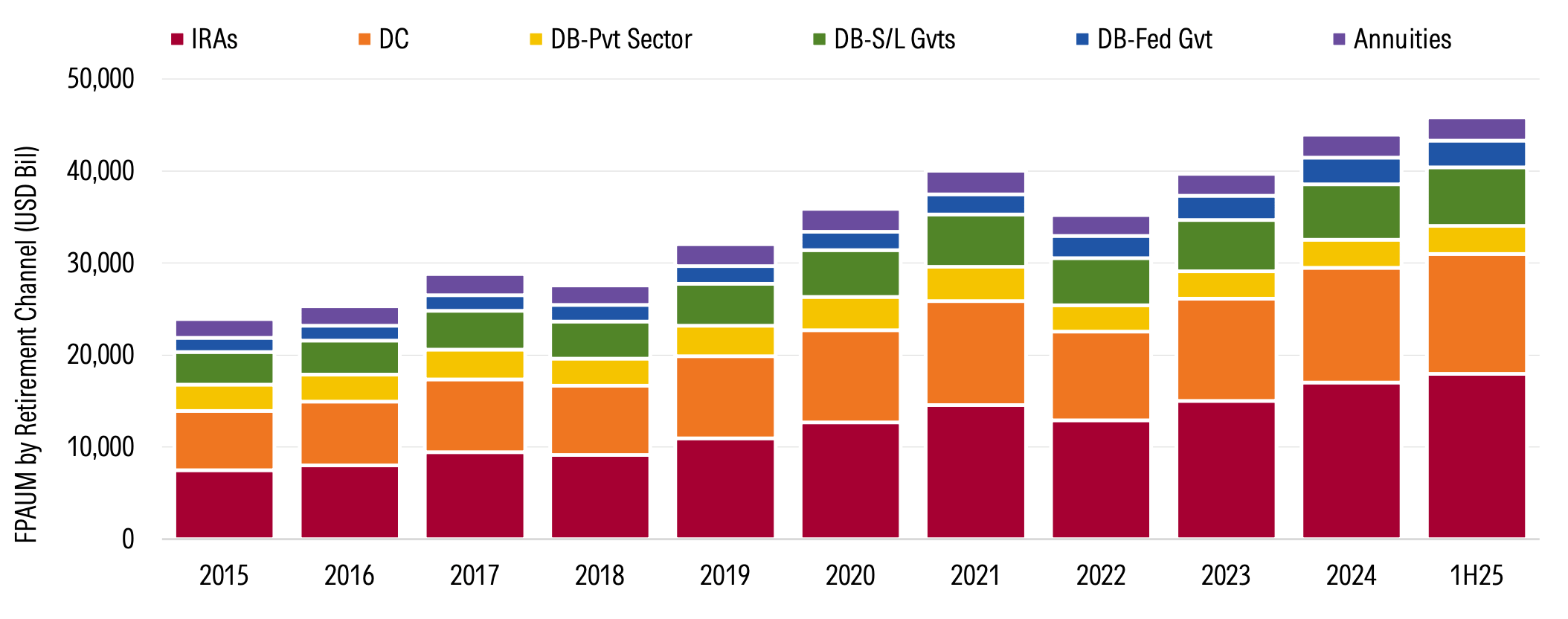
While the US retail market (as differentiated from the high-net-worth market) has been the "big white whale" for the alternative asset managers for much of the past two decades, recent regulatory moves could finally open the retail market, and more specifically defined contribution and individual retirement accounts, or IRAs, to alternative investments.
The current US administration has instructed regulators to review the rules that have historically restricted these types of investments to institutional and sophisticated/accredited investors. At the end of June 2025, there was $13 trillion invested in defined contribution plans and $18 trillion in IRAs in the United States, making it an attractive market to pursue.
Gaining access to defined contribution platforms may prove difficult, though, as plan sponsors tend to be conservative (and litigation risk averse), noting the current dearth of exchange-traded funds, or ETFs, on these platforms because most plan sponsors are wary of allowing brokerage capabilities in their plans.
We expect future retail access to private capital markets to be intermediated through registered funds like closed-end funds, interval funds, and tender-offer funds.
Fee-Earning AUM by Retirement Channel
Source: Investment Company Institute—Quarterly Retirement Market Data, Second Quarter 2025. Data as of Sept. 18, 2025.
Consolidation looks increasingly likely
Institutional and high-net-worth investors in private capital markets prefer fewer asset manager relationships, large funds, diversified exposures, and strong investment track records when allocating capital.
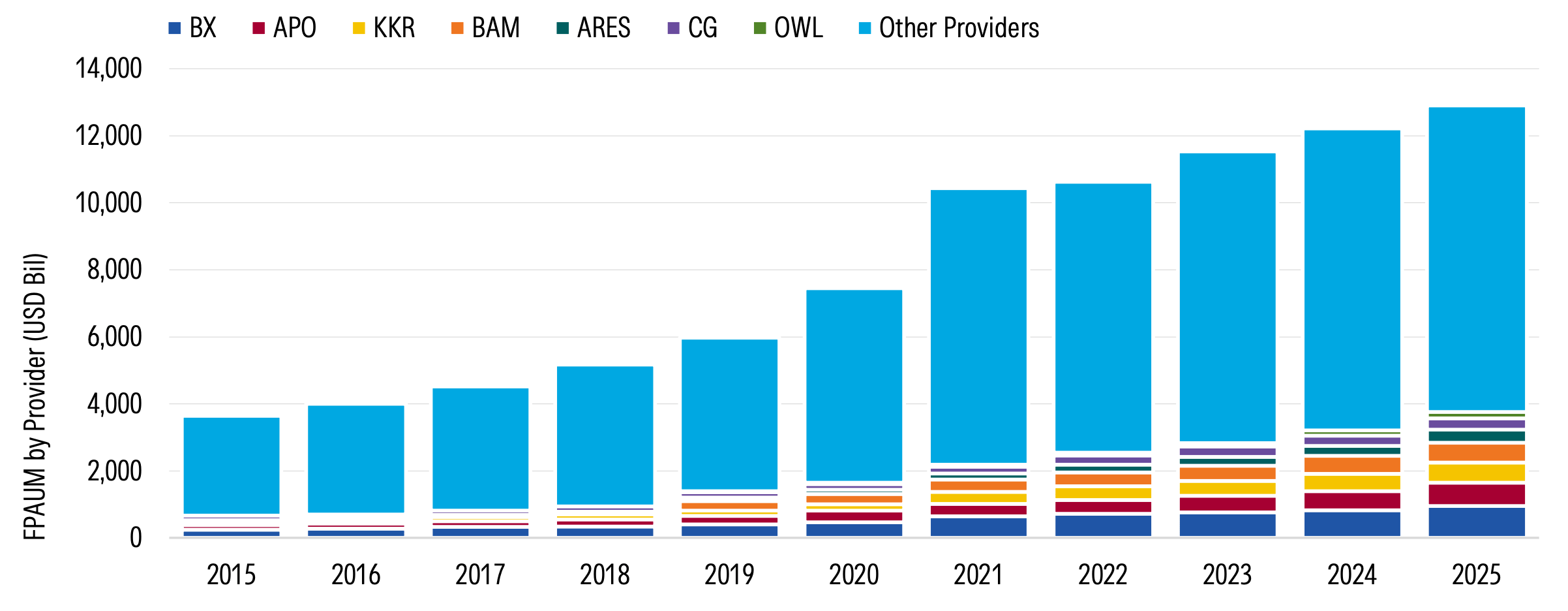
The firms in our coverage have dominated flows and fee-earning AUM levels, continuing to generate a bigger share of annual fundraising and holding larger amounts of fee-earning AUM and dry powder. We expect this trend to continue, with levels and diversification of fee-earning AUM almost becoming a proxy for reputation and quality.
The largest alternative asset managers continue to capture a larger share of fundraising in private capital markets, driving a commensurately larger share of fee-earning AUM over time.
Share of Fee-Earning AUM in the Private Capital Markets Over Time
Source: PitchBook, company reports, and Morningstar data and estimates. Data as of Nov. 21, 2025. Private Capital Market data for Brookfield and Blue Owl prior to 2020 was not reported regularly.
Dry powder has been piling up
Alternative asset management firms continue to raise capital and be more selective with deployments, driven largely by market turmoil in 2025. This has allowed more capital to amass that isn’t actively generating returns.
Dry powder allows firms to have capital at the ready to take advantage of investment opportunities quickly when they arise. Over time, however, dry powder can dilute internal rates of return if asset managers don’t efficiently deploy capital.
And if dry powder levels are too high across market segments, competition for attractive assets could drive up valuations and be a drag on investor returns.
While fee-earning AUM accounts for around 75% of total AUM on average for most of our coverage, Brookfield, which is more focused on real estate/real assets, holds the most undeployed capital in our coverage, at 50% as of September 2025.
For a deeper analysis of firms’ competitive strengths and weaknesses, download the full report.
Brookfield Holds the Most Undeployed Capital in Our Coverage
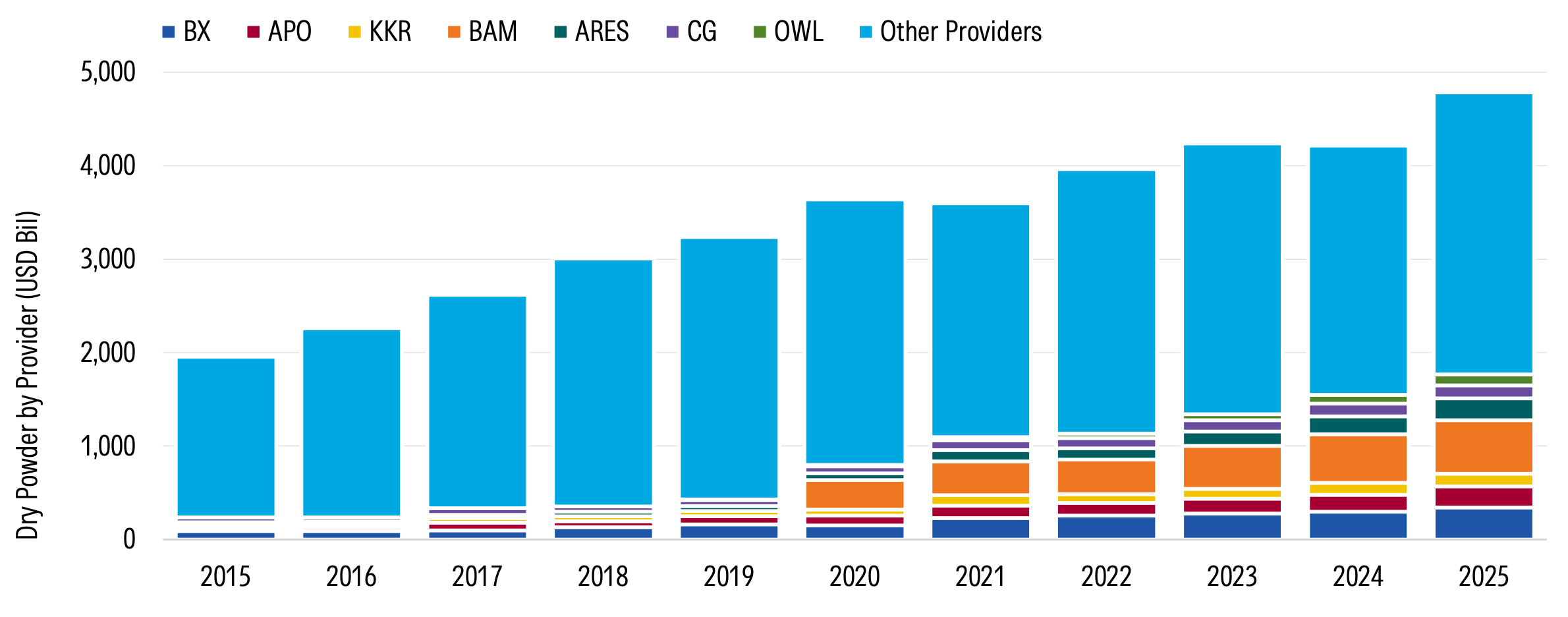
Source: PitchBook, company reports, and Morningstar data and estimates. Data as of Nov. 21, 2025. Private Capital Market data for Brookfield and Blue Owl prior to 2020 was not reported regularly.
Due Diligence Factors for Alternative Investments
Morningstar focuses on three pillars when assessing which semiliquid funds are most likely to outperform their peers in the long run: People, Process, and Parent.
When conducting due diligence on semiliquid funds, advisors should consider the below.
- Management teams: Experience in illiquid assets across key decision-makers and supporting resources.
- Costs: How expenses compare with other similar offerings. Semiliquid funds often come with management fees, performance incentive fees, and borrowing and operational costs higher than those of traditional funds.
- Liquidity management: How effectively firms manage liquidity in the context of periodic redemptions, and how well an investment vehicles’ liquidity provisions line up with its holdings.
- Risk management: Risk in terms of portfolio bias and ability to execute an investment strategy, as well as how teams approach managing risks.
- Valuation methodologies: The source and reliability of valuations for nontraded assets.
- Deployment and realization capabilities: Ability to use capital efficiently, and the process and timeline for achieving exits.