
9 min read
Key Trends in the Canadian Gold Market

Key Takeaways
Gold's calendar year increase was its largest since 1979, its strongest year in more than four decades.
The median Canadian gold stock entered 2025 at Quantitative Price to Fair Value ratio of 1.18, above the Morningstar Canada Index median of 0.99, and the valuation gap widened as the year progressed.
Gold should continue to fill a valuable role as a buffer against equity market volatility.
Gold posted its largest calendar-year price gain in decades in 2025, and the metal’s sizable weight in Canada’s equity market made it a major driver of index performance.
Gold-related stocks accounted for 9.9 percentage points of the Morningstar Canada Index’s 32.3% calendar-year return. Gold’s strong run also drove inflows to thematic gold funds and exchange-traded funds, with investors primarily favoring bullion and covered call strategies.
However, forecasting gold’s near-term moves is difficult. Market structure can heavily shape returns, and understanding what truly drives performance is far more informative than the headline result alone.
How Did Gold Perform in 2025?
Gold prices rose 67% in 2025, climbing to USD 4,368 from USD 2,609. In Canadian dollar terms, gold returned 59%, slightly lower due to modest CAD appreciation over the year. By historical standards, the 2025 rally is extraordinary: gold's calendar year increase was its largest since 1979, its strongest year in more than four decades.
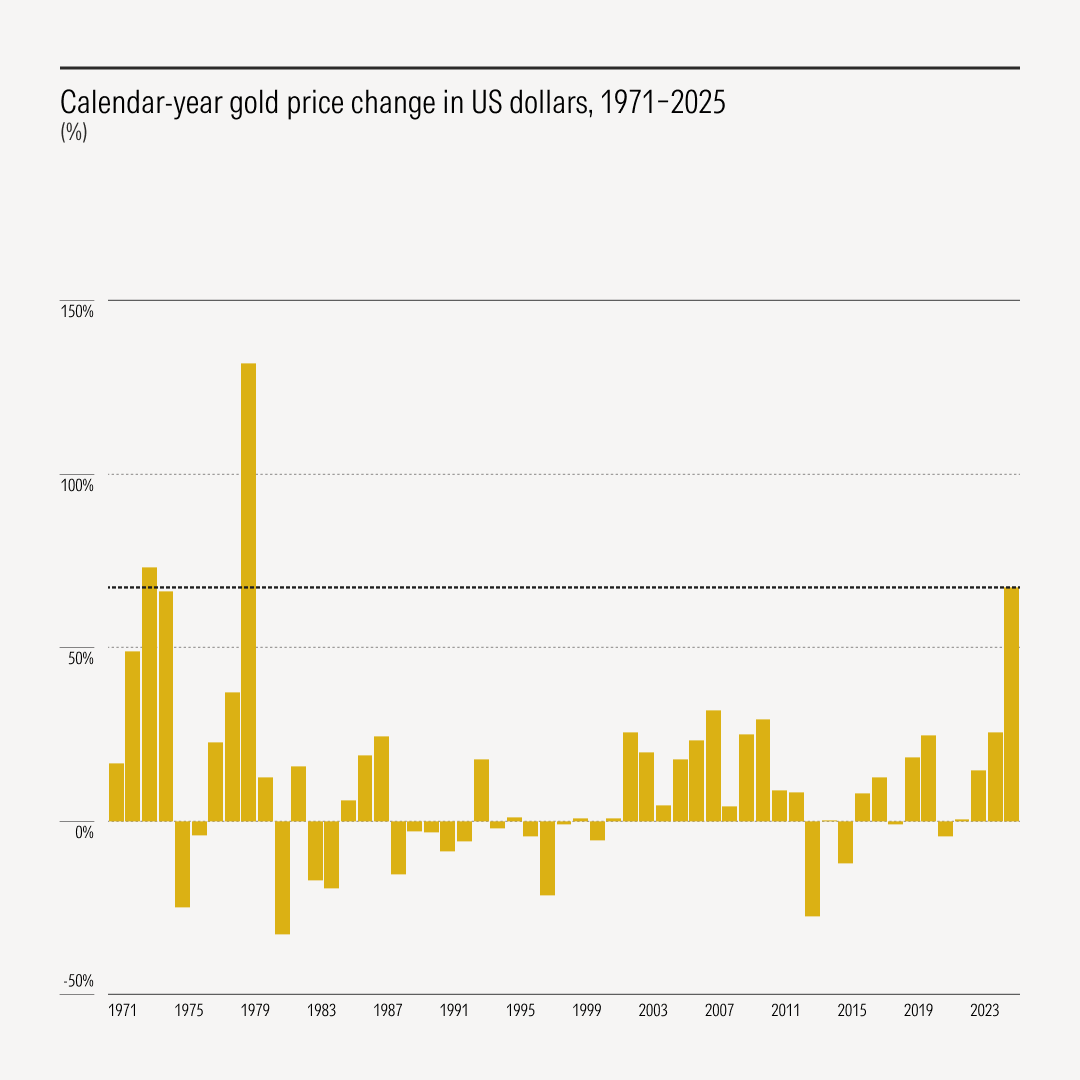
Gold's calendar year increase was its largest since 1979.
Key Trends in the Gold Market
Below we break down the standout year for gold into four major trends.
iShares Remains the Gold Fund Leader
BlackRock-owned iShares entered both the gold equity and bullion markets early—launching its flagship funds in 2001 and 2009, respectively—and remains the largest manager of gold-focused funds and ETFs in Canada.
While the gold equity segment has stayed relatively stable, the bullion market has become more competitive in recent years. New entrants such as BMO, Purpose, and CI have gained meaningful ground by introducing lower-fee funds that have attracted investor assets. You can explore these funds with Morningstar investment research tools.
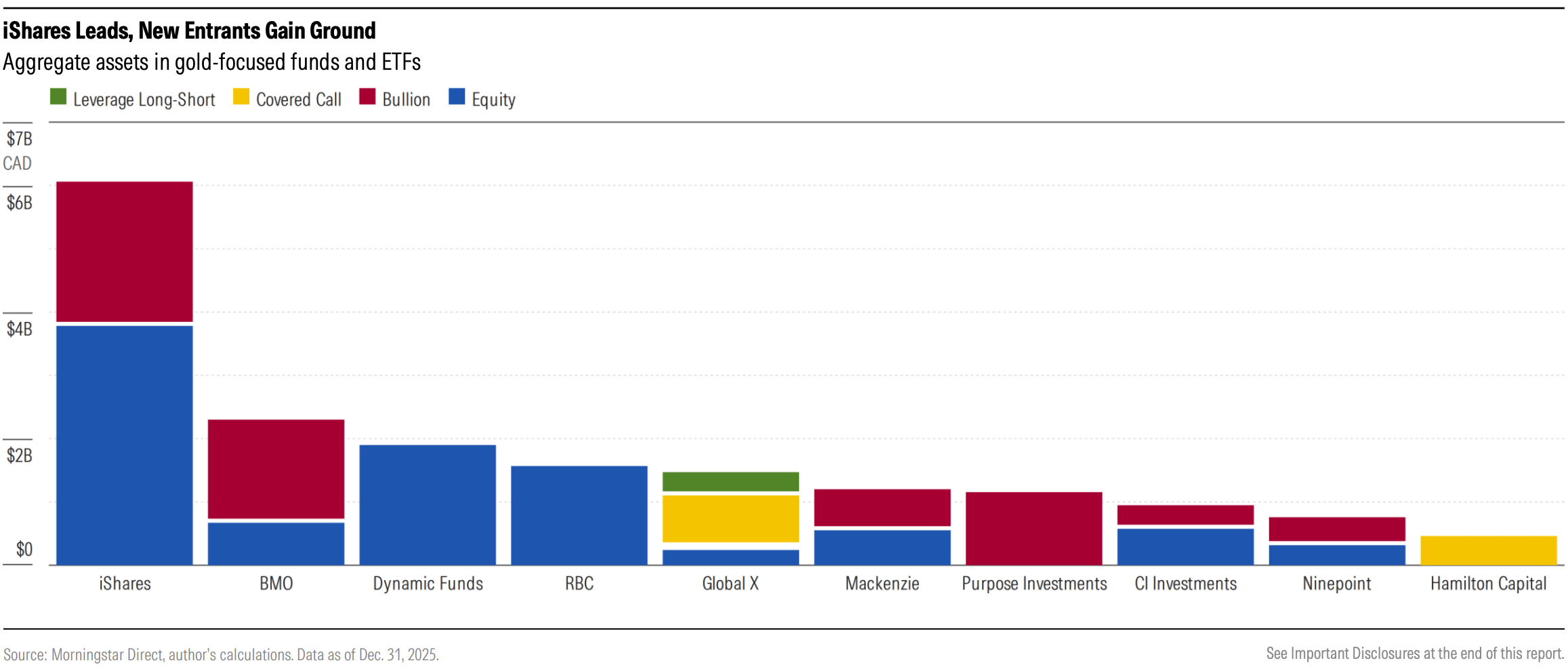
iShares remains the largest manager of gold-focused funds and ETFs in Canada.
Gold Stocks Started and Stayed Expensive
The median Canadian gold stock entered 2025 at Quantitative Price to Fair Value ratio of 1.18, well above the Morningstar Canada Index median of 0.99. This valuation gap widened as the year progressed.
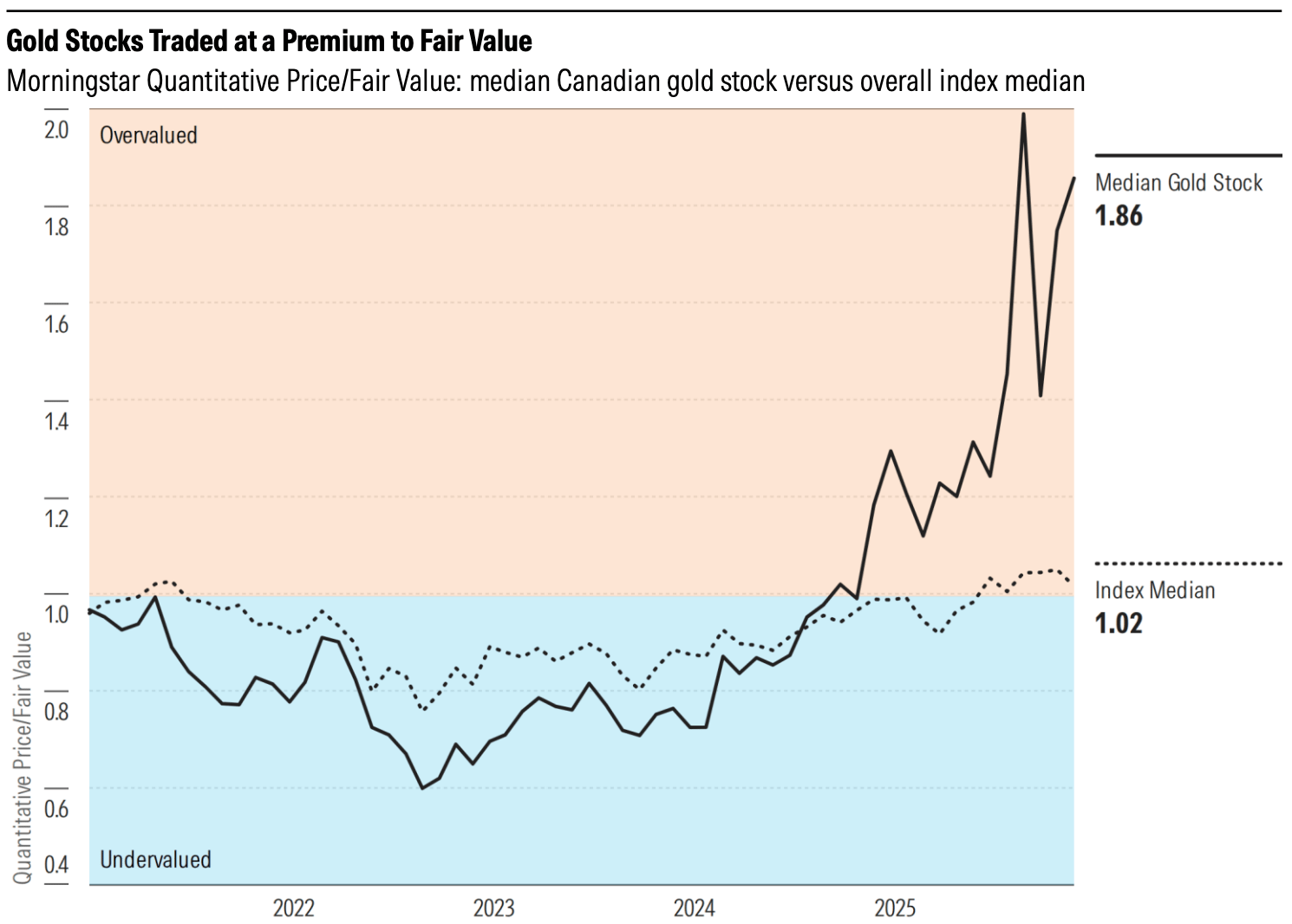
Gold stock entered 2025 looking overvalued and the valuation gap only widened as the year progressed.
Systematic Strategies Followed Price Strength
Momentum-oriented and systematic strategies, which rely on market trends and quantitative signals, tended to maintain or increase their exposure as gold-related names' strength persisted.
These allocations were consistent with their rule-based processes.
Value Sits Out as Valuations Soar
Managers with fundamentally driven, valuation-focused approaches largely viewed gold stocks as expensive and stayed underweight, consistent with their long-term emphasis on margin of safety and earnings durability.
The Benefits and Risks of Gold Exposure
Gold exposure in a portfolio has some key benefits. Given their low correlations with most other asset classes, commodities like gold often stand out as portfolio diversifiers, particularly during bouts of extreme market stress.
Gold should continue to fill a valuable role as a buffer against equity market volatility. The precious metal also has a strong reputation as an inflation hedge, and gold aficionados often point to gold’s ability to hold its value over time. And if you can stomach a little uncertainty, gold could be a potential driver of long-term growth.
In 2024, the LBMA Gold Price PM Index delivered a strong year, outdoing 2023’s 14.6% return with an incredible 25.5% gain. The recent surge in demand is driven partly by geopolitical turmoil. In 2023, demand from central banks increased as some governments opted to diversify away from the US dollar, in some cases prompted by regional wars and conflicts.
These concerns continued into 2024, amplified by the backdrop of the US presidential election. Many anticipated that the Trump administration’s policies would increase debt, which would further weaken the dollar and raise inflation, making gold even more attractive as a safe haven asset. With at least three more years of the Trump administration, the road could be rocky but beneficial to portfolios. Politics aside, there’s always the opportunity cost associated with gold. If the equity market outperforms the commodity, portfolios could miss out on returns.
Financial advisors looking for a conversation starter about risk tolerance and tradeoffs can turn to the Morningstar 2025 Diversification Landscape Report. It covers commodities, like gold, as well as alternative assets, and any others.
How Much of a Portfolio Should Be in Gold?
As with other specialized fund categories, Morningstar’s Role in Portfolio Framework recommends that individual investors keep their gold exposure limited. Morningstar defines “limited” as 15% of assets or less. The Framework also recommends holding gold for at least 10 years. We came up with this guideline partly by looking at the historical frequency of losses over various rolling time periods ranging from one year to 10 years. We also considered how long it usually takes to recover after a drawdown.
But how do you invest in gold? There’s a variety of vehicles investors use to gain portfolio exposure. In additional to investing in physical gold, there’s four main categories of funds. It’s worth noting that Canadian equity funds often already have more exposure than other markets.
Gold bullion funds
Gold bullion funds hold physical gold or track the spot price through futures or other instruments. Bullion funds attracted the most investor interest in 2025, recording net inflows in all but one month of the year and averaging more than CAD 100million in monthly inflows.
Gold equity funds
Gold equity funds invest in companies involved in the exploration, mining, or processing of precious metals, primarily gold. Gold equity and gold bullion funds remain the most established segments in Canada, representing 53% and 39% of total gold-focused fund and ETF assets, respectively.
Gold equity funds experienced minimal net organic growth in 2025.
Gold covered call funds
Gold covered call funds are variants of gold equity funds that write covered call options to generate additional income, appealing to yield-oriented investors. Covered call funds are a smaller but rapidly growing category, supported by recent ETF launches from CI, Global X, Hamilton Capital, and BMO. Covered call gold funds attracted investor flows at a pace similar to bullion funds, though total inflows remained smaller, given their more modest asset base.
Gold leveraged long-short funds
Gold leveraged long-short funds use derivatives to provide magnified, short-term exposure to gold price movements. Leveraged long-short funds hold the smallest share of gold-focused assets. They are typically used for short-term tactical positioning or hedging rather than long-term allocations.
Leveraged long-short gold funds were the only category to post net outflows for the year. However, longer-term net-flow figures are less meaningful for these funds because their short-term focus leads to frequent, often sizable shifts in investor flows.
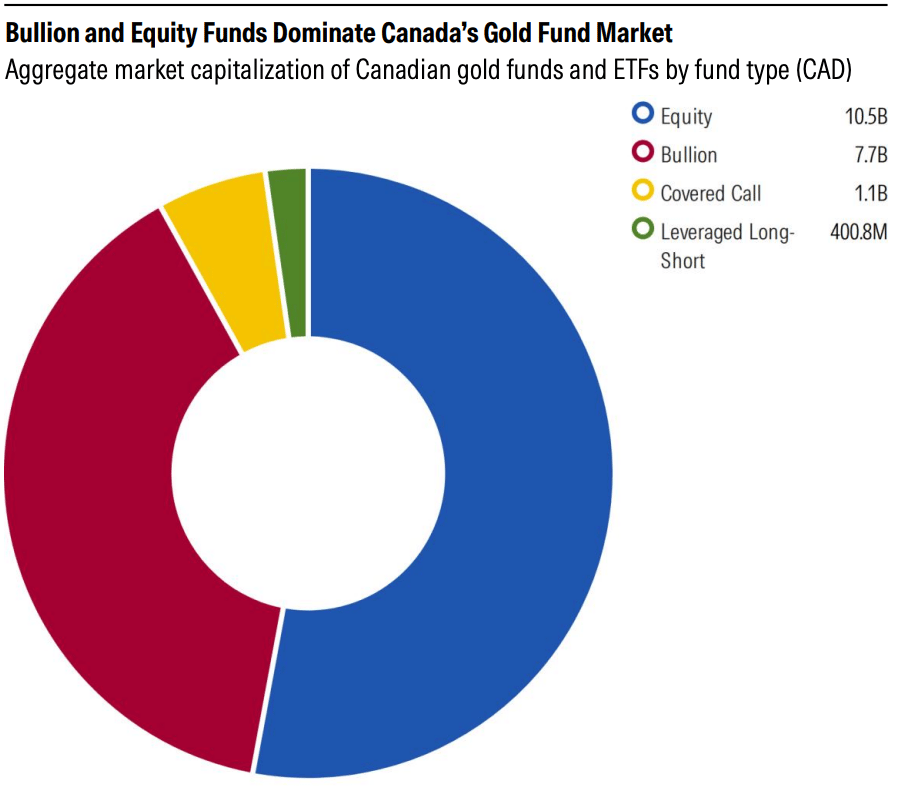
Gold equity and gold bullion funds remain the most established segments in Canada, representing 53% and 39% of total gold-focused fund and ETF assets, respectively.
A Case Study in Market Structure
Gold's rise in 2025 was unusual in terms of both magnitude and stability. Using data going back to 1969, gold prices have delivered larger returns in only two years—1973 and 1979—and both of those years saw more-volatile ups and downs in the metal's price than 2025. Over the medium to long term, historical patterns would suggest an eventual period of consolidation or pullback. However, it's difficult to know when that might happen. Wide variation in the magnitude and length of prior gold cycles makes forecasting inherently hard.
Rather than forecasting what comes next in 2026, gold’s standout year is most useful as a case study. It highlights broader lessons about market structure and underscores the value of knowing what you own and how it can affect your portfolio's results.
Download the full report, Canada’s Golden year, for more robust commentary and analysis from the Morningstar Manager Research team.