
Why Are These Big Index Funds Underperforming?
Vanguard Total Market Index, Vanguard Short-Term Corporate Bond ETF, and iShares iBoxx $ Investment Grade Corporate Bond ETF among the laggards.


This article mentions funds that have an issuer-initiated rating and/or track a Morningstar Index. For full disclosure information, please refer to the specific funds, which are demarcated with a * symbol, listed below.
The past year has been a difficult one for investors in both actively managed funds and those tracking indexes. But in a change from recent years, many of the largest stock and bond index funds have underperformed.
Of the 10 largest stock index funds, nine landed in the bottom half of their Morningstar Categories in 2022, compared with just one underperforming in 2020 and 2021. While six of 2022′s underperformers lagged their average category peers by just a small amount, three of these strategies landed in the bottom 25% of all funds. Among the bottom performers: S&P 500 funds and Vanguard’s Total Stock Market Index.
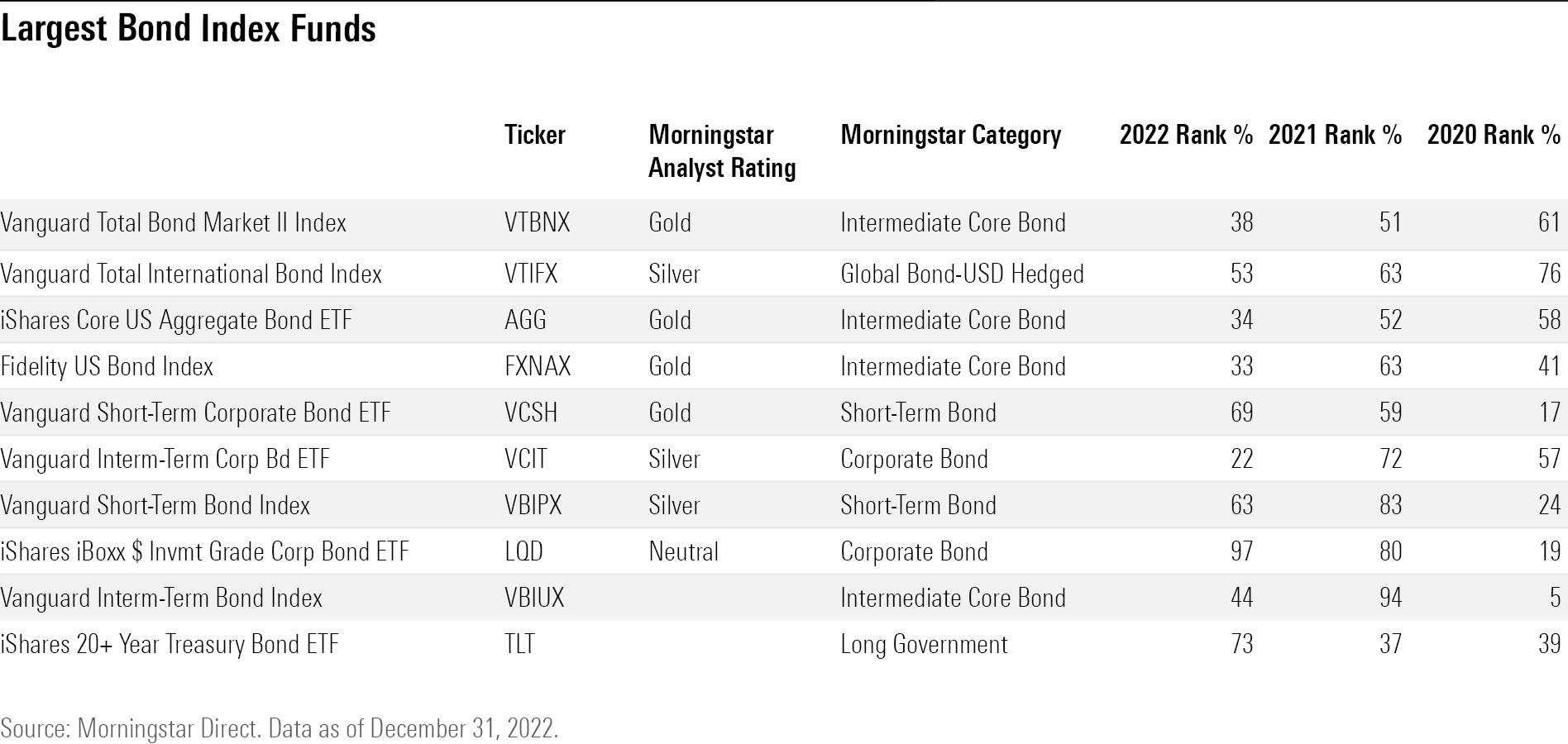
It was a more nuanced story among the largest index-tracking bond funds. In 2022, five of the 10 largest bond index funds were in the bottom of their categories. That was actually an improvement over 2021, when nine of the 10 largest funds lagged their average category peers. But it was a worse showing than in 2020, when only four were among the bottom performers.
To be sure, these returns reflect short-term performance. “Over the long term, passive funds gain an advantage by providing broad diversification, and their low-fees more often than not lead to strong performance,” says Morningstar’s director of passive strategies Bryan Armour.
Why Big Stock Funds Are Lagging
The most widely owned stock index funds are built using indexes where the weights of each stock in the portfolio are determined by the market cap of the stock. The result is that the largest stocks can have an outsize impact on performance.
In 2020 and 2021, that worked in favor of many stock index funds, thanks to the strong performance of mega-cap stocks such as Tesla TSLA, Facebook parent Meta Platforms META, and Google parent Alphabet GOOGL. In 2020, the five largest stocks contributed 37% of the U.S. stock market’s 20.9% return.
In 2022, interest rates surged and those same stocks suffered losses far worse than the overall market. Other sectors outperformed the market, most notably energy stocks, which have had smaller weights in most index funds after years of poor performance. Against this backdrop, the advantage these stock index funds had possessed in recent years dissipated.
“Active funds, by nature, have more opportunity to get out earlier in a falling market because index funds adhere to a set schedule for rebalancing the weights of their holdings. But market-timing is very difficult—active managers don’t have a crystal ball,” says Armour. Active funds also can have an advantage in down markets because they have the option to hold cash. “In rising markets this is a ‘cash drag,’ but in down markets it can become a ‘cash boost,’” says Armour.
Which Stock Index Funds Lagged?
Funds that track the S&P 500, including the $352.8 Fidelity 500 Index FXAIX and $369.5 billion SPDR S&P 500 ETF Trust SPY, lost around 18%, which put them in the 51st percentile in the large-blend category.
Funds that track the overall stock market fell slightly more in 2022.
The $271.0 billion Vanguard Total Stock Market Index VSTSX lost 19.5%, putting it in the 74th percentile in the large-blend category.
One key difference between broad market funds and S&P 500 trackers is that stocks must pass a profitability screen to be included in the S&P 500. “This can be a ballast during a down market,” says Armour.
Additionally, Vanguard Total Stock Market Index’s holdings in the healthcare and technology sector fell further than those in the S&P 500, according to performance attribution analysis from Morningstar Direct. Vanguard Total Stock Market Index also suffered from exposure to smaller stocks owing to the fund’s broader mandate.
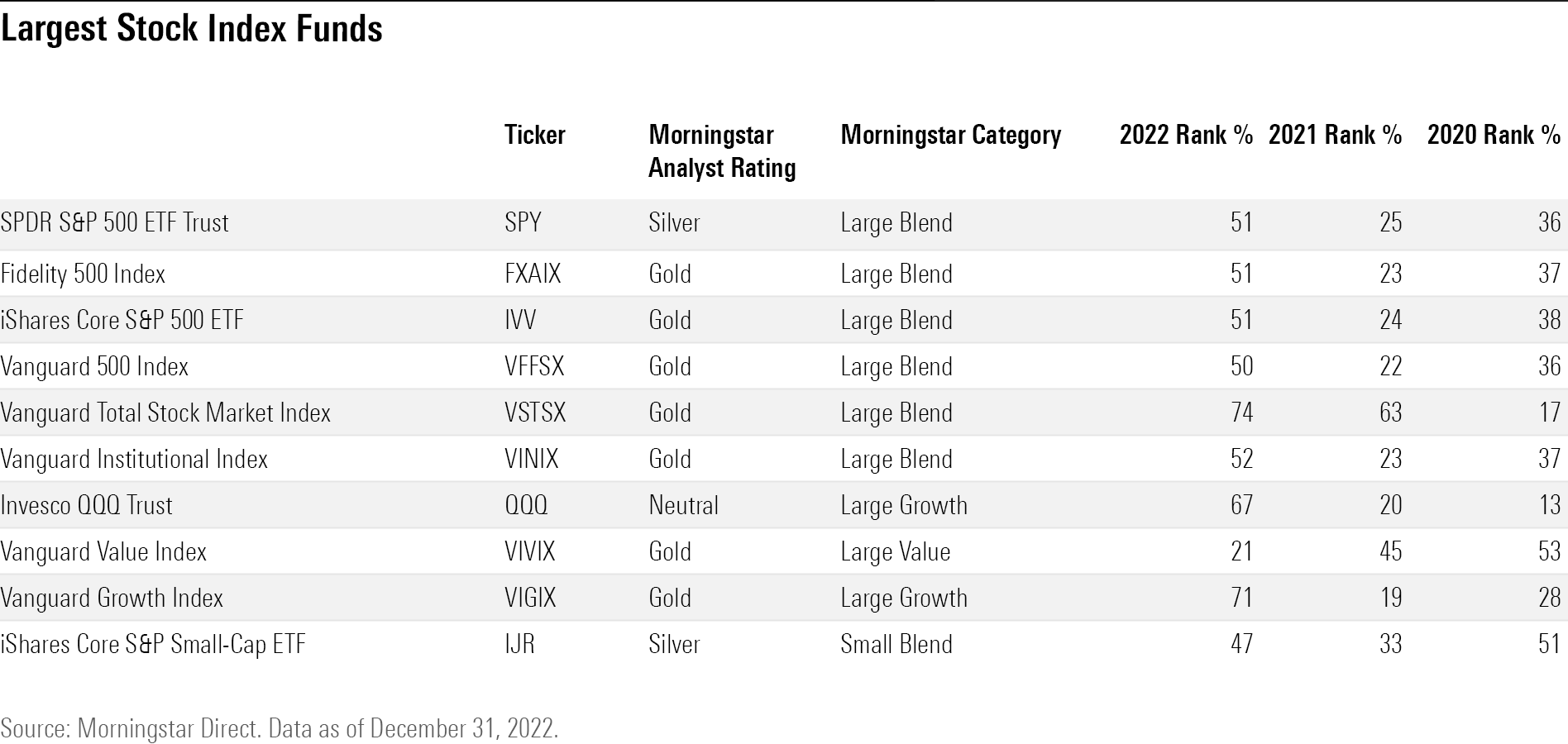
The $150.2 billion Invesco QQQ Trust QQQ landed in the top quintile of large-growth funds in 2020 and 2021, bolstered by large stakes in fast-growing tech firms. More than half the portfolio is invested in tech and communication sector companies, more so even than the average large-growth fund. In 2022, QQQ lost 32.5%, putting it in the 67th percentile. ”A 100-stock ceiling and market-cap weighting make this a top-heavy portfolio. Piling into the market’s hardest hitters has paid off over the past 15 years, but broad diversification is more attractive in the long run,” writes analyst Ryan Jackson.
Underperforming Bond Index Funds
It wasn’t quite as bad a picture for the largest passive bond funds in 2022. However, there were still a few significant laggards
The $38 billion iShares iBoxx $ Investment Grade Corporate Bond ETF LQD was one of the worst funds in the corporate bond category in 2022. With an 18% decline last year, 85 of 89 corporate bond funds posted better returns than the iShares ETF. The average corporate bond fund lost 15.2% in 2022.
The fund’s struggles in 2022 can be attributed to the fact that its portfolio duration is longer than the average corporate bond fund, meaning it’s more sensitive to changes in interest rates. This has hurt the fund, as the Fed raised rates at an unprecedented pace over the course of the year.
It’s been a tough stretch for LQD. Last year’s dismal showing meant the fund landed in the bottom 20% of the corporate bond category for the second consecutive year.
The same dynamic hurt the largest inflation-protected bond fund. The $23.5 billion iShares TIPS Bond ETF TIP lost 12.1%, while the average fund in the category declined only 9.0%. TIP tracks the Bloomberg US Treasury Inflation-Protected Securities Index, which carried an average effective duration of 6.79% as of November 2022, writes associate analyst Mo’ath Almahasneh. That compares to a category average of 5.3 years.
However, iShares is switching the fund to a different benchmark, the ICE US Inflation Linked Treasury Index, at the end of January. The new index will carry a shorter duration of 5.97 years.
Two of Vanguard’s short-term bond funds also ended up in the bottom half of the short-term category. The $41 billion Vanguard Short-term Corporate Bond ETF VCSH and the $38.2 billion Vanguard Short-Term Bond Index VBIPX follow indexes with slightly more interest-rate risk than other funds in the category. For both, 2022 marked the second consecutive year of underperformance.
The author or authors own shares in one or more securities mentioned in this article. Find out about Morningstar’s editorial policies.

 United States