
Why Are So Many Quality Funds Falling Behind?
It’s been an unusually tough stretch for funds that emphasize quality.

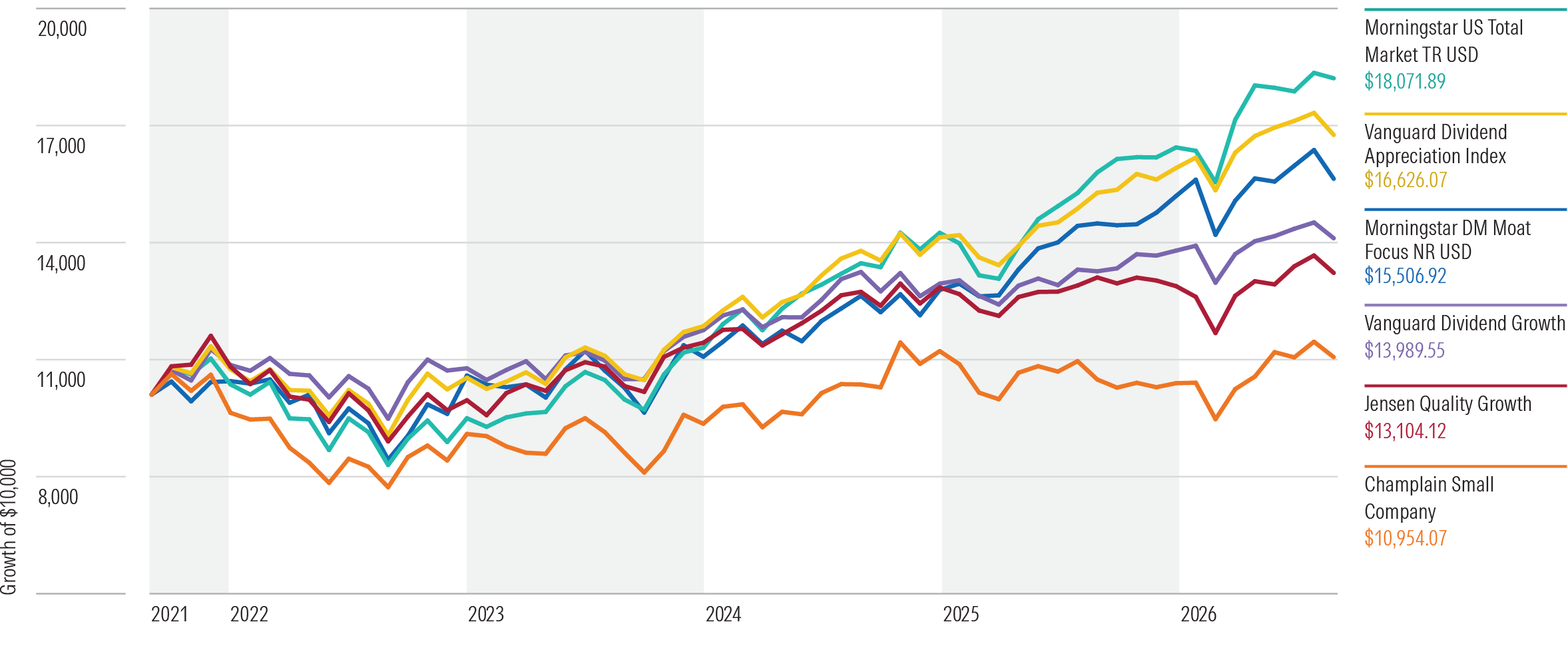
Vanguard Dividend Growth VDIGX has had a rethink. Over the past five years through September 2026, the fund gained a cumulative 40%. That sounds OK, except the Morningstar US Total Stock Market Index gained over 81% during that time.
Subadvisor Wellington Asset Management was well aware of the underperformance and changed the fund’s manager and strategy in July 2026. It was a surprising turn of events for a fund that Morningstar analysts have long admired and Vanguard investors have embraced. Wellington named Tim Casaletto and Tom Levering to take over for Peter Fisher, who had succeeded Don Kilbride in 2024.
But maybe there was something wrong with Wellington’s approach to dividend growth. Casaletto and Levering are making changes. They are more willing to own cyclical firms, which their predecessors avoided to emphasize durable cash flows. They are also relaxing the requirement that portfolio holdings pay and increase a dividend. The reset led us to lower our People and Process ratings to Average.
These changes are a window into the crisis at quality-oriented funds. Some have a dividend-growth mandate, and others are labeled “quality growth,” but they fish in similar waters. Quality companies generally have wide moats, meaning they have certain advantages that are difficult for competitors to penetrate, such as Coca-Cola’s KO great brand, Microsoft’s MSFT strong embedded positions in the corporate world, and Bristol-Myers Squibb’s BMY patent protections and drug pipelines.
Quality companies also have strong recurring cash flows and high credit ratings; many steadily raise their dividends. Thus, a dividend-appreciation fund will own lots of quality companies even if that’s not the nominal goal, and a quality-growth fund will have lots of rising-dividend stocks even if that’s not its focus.
Quality stocks are better protected from recessions and thus have strong defensive characteristics, but the premium you must pay for them can reduce the return potential. In the current economy and market environment, you wouldn’t expect quality stocks to be top gainers, but it’s shocking to see just how much they have lagged.
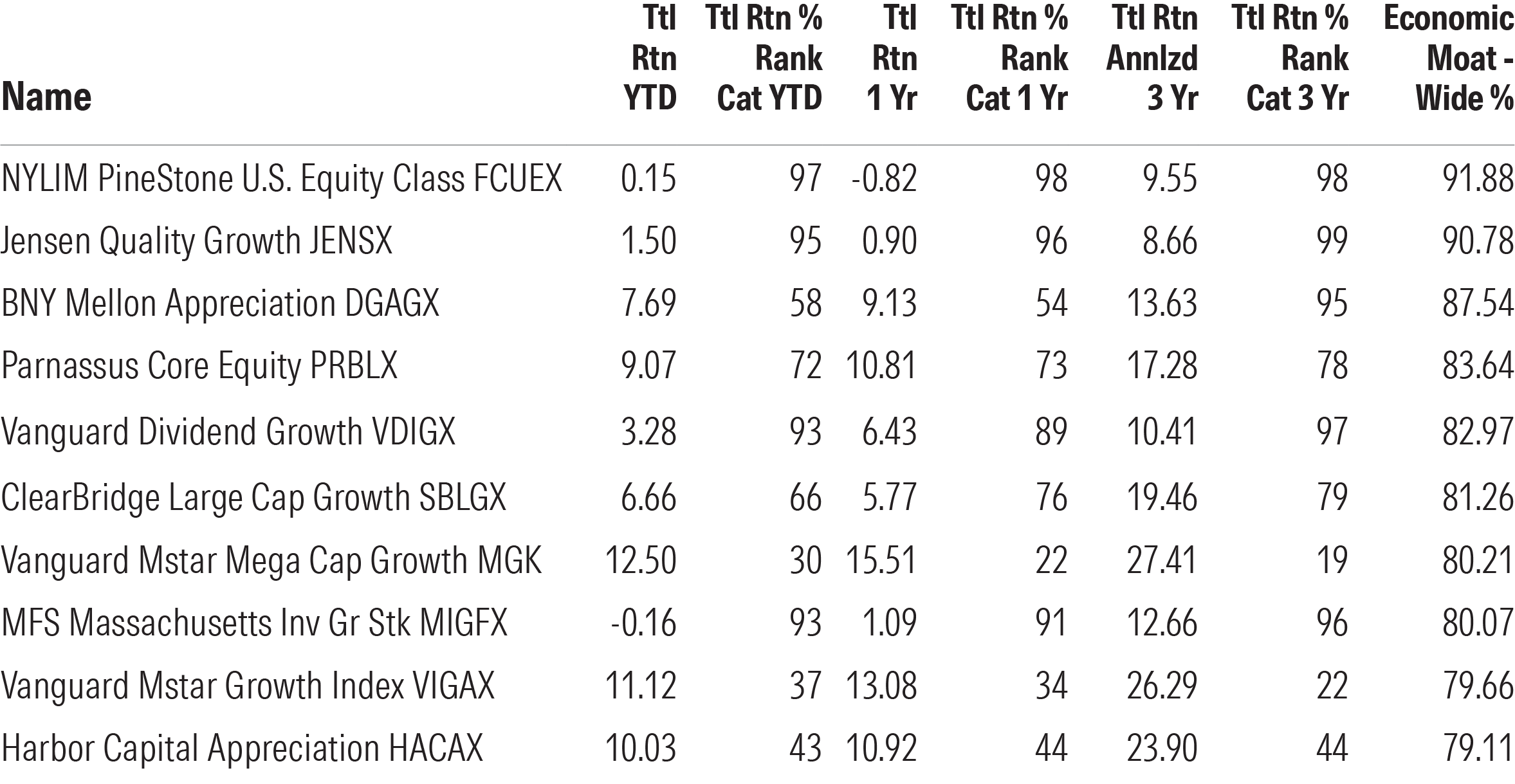
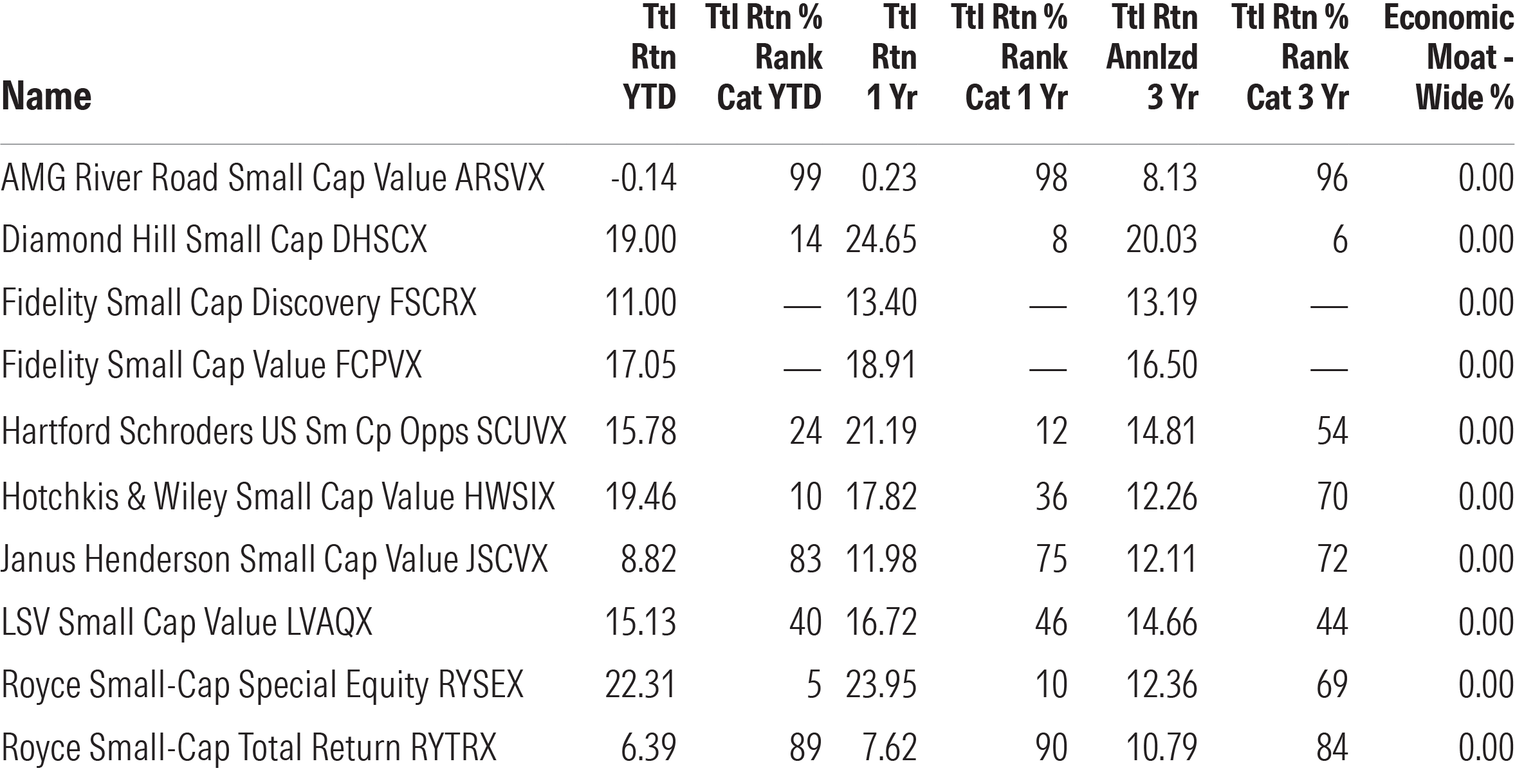
The 10 mutual funds and exchange-traded funds in Morningstar FundInvestor with the highest percentage of wide-moat stocks were up an average of just 6% for the year to date through September 2026, compared with 14% for those with the lowest percentage.
Returns of the 10 Funds With the Most Money in Wide-Moat Stocks
Returns of the 10 Funds With the Least Money in Wide-Moat Stocks
In this market, artificial intelligence-related businesses have put up remarkable growth—and they have inspired predictions about the amazing (and horrible) things this technology might achieve. A number of AI plays have wide moats and could be considered quality by many standards. In fact, Harbor Capital Appreciation HACAX is thriving with a high number of wide-moat stocks, such as Nvidia NVDA, Apple AAPL, and CrowdStrike CRWD.
But many of our favorite quality funds have been left in the dust. As implied by the changes at Vanguard Dividend Growth, dividends are one thing that has tripped up quality funds. Many of the fastest-growing companies leading the market have no dividends or tiny ones. Thus, Vanguard Dividend Growth’s managers want to have at least a little exposure to them. Valuations or a desire for steady cash flow growth have held others back, as the winning tech companies trade at stretched valuations, and investors have focused on high revenue growth rather than steady cash flow growth. Fears that AI would encourage software users to use agents to write their own code rather than pay licensing fees to others for their programs also hurt quality funds this year. Software licensing revenue, once considered steady and sticky, is just what quality investors look for, but AI made that revenue look less recurring. Hedge funds started buying AI plays and shorting software stocks, and a rout was on. Software has rebounded recently, but it’s still been a brutal year.
Jensen Quality Growth JENSX had a five-year cumulative return that was 9 percentage points behind Vanguard Dividend Growth. Yes, the fund owns tech giants, but names like Sherwin-Williams SHW, Marsh MRSH, and Mastercard MA have held it back. Poor performance spurred sizable outflows, and the firm is down to one-third of the assets it managed in 2021. As a result, Jensen cut staff by 28%; some investment professionals left voluntarily. The fund’s process hasn’t changed, but the signs of decline and sluggish results have led us to downgrade our Parent and People ratings to Average. (I’ve been cutting my position in Jensen as the fundamentals have declined.)
Another 21 percentage points behind Jensen was Champlain Small Company CIPSX with five-year cumulative returns of just 9.5%, or 1.8% annualized. Assets at the firm have fallen to $3.8 billion from $22 billion in 2021. At the end of 2025, co-CIO Corey Bronner and tech analyst Andrew Hanson departed, and Champlain said they wouldn’t be replaced. We lowered our Parent rating to Average from Above Average, and the Process and People ratings fell to Above Average from High.
Notably, the passive side of quality hasn’t been as bad. Vanguard Dividend Appreciation Index VDADX was 14 percentage points behind the total market, but its 66% cumulative gain landed only in the third quartile for the trailing five years. Pharmaceutical stocks and energy stocks that are underrepresented in the active quality funds provided solid gains. The poor results of the three active funds I highlighted illustrate all the land mines surrounding quality funds.
How Quality Has Fallen Behind the Rest of the Market
What’s Next?
I’ve seen other market factors fall painfully out of sync with the market before. In 2008-09, deep-value stocks were punished because of a severe financial recession. Financial stocks got barbecued, and so did economically sensitive stocks and just about anything with a fair amount of debt, as investors worried that no one would lend to those companies again. From Jan. 1, 2007, to Feb. 28, 2009, Hotchkis & Wiley Mid-Cap Value HWMAX lost 63% of its value. But from March 1, 2009, to March 31, 2011, the fund gained a cumulative 185%. Ariel ARGFX, which isn’t a deep-value fund but had companies with plenty of debt, lost 62% of its value from January 2007 through February 2009, then rebounded a cumulative 202% from March 1, 2009, to March 31, 2011.
Such a turnaround would be the absolute best-case scenario for quality funds. But quality outperforms in down markets, so it’s possible that quality regains its edge by losing less in the next bear market. Capital preservation is vital, but obviously that’s not as exciting to investors as the idea of triple-digit gains. On the downside, what if the fears of AI eating software companies’ lunch are realized and profit margins are compressed? Then maybe quality has a prolonged slump ahead, and we’re only halfway through it.
Choose Your Champion
As Champlain and Jensen cut staff, the best play may be the super cheap Vanguard Dividend Appreciation Index and other passive quality funds. No worries about staffing there. And our Morningstar Medalist Ratings back this up. We have a Gold rating on Vanguard Dividend Appreciation Index compared with Bronze for Vanguard Dividend Growth and Neutral for the Champlain and Jensen funds.
Then again, in the deep-value snapback, it was the funds punished the most that rebounded most strongly. That would suggest Champlain and Jensen are the bets to make. This would also be a wager on the asset management firms themselves rebounding. A big recovery for quality would certainly be a boost for the fund companies, but a prolonged quality drought would add to the strain.
Instead, you could compromise between the low fees of passive funds and the appeal of active funds. If you think that Wellington is on the right path in tweaking its definition of quality, then low costs make Vanguard Dividend Growth the optimal turnaround play.
Load for Bear Market
Markets are hard enough to predict in normal times. Guessing where AI will take quality stocks seems extra hard. That’s why you want exposure to quality. Even if you change your mind about the quality fund you own, it’s wise to be sure you have some exposure for the next bear market.
This article first appeared in the October 2026 issue of Morningstar FundInvestor. Return figures in this article are through September 2026. Download a complimentary copy of FundInvestor by visiting this website.
The author or authors own shares in one or more securities mentioned in this article. Find out about Morningstar’s editorial policies.

 United States