
The Thrilling 37
Just a few strict screens can narrow the field to an elite group of funds.


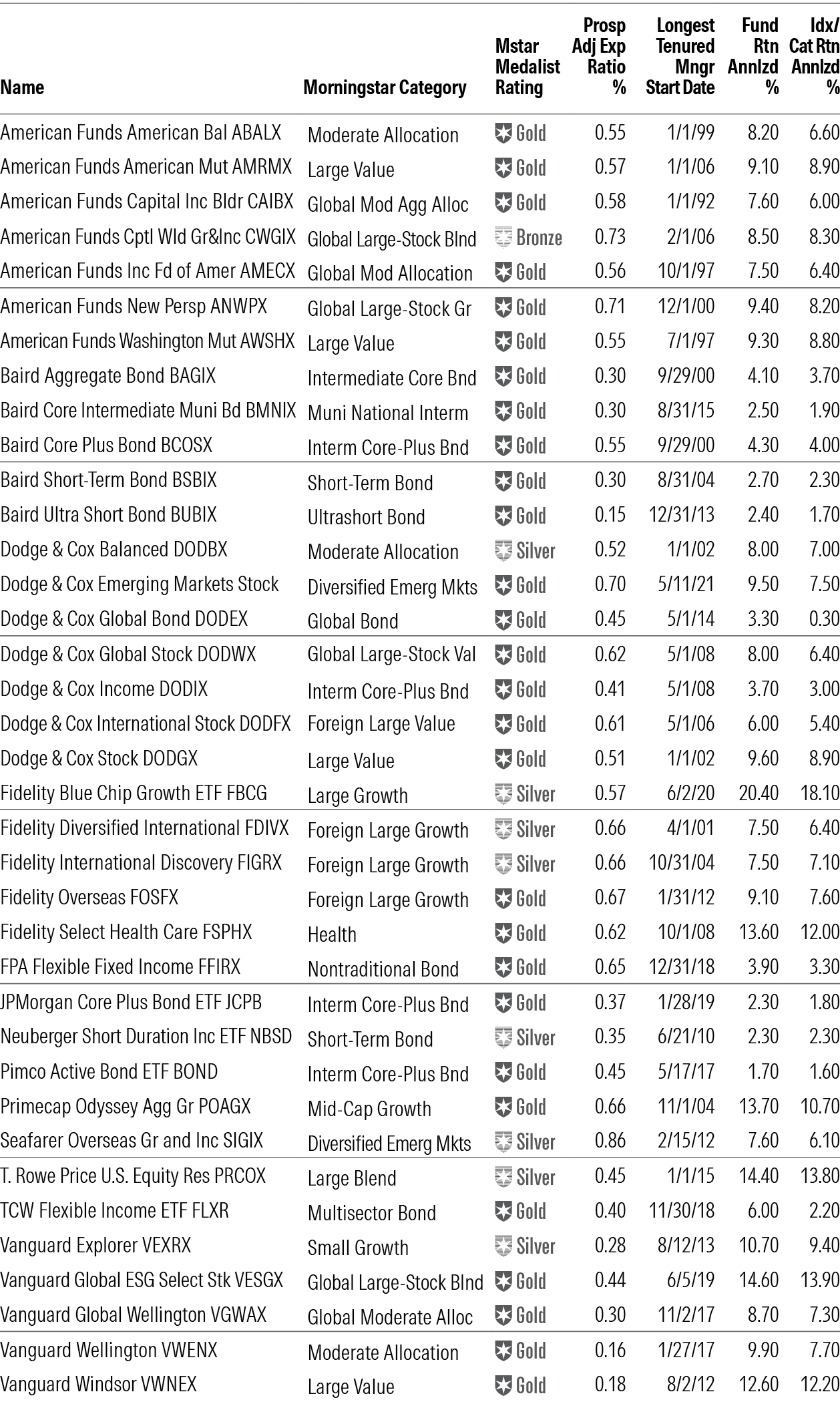
It’s time once again for the Thrilling 37. As you may recall, this is a list I generate with simple, strict criteria to narrow a universe of thousands of fund share classes down to a short list ranging between 25 and 50. It’s purely a screen; I don’t make any additions or subtractions. One change this year: I’m including exchange-traded funds.
With so many funds out there, you can be choosy. It’s better to set high standards on the most important factors than to screen on minor data points. I emphasize fees, Morningstar Medalist Ratings, long-term performance, and fund company quality.
I also throw out funds with Morningstar Risk ratings of High because investors have a hard time using the most volatile funds well: They’re hard to hold on to in downturns and tempting to buy after they’ve already rebounded from past lows.
The Morningstar Risk measure is relative to peers, meaning there are emerging-market funds with Low risk ratings and short-term bond funds with High risk ratings. It tells you about relative risk, not absolute risk. Specifically, it tells you about downside volatility over the trailing three, five, and 10 years.
Here are the tests:
- Expense ratio in the open-end Morningstar Category’s cheapest quintile. (I use the prospectus-adjusted expense ratio, which includes underlying fund fees but does not include leverage and shorting costs.)
- Manager investment of more than $1 million in the fund (the top rung of the investment ranges reported in SEC filings).
- Morningstar Risk rating lower than High.
- Morningstar Medalist Rating of Bronze or higher.
- Parent Pillar rating better than Average.
- Returns greater than the fund’s category benchmark over the manager’s tenure for a minimum of five years. In the case of allocation funds, I also used category averages because benchmarks are often purely equities or bonds and therefore not good tests.
- Must be a share class accessible to individual investors with a minimum investment of no greater than $50,000.
- No funds of funds.
- Morningstar analysts must rate the funds.
There’s a simple tool on the Morningstar FundInvestor site called FundInvestor Selector that lets you enter a ticker and see how your fund stacks up on the tests plus the People rating. This year, we have 37 funds, including five ETFs. Seven funds dropped off last year’s list of 33. That means 11 of the 37 funds were not on the 2025 list.
American Funds Capital World Growth and Income CWGIX has enjoyed a strong 18 months of performance and slightly lower fees, and that’s enough to get the fund on the list. The return improvement means the fund’s 20-year returns, which include the longest-serving manager Sung Lee’s tenure, are now ahead of peers. Four of the fund’s managers have more than $1 million invested in the fund, and they have done a fine job balancing its income and capital appreciation goals.
Dodge & Cox Balanced DODBX reflects the depth of Dodge & Cox. The firm does outstanding stock and bond investing with a large, experienced cadre of analysts and managers. Remarkably, every Dodge & Cox fund qualified for the Fantastic list.
Dodge & Cox Emerging Markets Stock DODEX shows the firm can adapt to its environment. It already had robust coverage of developed markets but wanted more names to build a diversified emerging-market fund. So, Dodge & Cox built up its quantitative effort to identify more emerging-market companies that fit its house value approach. The results have been outstanding.
Fidelity Blue Chip Growth FBCG is our first ETF to make the grade. Investments in artificial intelligence have driven the fund’s impressive five-year returns. Manager Sonu Kalra’s focus is on growth potential, and he doesn’t mind paying high prices for current earnings if companies can grow into them. The mutual fund, which has a longer record, did not qualify for our list because it has a High risk rating, whereas the ETF’s is Above Average.
With few constraints and no set benchmark, FPA Flexible Fixed Income’s FFIRX goal is to produce a positive absolute return over trailing three-year periods while beating inflation by 200 basis points over five years. So, while those targets—and a risk-sensitive culture at First Pacific Advisors—make it unlikely to go to extremes, the strategy’s only constraint on interest rate risk, as measured by duration, is to stay positive. It can also hold up to 75% of assets in debt rated BBB or lower.
FPA has run this fund’s sibling, FPA New Income FPNIX, with great long-term success. This fund has more flexibility but shares much of its sibling’s style and process.
JPMorgan Core Plus Bond ETF JCPB is a real bargain for an expense ratio of just 0.37%. A deep team runs the strategy that aims to outperform the bond market by taking on a little more credit risk and making top-down calls on interest rates and sectors. Securitized debt looms large here. Agency mortgage-backed securities typically account for about half of the 35% to 50% in securitized assets. The fund has topped peers and the benchmark over the trailing five years.
Neuberger Short Duration Income ETF NBSD embraces more risk than its peer FPA Flexible Fixed Income. Converted from a mutual fund in 2024, the ETF owns more high-yield and securitized bonds than peers, which boosts both income and risk.
Pimco Active Bond ETF BOND is not a clone of Pimco Total Return PTTRX. It has different managers and focuses on income rather than total return. That said, the team running the fund is in the firm’s total-return group and owns some of the same things that Pimco Total Return owns. The fund is somewhat cautious, making fewer currency bets than its sibling, and is restrained with high yield. It does own a fair amount of securitized debt, though. (I own the open-end fund in my 401(k).)
T. Rowe Price U.S. Equity Research PRCOX is an unlikely fit for this list. The fund keeps its sector allocations in line with its benchmark and tries to beat it by giving analysts buy/sell power within their industries. In most years, the fund’s returns are within 100 basis points of its index, but the analysts have logged enough wins to pull ahead over time.
TCW Flexible Income ETF FLXR began as an open-end fund in 2018 and converted to an ETF in 2024. In both forms, it has outperformed its multisector income peers by a wide margin. However, it will be hard for the fund to repeat its exceptional performance as it made bold bets on small-scale interest-only securities that it couldn’t do today at its larger size.
Vanguard Global ESG Select Stock VESGX has beaten its benchmark by a modest amount over Yolanda Courtines’ seven-year tenure. Courtines and her Wellington colleague Samuel Cox look for good stewards capable of generating strong returns on capital. Taiwan Semiconductor Manufacturing TSM, Microsoft MSFT, and Visa V top their portfolio. The fund is putting up excellent returns in 2026.
Who Fell Out?
Here’s a quick look at which funds from last year’s list fell out and why.
American Funds New Economy ANEFX lagged its benchmark by just a few basis points.
Fidelity Contrafund FCNTX dropped because its expense ratio is now just over the line, and manager Will Danoff is retiring.
Fidelity Total Bond FTBFX continues to perform well, but its expense ratio fell out of the cheapest 20%.
Meridian Growth MERDX was dropped from coverage, but it also failed the expense ratio and returns tests.
Vanguard Capital Opportunity VHCAX, Vanguard Primecap VPMCX, and Vanguard Primecap Core VPCCX are having a great year, so they didn’t fail the returns test. All three clocked in with a Risk rating of High, so out they go. (I own Vanguard Capital Opportunity and Vanguard Primecap Core.)
The Thrilling 37
Additional Ownership Disclosure
Besides the funds mentioned above, I also own American Funds Washington Mutual AWSHX, Dodge & Cox International Stock DODFX, and Primecap Odyssey Aggressive Growth POAGX.
The author or authors own shares in one or more securities mentioned in this article. Find out about Morningstar’s editorial policies.

 United States