
How Retirees Can Determine a Safe Withdrawal Rate in 2025
Four ways to improve your retirement plans using Morningstar’s income research.


The headline safe withdrawal rate from Morningstar’s 2024 retirement income research was dispiriting: We pegged 3.7% as a baseline safe starting withdrawal percentage for people who are just embarking on retirement.
Does that mean all retirees should automatically adjust their withdrawals to 3.7% for 2025? Definitely not. While we’ve been revisiting this research annually, we’re not suggesting that the retiree who followed our 2021 research would take a 3.3% withdrawal in 2022, 3.8% in 2023, 4% in 2024, and 3.7% for the year ahead to reflect each edition’s finding.
Ratcheting spending up or down in line with Morningstar’s latest recommendations is apt to introduce more volatility into retirees’ cash flows than they’re likely to find acceptable. Rather, our base case assumes that the retiree withdraws a given percentage at the outset of retirement—say, $33,000 on a $1 million portfolio at the beginning of 2022—and then inflation adjusts that dollar amount or uses some other method to adjust subsequent expenditures thereafter. A $33,000 withdrawal at the beginning of 2022, for example, would be $35,145 at the beginning of 2023, factoring in 6.5% annualized inflation in 2022, and $36,340 at the beginning of 2024, incorporating 2023’s 3.4% inflation rate.
Nor should this research be construed as a market call. While it does embed Morningstar Investment Management’s capital markets assumptions, the team’s forecast is long term, and we use an even longer, 30-year horizon for our spending simulations. Even though the highest safe spending rate for our base case corresponds with a portfolio with just 20% to 50% in stocks, that’s an outgrowth of the very conservative spending system that underpins the base case.
Instead, the research might be the most valuable to investors and their advisors in the following situations.
Use Case 1: As a Temperature Check
Because our research employs forward-looking inputs for stock and bond market returns and inflation, it can guide how aggressive or conservative retirees might be with their withdrawals in the near future. When our base case starting withdrawal percentage was just 3.3% in late 2021, for example, that was a signal to retirees to be prepared to tap on the brakes with withdrawals; bond yields were ultralow, and equity valuations were high. And indeed, caution on portfolio withdrawals was valuable in 2022 as both the stock and bond markets sold off. Retirees who could get by on less benefited by leaving more assets in place to rebound when stocks and bonds recovered in 2023. Our 2023 research, by contrast, pointed to a more normal starting withdrawal percentage of 4% as sustainable over a 30-year period, thanks in large part to higher fixed-income yields/return prospects and moderating inflation. Our 2024 research suggests caution once again, as equity valuations look a bit high.
As retirees and their advisors consider more cautious or generous withdrawal percentages, it’s also valuable to remember the interplay between actual portfolio values and withdrawal amounts. Balanced stock/bond portfolios dropped by about 17.0% in 2022, so our 3.8% safe withdrawal recommendation in late 2022, while a higher percentage than the year before, corresponded with a lower portfolio balance, and in turn, withdrawal amount, for most investors. By contrast, this year’s 3.7% withdrawal percentage is apt to look better on a dollar basis, given that portfolio values have generally increased for two years running. In other words, it’s not the percentage that matters to retirees; it’s the dollar amount.
Use Case 2: To Depict the Interplay Between Age and Spending
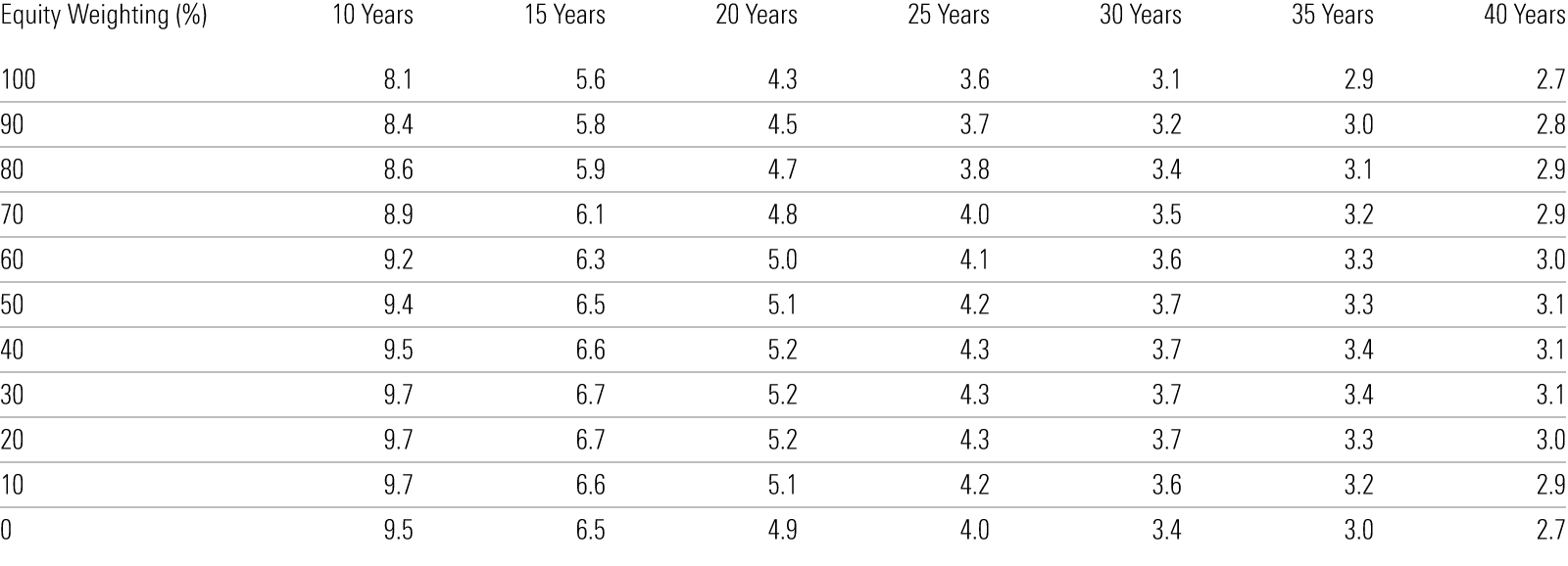
Additionally, the research illustrates how age influences safe spending rates. All else being equal, safe spending rates may increase with age. While our base case simulation assumes a 30-year spending horizon and therefore is best suited to new, traditional-age retirees, the research can also provide a valuable spending check for people who have been retired for several or more years. While many retirees anchor on the “4% rule,” our research shows that older retirees with shorter time horizons can reasonably spend more as they age.
As shown in the table below, a retiree with a 20-year anticipated time horizon/life expectancy (rather than 30) can reasonably spend more than 5% of a balanced portfolio, with that dollar amount inflation-adjusted thereafter. Meanwhile, the retiree with a 15-year spending horizon could reasonably spend nearly 7% of their portfolio, with that dollar amount inflation-adjusted thereafter. By contrast, early retirees will want to keep caution in mind when calculating a safe starting withdrawal percentage, assuming our “base case” spending system. For example, in our base case, the highest starting safe withdrawal percentage for a 40-year horizon is just 3.1%.
30-Year Starting Safe Withdrawal Rate %, by Asset Allocation, 90% Success Rate
Use Case 3: To Illustrate the Trade-Offs That Accompany Various Spending Strategies and Asset Allocations
The research also helps illustrate the trade-offs that accompany various spending strategies, from more rigid, paycheck-equivalent spending strategies like the base case to ones that entail more variability. The findings of this research assist retirees home in on the right withdrawal system, given their preferences on four key variables.
Starting Withdrawal Percentage: Do new retirees have expensive plans for the early years of retirement—for example, heavy travel or providing help to adult children for weddings and home down payments? Every one of the variable strategies that we tested produced a higher starting safe withdrawal rate than the base case, which is built for a worst-case scenario.
Lifetime Spending Amounts: Flexible withdrawal strategies also generally enlarge lifetime spending relative to the base case. That’s because strategies reduce spending following portfolio losses while most allow for raises following strong gains. For retirees who aim to wring the highest possible cash flow from their portfolios during their lifetimes and are comfortable adjusting spending up or down based on market conditions, pairing a flexible strategy such as guardrails or the required minimum distribution approach with an equity-heavy portfolio can help deliver on that aim. It also stands to reason that dynamic strategies will be most agreeable for retirees who have a healthy share of their necessary living expenses coming from nonportfolio sources of income like Social Security and a pension. Periodic portfolio spending adjustments, especially downward ones, won’t cut into the household’s basic needs.
Cash Flow Consistency: For retirees who prize cash flow consistency that’s similar to their paychecks from work, employing a highly variable withdrawal strategy, especially with an equity-heavy portfolio, likely won’t be suitable. A spending strategy like the base case, or a strategy that modestly adjusts spending, such as the actual spending or forgo inflation adjustment methods, will tend to be the best fit.
Bequests: Do retirees wish to maximize consumption during their own lifetimes, including lifetime giving, or is leaving a healthy bequest to family or charity after death an equally important goal? Strategies that limit ongoing portfolio adjustments, especially the base case, will tend to lead to the highest end-of-life balances. That’s because the starting withdrawal amount, which is adjusted only for inflation thereafter, is modeled around a worst-case scenario that often doesn’t materialize. That said, there are other, more straightforward ways to achieve similar aims. One would be to simply separate the bequest portfolio from the spendable portfolio at the outset of retirement. The retirees could then spend from the remaining portfolio with any approach that suits them. This approach has a salutary benefit, in that the separate portfolio can be invested with heirs’ time horizons in mind rather than the retirees’ own, likely shorter, time horizons.
Use Case 4: To Arrive at a Holistic Retirement Income Plan
Finally, portfolio spending is just one piece of the retirement income puzzle. Most retirees will be able to rely on Social Security in addition to their portfolio withdrawals; a smaller subset will be able to rely on a pension. Still, other retirees may wish to generate income from an annuity, working in some fashion, or through real estate rental income. Those types of nonportfolio income sources can go hand-in-hand with portfolio withdrawals. Jason Kephart explored the interplay between portfolio spending and nonportfolio income sources in this article. A key takeaway is that strategies that take a chunk out of the portfolio early on—such as purchasing an annuity or spending more heavily from the portfolio to enable delayed Social Security filing—enlarge lifetime income even as they shrink the amount of assets left over after 30 years.
The author or authors do not own shares in any securities mentioned in this article. Find out about Morningstar’s editorial policies.

 United States