
What’s a Safe Retirement Spending Rate for 2025?
Starting safe withdrawal rates have declined, but staying flexible and enlarging guaranteed income can help boost lifetime payouts.



New retirees who want to take a conservative approach to retirement spending should be prepared to tap on the brakes, according to our 2024 research on retirement spending.
Owing to higher equity valuations and slightly lower bond yields, the highest starting safe withdrawal percentage for a retiree seeking fixed real portfolio withdrawals and a 90% success rate over a 30-year horizon is just 3.7%. That is down slightly from the starting safe withdrawal percentage of 4.0% we estimated in last year’s report. (The highest starting safe withdrawal rate for a 30-year horizon with a 90% probability of success was 3.3% in 2021 and 3.8% in 2022.)
Yet retirees who want to maximize their lifetime spending in retirement can and should explore alternative approaches. In our latest research, my colleagues Amy Arnott, Jason Kephart, and I delved into flexible portfolio-spending systems; as in previous years’ research, we found that such strategies help enlarge lifetime spending relative to static spending systems.
We also examined how such strategies can work hand in hand with other ways of enlarging lifetime income: specifically, delaying Social Security, setting up a laddered portfolio of Treasury Inflation-Protected Securities, or purchasing an annuity. We found that employing such strategies helps enlarge lifetime income. Moreover, seeking out stable sources of in-retirement cash flows can help offset the cash flow volatility inherent in flexible spending systems.
For retirees in search of a simple, low-risk way to generate a decent level of retirement income, building a ladder of TIPS also looks attractive today. As of the end of September 2024, building a laddered portfolio of TIPS to mature over a 30-year horizon would lead to a 4.4% withdrawal rate, with a 100% probability of success. However, using that strategy also liquidates the portfolio by year 30.
Digging Into the Research: An Analysis of Safe Withdrawal Rates
As in previous years’ research, we employed a “base case” to test safe starting withdrawal rates. Specifically, we assumed a new retiree with a 30-year anticipated time horizon who would like to secure a 90% probability of not outliving their money. We further assume the retiree is seeking fixed real withdrawals throughout retirement, setting the starting withdrawal amount based on a percentage of the portfolio’s value and then taking inflation adjustments to that dollar amount each year thereafter.
We held these key inputs steady from last year, but the expectations for future portfolio returns fell based on the capital markets assumptions put together by our colleagues in Morningstar Investment Management. The anticipated 30-year returns for stocks and bonds were slightly lower in this year’s research compared with the previous year.
Projected 30-Year Asset-Class Return % and Inflation % Assumptions, 2024 vs. 2023
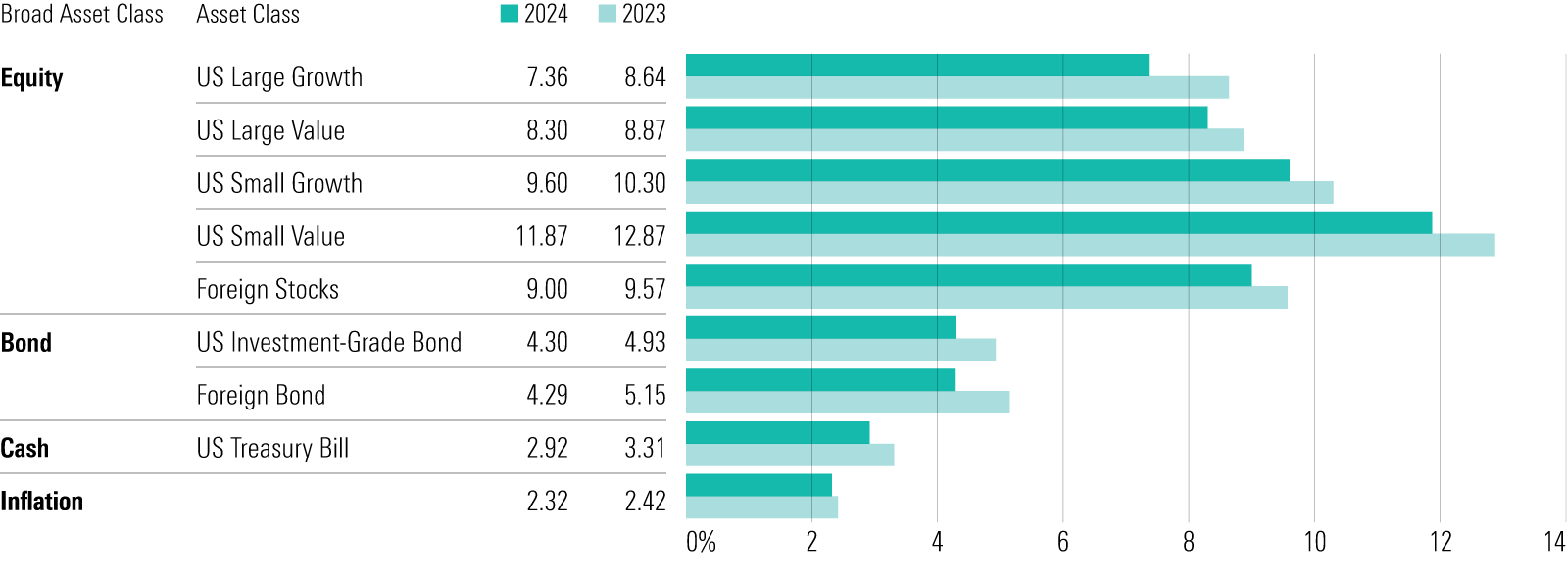
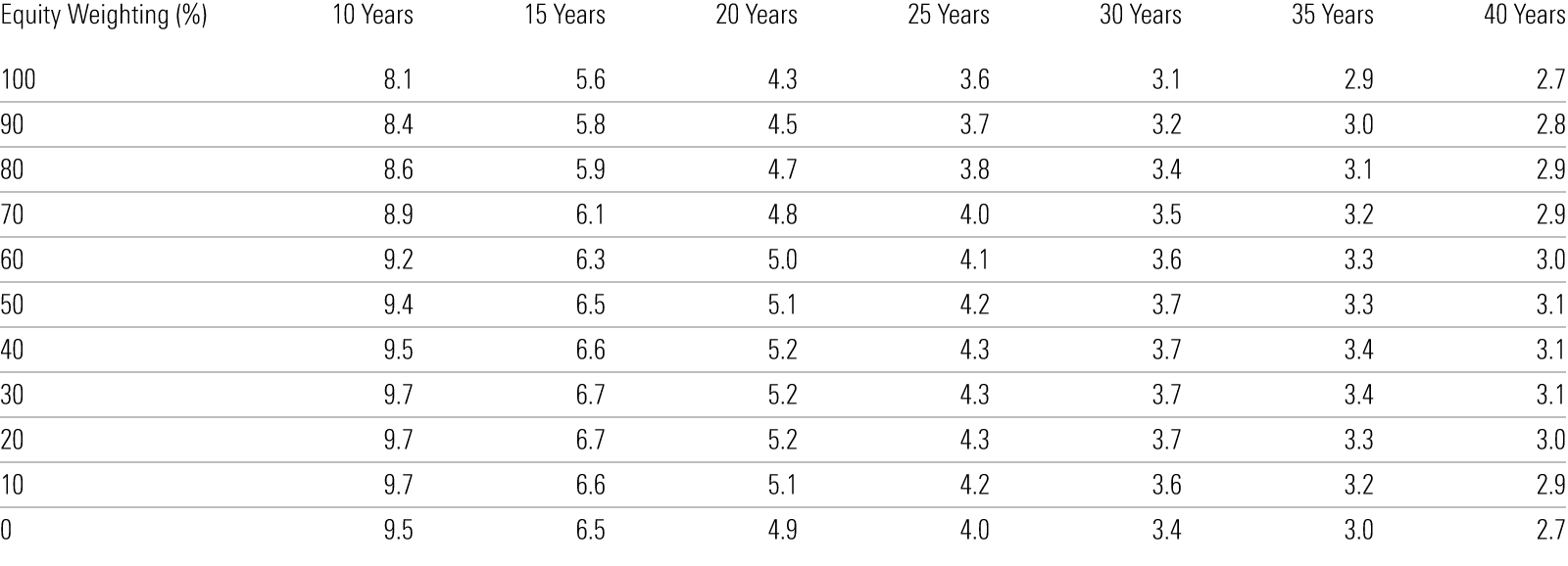
More muted return expectations depress starting safe withdrawal percentages for our base case. As shown in the table below, we estimate that a new retiree planning for a 30-year time horizon can safely withdraw 3.7% of a portfolio with an equity weighting of between 20% and 50%. Because of the higher volatility associated with higher equity weightings, boosting stocks detracts from the starting safe withdrawal percentage rather than adds to it. The below table also shows the connection between time horizon, asset allocation, and safe withdrawal rates, indicating that older retirees can reasonably spend well more than the 3.7% in our base case, which assumes a 30-year horizon.
30-Year Starting Safe Withdrawal Rate %, by Asset Allocation, 90% Success Rate
How Flexible Strategies Can Help
A 3.7% starting safe withdrawal percentage might seem dispiriting; after all, it’s even lower than the 4.0% that would have been supported in even the worst 30-year periods in market history. But it’s important to underscore the conservative assumptions that underpin our base case. Our return expectations are lower than historical market returns, and we also assume a retiree is seeking a 90% probability of not running out of funds over a 30-year period. Most importantly, we assume that a retiree will hold real spending constant over the whole 30 years instead of making adjustments along the way.
If a retiree is willing to adjust their spending in line with portfolio performance, however, that allows for higher starting withdrawals and generally higher lifetime withdrawals. As in previous years’ research, we explored several such strategies, ranging from straightforward adjustments—such as forgoing inflation adjustments after the portfolio lost value in the preceding year—to more complex systems such as the “guardrails” approach originally developed by financial planner Jonathan Guyton and computer scientist William Klinger. All of these systems allowed for higher starting safe withdrawal rates than the fixed real spending rate we used as our base case.
Spending Methods Summary, 40% Equity/60% Bond Portfolio, 30 Years, and 90% Success Rates
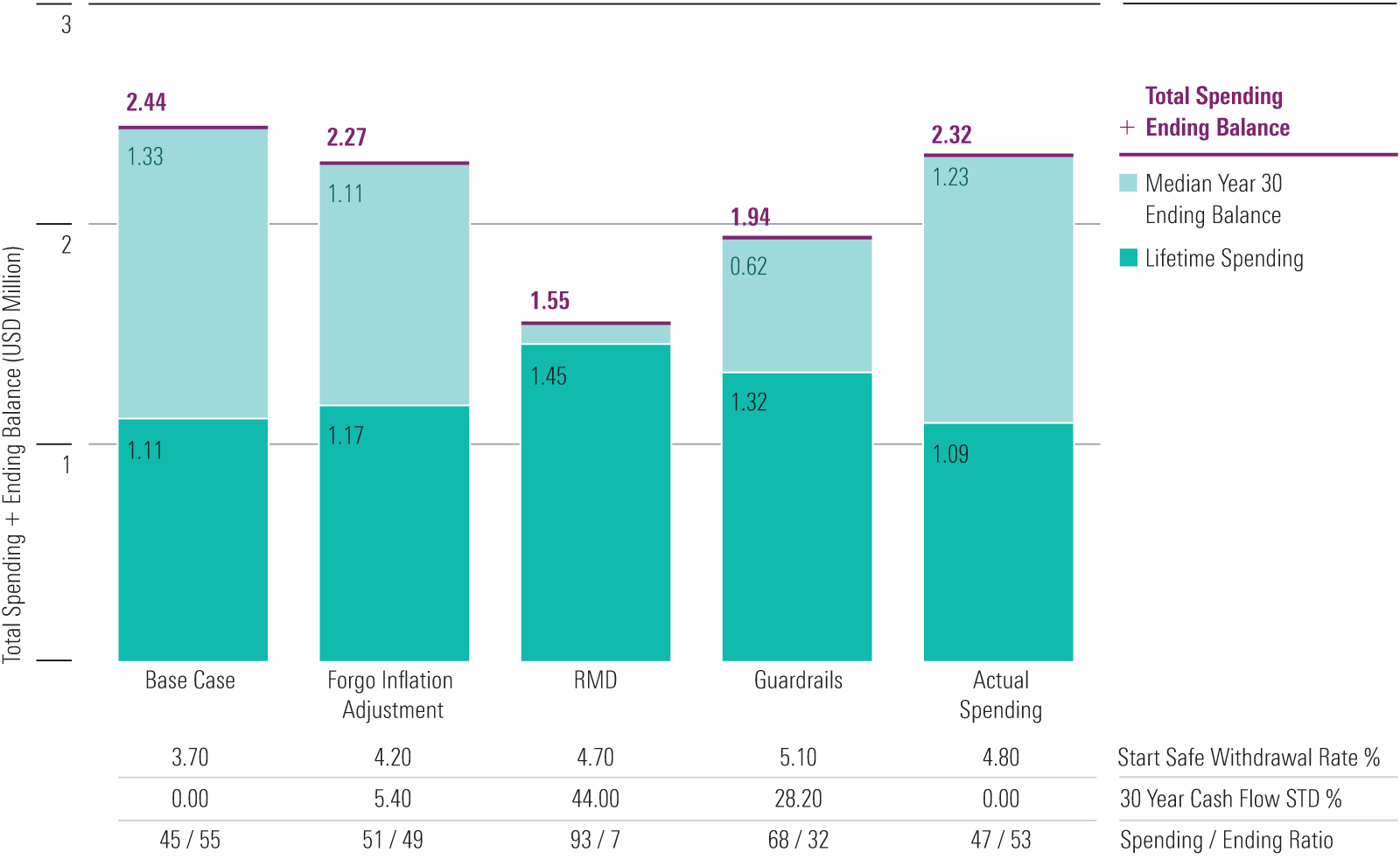
Yet as the graph above illustrates, such strategies involve trade-offs. While flexible strategies generally allow for higher starting and lifetime withdrawals relative to the base case, they do so at the expense of the amount of assets left over after 30 years. In this year’s research, we introduce a new metric—spending/ending ratio—to help retirees assess how a strategy balances lifetime spending with bequests.
In our simulations, we assumed that a retiree begins retirement with a $1 million portfolio and seeks a 90% probability of not running out of funds over a 30-year horizon. In the base case, the retiree spends 3.7% initially ($37,000) with annual inflation adjustments thereafter. Because real portfolio withdrawals are fixed, the cash flow volatility, as measured by standard deviation, is low. Moreover, that strategy leads to underspending in many market environments, so the amount of assets left over after 30 years is the highest of any of the strategies we tested.
By contrast, a strategy like the guardrails approach, which tethers withdrawals to portfolio performance, boosts both the starting withdrawal rate and lifetime withdrawals. However, it entails more cash flow volatility on a year-to-year basis. And because it gives “raises” in good years, it generally shrinks the amount of assets available for bequests after 30 years.
The Role of Guaranteed Income
The preceding discusses portfolio spending strategies without consideration of nonportfolio income. However, almost all retirees receive at least some type of nonportfolio lifetime income, often Social Security, and in many cases that income is their largest source of cash flows in retirement.
The exhibit below depicts how strategies that include guaranteed income affect lifetime cash flows as well as the amount of assets left over after a 30-year period. These strategies start with the same $1 million, 40% equity/60% bond portfolio used throughout the paper and assume the retiree claimed Social Security at age 67 when they receive a hypothetical full benefit of $36,000 a year that is adjusted annually for inflation at a rate of 2.3%. (Actual Social Security income at age 67 will vary based on an individual’s earnings history, and future inflation increases will be linked to CPI.) We also replace the starting safe withdrawal rate with the first-year spending amount to better reflect the impact of the guaranteed income.
Key Findings When Including Guaranteed Income
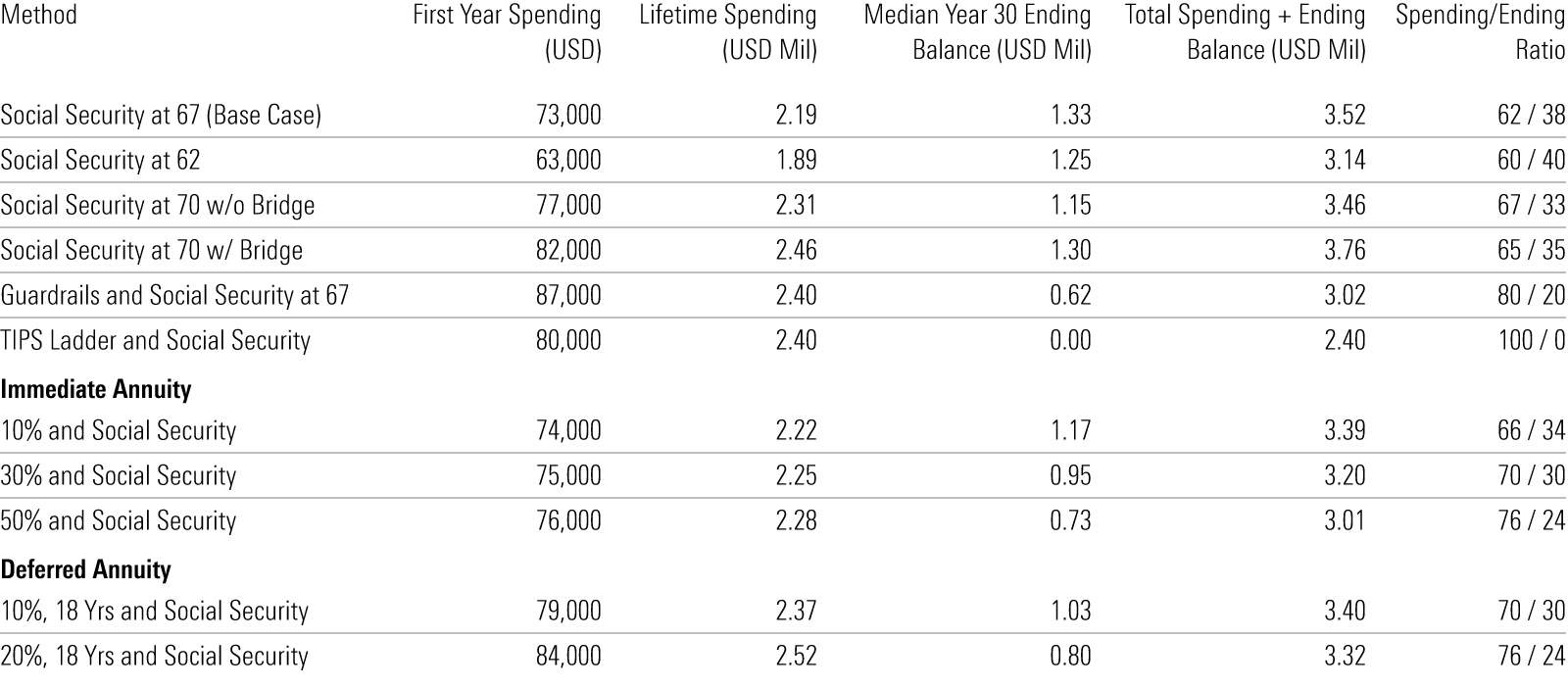
Needless to say, including Social Security and other forms of guaranteed income alongside the base case spending system with a 40% equity and 60% fixed-income portfolio raises the amount of lifetime spending. It can also make dynamic withdrawal strategies, like the guardrails approach outlined above, more efficient. The trade-off of allocating a portion of the portfolio to guaranteed income is generally lower median ending balances. For retirees who prefer maximizing lifetime spending over leaving behind large bequests, these strategies may be more appealing. But retirees who don’t live the full 30 years that we modeled in our study won’t benefit as much from guaranteed income.
Amy Arnott and Jason Kephart contributed to this article.
The author or authors do not own shares in any securities mentioned in this article. Find out about Morningstar’s editorial policies.
Morningstar Investment Management LLC is a Registered Investment Advisor and subsidiary of Morningstar, Inc. The Morningstar name and logo are registered marks of Morningstar, Inc. Opinions expressed are as of the date indicated; such opinions are subject to change without notice. Morningstar Investment Management and its affiliates shall not be responsible for any trading decisions, damages, or other losses resulting from, or related to, the information, data, analyses or opinions or their use. This commentary is for informational purposes only. The information data, analyses, and opinions presented herein do not constitute investment advice, are provided solely for informational purposes and therefore are not an offer to buy or sell a security. Before making any investment decision, please consider consulting a financial or tax professional regarding your unique situation.

 United States