
Paying Attention to Investment Factors? You Should Be
Delve into factors like value, momentum, and quality to unlock fresh perspectives on portfolio performance.


Betting on different parts of the market is tricky business. That’s one takeaway from a “Periodic Table” of calendar-year returns for Morningstar Factor Indexes.* In any given year, a different group of stocks could be on top. One year it’s “value,” another year “quality,” the next, “low volatility.”
That’s why it makes sense for many investors to buy a broad market index fund and call it a day.
Morningstar Factor Indexes: Periodic Table of Returns
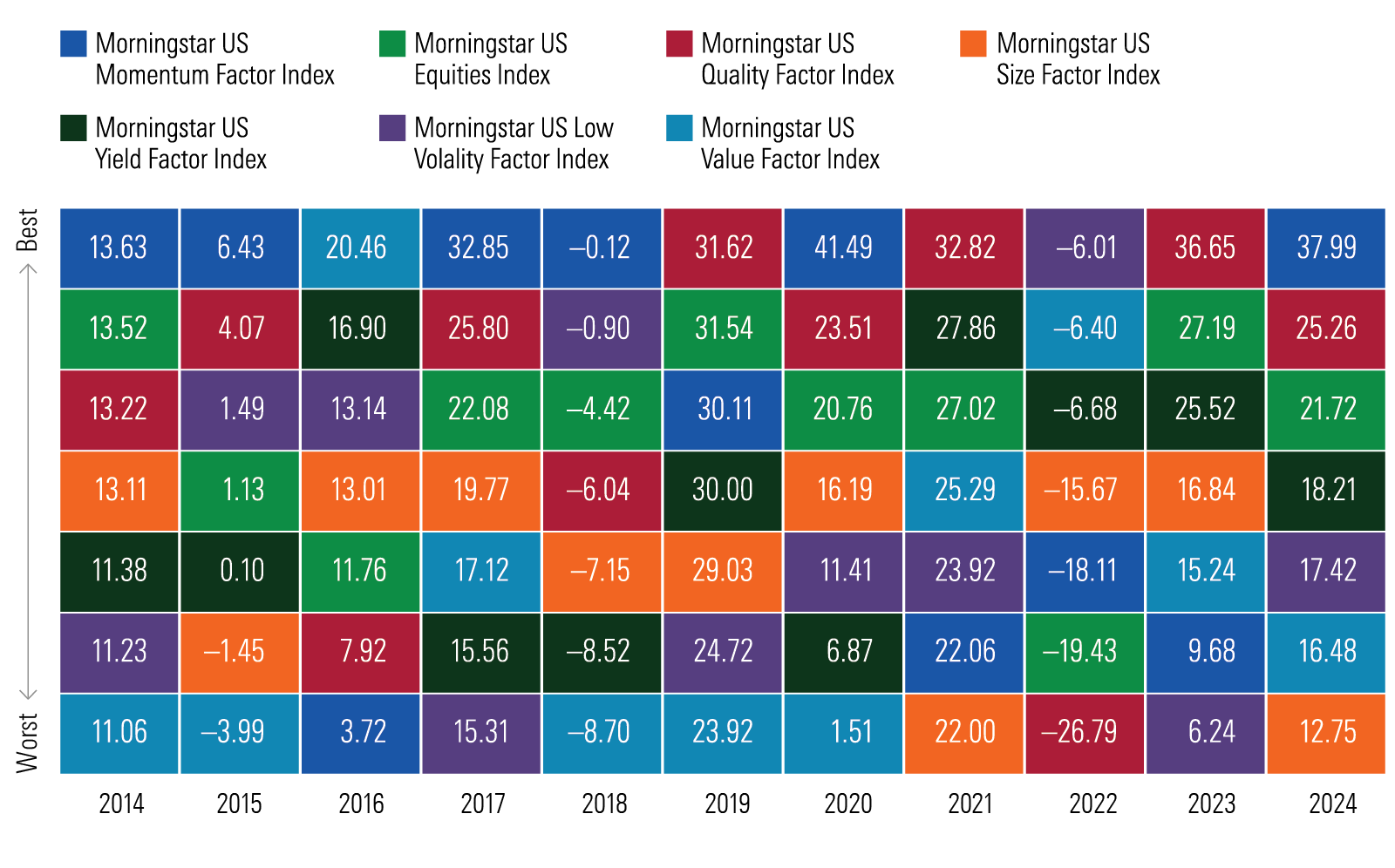
In fact, for the past 15 years, owning the market rather than factor picking has been an extremely successful investment approach. The Morningstar US Target Market Exposure Index, the broad gauge of equities from which the factor benchmarks are derived, has posted an average annual gain of 14% for the trailing 15-year period through 2024’s third quarter. That’s well above historical trend and better than only two factor indexes—momentum and quality.
The future could look different, of course. The Periodic Table shows that factor leadership is changeable. In years like 2016 and 2022, most factors individually outperformed the market, and investors wonder why their portfolios don’t tilt toward value, size, or low volatility. We even had a factor flip-flop in 2024’s third quarter, when market leadership rotated. October saw a reversion to trend, meaning momentum and quality regained their familiar leadership positions.
So should investors consider factors when building or rebalancing their portfolios—or tactically tilt their portfolios toward particular factors and away from others? Here’s what to consider.
What Is Factor Investing?
Musical elements, nutrients, and atoms are among the creative metaphors factor nerds have used to explain the concept. “Sources of security return” is the prosaic definition. Anyone familiar with the Morningstar Style Box or professors Fama and French knows that there are different types of stocks that behave differently. Factors are useful for understanding divergence within the market.
Factors are also about beating the market. According to academic research, value, momentum, quality, small size, and yield have outperformed over long periods. Low volatility has been associated with better risk-adjusted returns. Links to academic work on factors are included in this paper introducing the indexes. Both the indexes and the Morningstar Factor Profile are derived from the Morningstar Risk Model.
Factors’ persistence should be supported by strong economic rationale, related to either risk or investor behavior. Value investing is premised on both. The stocks of low-priced companies are said to outperform both because they are riskier and because of low expectations. Quality investors believe the market underestimates profitable companies with strong balance sheets.
Rules-based factor strategies package sources of outperformance that active managers have long exploited—either knowingly or unknowingly. Ideally, they do so at a far lower price than active management. Unlike a human, a factor strategy sticks to its approach even when it’s underperforming.
And it will underperform. There’s no shortage of witticisms when it comes to factors, all containing important truths. “No pain, no premium” speaks to the inevitable tough spells that come with risk. “There’s no such thing as a bad backtest,” refers to factor anomalies discovered through “torturing the data until it confesses.”
Less witty, but nonetheless critical, is the old investment saw that the past isn’t predictive. Even in the case of the most established factors, past success is no guarantee of future outperformance. Market dynamics change. The small-cap premium has been questioned by Morningstar analyst Zachary Evens and others. Then there’s the matter of how much time it takes for factors to work out. It can recall the quip attributed to former Chinese premier Zhou Enlai when asked about the impact of the French Revolution—”It’s too soon to tell.”
Is Your Portfolio Built to Withstand a Market Rotation?
Can the Quality and Momentum Factors Continue to Win?
As seen in the Periodic Table, the Morningstar US Quality Factor Index has put up many strong years. Nvidia NVDA, Alphabet GOOGL, and Microsoft MSFT are among the market darlings that score well on metrics like return on assets and debt/invested capital. Quality’s run is not all about tech, though. For the purposes of index selection, companies are compared with their sectors peers. Mastercard MA and Visa V are other top-performing “quality” stocks. It’s the “winner take all” or “winner take most” dynamic at play, in the eyes of some observers.
Momentum is a chameleon factor. Because quality has performed well, the Morningstar US Momentum Factor Index has often ridden the quality wave. It sounds almost ridiculous, but momentum investing targets stocks with strong recent returns on the premise that they’ll continue to outperform. There’s substance to the strategy. Investors chase performance and the market can underreact to news. Even hard core value investors acknowledge the power of the “Big Mo” (not to be confused with the other “Mo,” Morningstar’s artificial intelligence-powered chatbot).
Momentum investing has major weaknesses, though. First, it can be hard to implement. Momentum can look good on paper but breakdown in practice due to frictions like trading costs and taxes.
Second, momentum investing works until it doesn’t. In unidirectional markets, momentum coasts along. But at “inflection points,” momentum can get whipsawed. Have a look at 2022 and 2023 in the Periodic Table. In 2022, inflation and rate hikes sent markets tumbling. Quality stocks crashed. Value and low volatility held up best. So, when the momentum index rebalanced in December 2022, it loaded up on value and low-volatility stocks, only to see quality come back in 2023—the year of the “Magnificent Seven”—and leave momentum out of step. In 2024, however, the quality cohort has led. So, chasing last year’s winners has worked well.
Should Investors Stick With Underperforming Factors?
Low volatility is a factor known for resilience in “risk-off” environments. It’s not surprising that it performed well in down years for the market like in 2018 and 2022. Stocks with low past volatility have tended to offer better risk-adjusted performance than those with high volatility. The anomaly is typically explained by investors’ tendency to crowd into volatile stocks. During the selloffs of 2024’s third quarter, Morningstar US Low Volatility Factor Index constituents Berkshire Hathaway BRK. A BRK. B, Procter & Gamble PG, Coca-Cola KO, and Johnson & Johnson JNJ were ports in a storm. Down markets are when resilient low-volatility stocks should earn their keep.
Size, which tilts toward smaller companies, has been deeply out of favor as a factor. Despite academic research showing that smaller stocks have historically outperformed as compensation for extra risk, the size premium has failed to deliver over the past decade in the US (but not some other markets). As discussed above, its efficacy has been called into question. Only in 2022 and 2016 did the Morningstar US Size Factor Index outperform—2016 saw a postelection rally in economically sensitive, domestically oriented stocks. In the third quarter of 2024, size came back into favor as investors looked for a broadening of a mega-cap technology-dominated market. Smaller stocks were also viewed as cheap and as beneficiaries of interest-rate cuts.
Value and Yield have both been left behind by a market regime dominated by technology themes (most recently AI). The notion that lower valuations reflect higher expected returns, either as compensation for risk or because of undo pessimism, has failed to bear fruit over the past decade plus. The same is true for the shares of companies generously returning cash to shareholders, which tend to have a value bias. The Morningstar US Value Factor Index and the Morningstar US Yield Factor Index performed well in 2016, for some of the same reasons as size. They also held up relatively well in 2022, partly due to the energy sector, which benefited from a soaring oil price after Russia’s invasion of Ukraine. They also performed well in the third quarter of 2024’s factor flip-flop, before fading.
Cyclicality is a feature not a bug of factor investing. It’s important to remember that during the 2000-09 “Lost Decade” for US stocks, value, size, and yield performed well while the broad market went sideways. There are lots of catalysts for factor leadership: valuation, interest rates, and sector effects among them.
Is Factor Investing Worth It?
So, what’s an investor to do? Sticking with a chosen factor through thick and thin is one approach. Another is to diversify a portfolio by factor—a strategy reflected by the Morningstar US Multifactor Index. For other investors, eschewing factor bets and simply owning the broad market will be the way to go. It’s hard to see how returns for US equities over the coming years match those of the past, but, as seen in the variability of factor leadership, investment behavior is exceedingly difficult to predict.
*Morningstar Factor Indexes were launched in January 2023 with returns backcast to 2008 based on a methodology derived from the Morningstar Risk Model.
The author or authors own shares in one or more securities mentioned in this article. Find out about Morningstar’s editorial policies.
Morningstar, Inc., licenses indexes to financial institutions as the tracking indexes for investable products, such as exchange-traded funds, sponsored by the financial institution. The license fee for such use is paid by the sponsoring financial institution based mainly on the total assets of the investable product. A list of ETFs that track a Morningstar index is available via the Capabilities section at indexes.morningstar.com. A list of other investable products linked to a Morningstar index is available upon request. Morningstar, Inc., does not market, sell, or make any representations regarding the advisability of investing in any investable product that tracks a Morningstar index.

 United States