
Value Stocks Lead to Start 2025, but Growth Retains Its Long-Term Advantage
Value often matches growth on a monthly basis, but growth’s wins are bigger.


Key Takeaways
- Value stocks beat growth stocks in January after significantly underperforming in 2024.
- Growth stocks have outperformed in the long term, but on a monthly basis, value and growth are almost evenly matched.
- Financial services, healthcare, and communication services drove market gains in January. Notably, the tech sector contributed the least.
After underperforming growth stocks by nearly 10% in 2024, value stocks led in January, with the Morningstar US Value Index gaining 4.5%, ahead of the 3.9% return on the Morningstar US Growth Index. Meanwhile, blend stocks, as measured by the Morningstar US Core Index, lagged both growth and value stocks, returning 2.8%. Healthcare stocks, which gained 6.8% on the month, and financial services stocks, which rose 6.7%, were the primary drivers of the value rally.
Among the main contributors to the gain on the US Value Index in January:
- JPMorgan Chase JPM
- Walmart WMT
- UnitedHealth Group UNH
- International Business Machines IBM
- Wells Fargo WFC
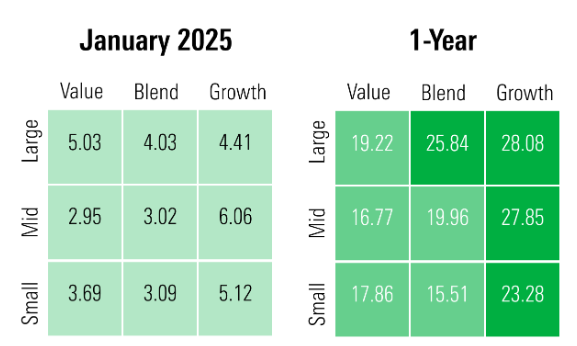
Though value stocks beat growth and core overall, the Morningstar Style Box shows more of a mixed picture under the hood. Mid-cap growth led the nine style box categories with a 6.1% gain in January, followed by small growth, which rose 5.1%. Large value placed third, gaining 5%. The worst-performing category was mid-cap value, rising 3%.
US Equity Style Box Performance
Growth vs. Value Stock Performance History
This month’s value outperformance is not unusual when looking at historical trends. Over the past 20 years, value stocks have outperformed growth in 46% of months, suggesting market leadership has been roughly even on a month-to-month basis. That figure dipped slightly to 43% over the past 10 years but returned to 46% over the past five years.
3 Top Value Stocks to Buy and Hold for 2025
In months when growth stocks outperformed, they did so by an average of 2.5 percentage points, with an average monthly return of 2.9%. In months when value stocks outperformed, they had an average outperformance of 2.3 percentage points, with an average monthly return of 1.1%.
This suggests that though growth and value stocks outperformed in a similar number of months, growth’s outperformance was larger on average and often occurred during more bullish market conditions. When compounded over time, these small differences result in a significant impact on total return. Looking at annual returns, the growth dominance becomes even more evident. Growth has outperformed value in 14 of the last 20 years. More recently, growth has led in eight of the last 10 years and four of the last five.
That’s good news for investors who have stuck with a growth strategy over the long term. The 20-year cumulative return on the US Growth Index is 784.9%, more than 100 percentage points ahead of the US Market Index’s 651.0%. Blend stocks also beat the market, with a 672.9% return. Value stocks, meanwhile, lagged far behind at 388.0%, roughly half the gain of growth stocks.
Which Stocks Led the January Value Stock Rally?
Financial services and healthcare stocks led the US Value Index’s 4.5% rally in January. Financial services stocks (25.2% of the index) contributed 1.8 percentage points to the gain, while healthcare stocks (16.7% of the index) added 1.1 percentage points.
Drilling down to the individual stock level, JPMorgan had the highest contribution at 0.5 percentage points. This was more than double the next-largest contribution, from Walmart. UnitedHealth, IBM, and Wells Fargo, which all added 0.2 points, round out the top five. Big banks like JPMorgan and Wells Fargo saw their share prices jump following strong fourth-quarter earnings, with both stocks posting double-digit gains on the month.
Looking at the US Growth Index, communication services and healthcare stocks contributed most to the index’s rally, with each sector adding 0.9 of the 3.9 percentage points gained. Communication services led all sector returns in January with a 9.1% gain.
Tech stocks, which often fall into the growth side of the style box, contributed the least to the index’s gain. AI stocks such as Nvidia NVDA and Broadcom AVGO fell as much as 15% in the late-month rout, bringing down tech. This is in stark contrast to 2024, when tech stocks accounted for nearly half the annual gain on the US Growth Index.
Meta Platforms META, which added 0.6 points, and Amazon AMZN, which added 0.4 points, were the leading contributors to the index in January. Thanks to the TikTok uncertainty and strong earnings, Morningstar analysts hiked Meta’s fair value twice during the month for a total raise of $210 per share—a 38% increase.
Netflix NFLX, Intra-Cellular Therapies ITCI, and Eli Lilly LLY round out the top five, each adding 0.1 points—less than a quarter of the amount added by Meta and Amazon.
The author or authors do not own shares in any securities mentioned in this article. Find out about Morningstar’s editorial policies.

 United States