
2 Funds Whose Caution Proved Costly
Vanguard Dividend Growth and Jensen Quality Growth struggled in 2024 as mega-cap stocks carried the market to new heights.

The S&P 500 dazzled in 2024, posting a 25% gain that rewarded large-blend funds that stayed close to the index. Large-blend funds ranking in the Morningstar Category’s lowest quartile of active share—a measure of how much their portfolios differ from the index—delivered an average before-fee return of 24%. Meanwhile, those that veered furthest from the index (highest quartile by active share) managed gains of around 18%. Yet again, America’s largest companies carried the day. The S&P 500’s 10 biggest constituents accounted for roughly two thirds of its gains.
Stock-pickers willing to stand out with benchmark-agnostic portfolios typically favored stocks outside the club of trillion-dollar giants. Their reasons varied. Some were wary of lofty valuations—especially those of Tesla TSLA and Nvidia NVDA. Others were skeptical of the long-term staying power of index leaders and the sustainability of their high earnings-growth rates. And many simply believed they had more opportunities to add value by investing in under-the-radar firms, where they could gain an analytical advantage.
Diverging from the index proved costly for Vanguard Dividend Growth VDIGX and Jensen Quality Growth JENSX. These quality-focused, risk-conscious funds posted returns of just 9% to 11%. Limited exposure to the top-performing mega-caps explains much of their underperformance. The Vanguard fund had small weightings in Microsoft MSFT and Apple AAPL, while Jensen had large positions in both. But neither held the best performers, including Nvidia, Broadcom AVGO, Tesla, and Meta Platforms META.
Their caution was generally a disadvantage in 2024. Other funds that have historically provided strong downside protection and index funds targeting low volatility also delivered tepid results, relative to the broad market. Vanguard Dividend Growth’s value bias was an additional disadvantage as large-growth stocks trounced their large-value counterparts.
Average gross total returns and value-growth scores of large-cap funds in 2024.
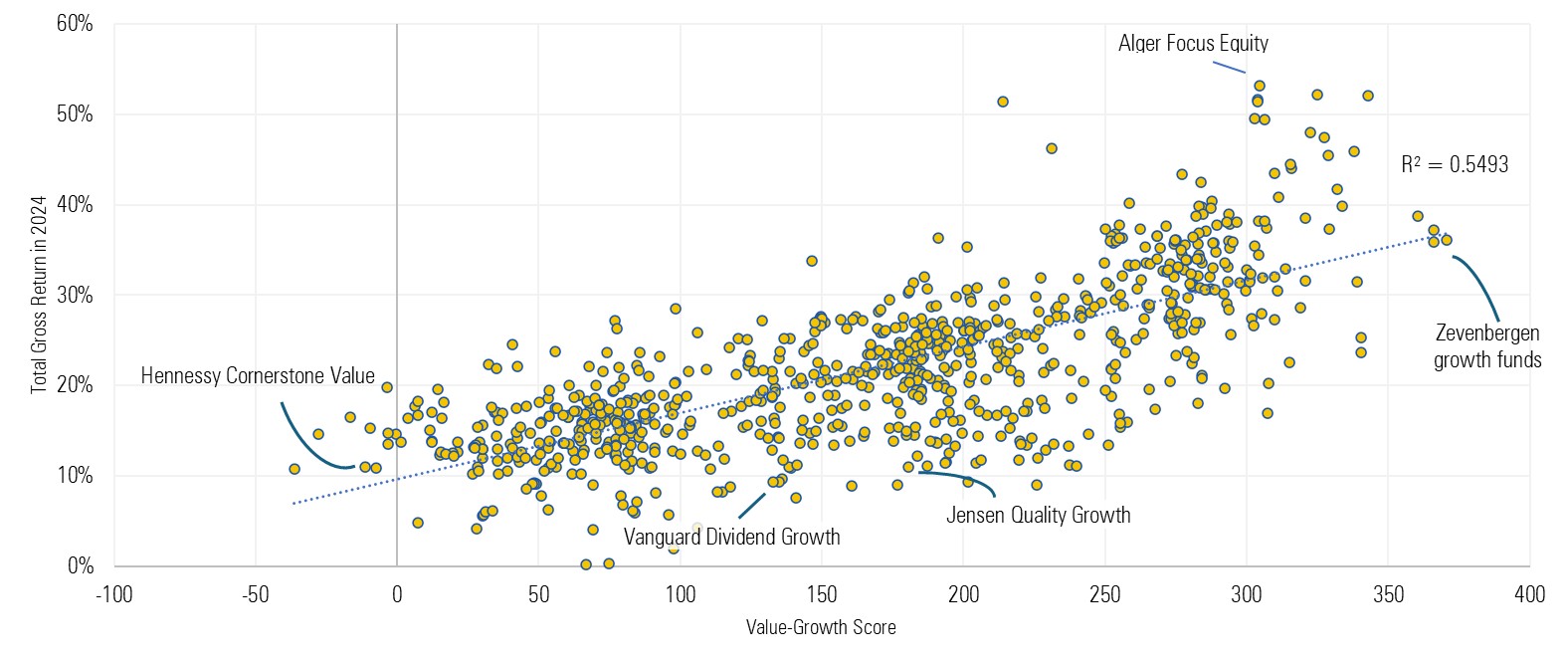
But style doesn’t fully explain the magnitude of the pair’s underperformance. They underperformed Invesco S&P 500 Equal Weight ETF RSP (a version of the S&P 500 that slashes large companies’ influence on the index), Vanguard Dividend Appreciation ETF VIG (an index fund that leans toward value stocks), and index funds targeting stocks with low volatility. The funds also faced specific headwinds from their stock picks.
Both funds suffered from heavy exposure to UnitedHealth Group UNH, the largest health insurer in the United States, which endured a challenging year. Medicaid rule changes reduced enrollment and revenue, while reforms to Medicare Advantage plans curtailed growth. On top of this, the rising use of medical services increased costs for its insurance business, weighing on profits.
They were also punished for holding Nike NKE, which grappled with declining sales in major markets, rising competition from brands such as Hoka and Chinese rivals, and heavy discounting to clear unsold inventory—all of which squeezed profit margins.
Despite their disappointing performance in 2024, Vanguard Dividend Growth and Jensen Quality Growth remain guided by seasoned teams plying disciplined investment processes. Their investment approaches are deliberate and distinct, and they prioritize companies’ long-term resilience over chasing short-term trends. Though these funds struggled in a year dominated by a handful of high-growth mega-caps, their steady, risk-conscious styles remain an effective counterweight to the recent extremes of market exuberance and valuations.
This article first appeared in the February 2025 issue of Morningstar FundInvestor. Download a complimentary copy of FundInvestor by visiting this website.
The author or authors do not own shares in any securities mentioned in this article. Find out about Morningstar’s editorial policies.

 United States