
What UnitedHealth Group’s Plunge Means for Large-Cap Funds
A market darling is on the ropes.


On Feb. 21, 2025, shares of UnitedHealth Group UNH plummeted in what ranks as one of the stock’s worst days in the past two decades. The culprit was a report from The Wall Street Journal that revealed a Department of Justice investigation into the company’s Medicare Advantage billing practices. The government is scrutinizing the company for allegedly encouraging providers to inflate diagnoses to secure higher Medicare reimbursements.
The market’s reaction was swift and brutal. The stock dropped over 10% in early trading, shaking not just healthcare investors but a significant portion of the US large-cap equity landscape. Why? Because UnitedHealth is a beloved holding across the style spectrum of large-cap funds.
UnitedHealth’s Influence on Large-Cap Portfolios
UnitedHealth Group, whose $400 billion-plus market puts it among the Morningstar US Market Index’s largest 15 constituents, enjoys a rare status among actively managed large-cap funds. UnitedHealth is a fairly consensus pick, appearing prominently in portfolios that otherwise have divergent investment philosophies, including growth-, value-, quality-, and income-oriented mandates.
The below funds, which span the style spectrum, all held positions in the company that were among the highest relative to their respective Morningstar Category indexes.
United They Stand
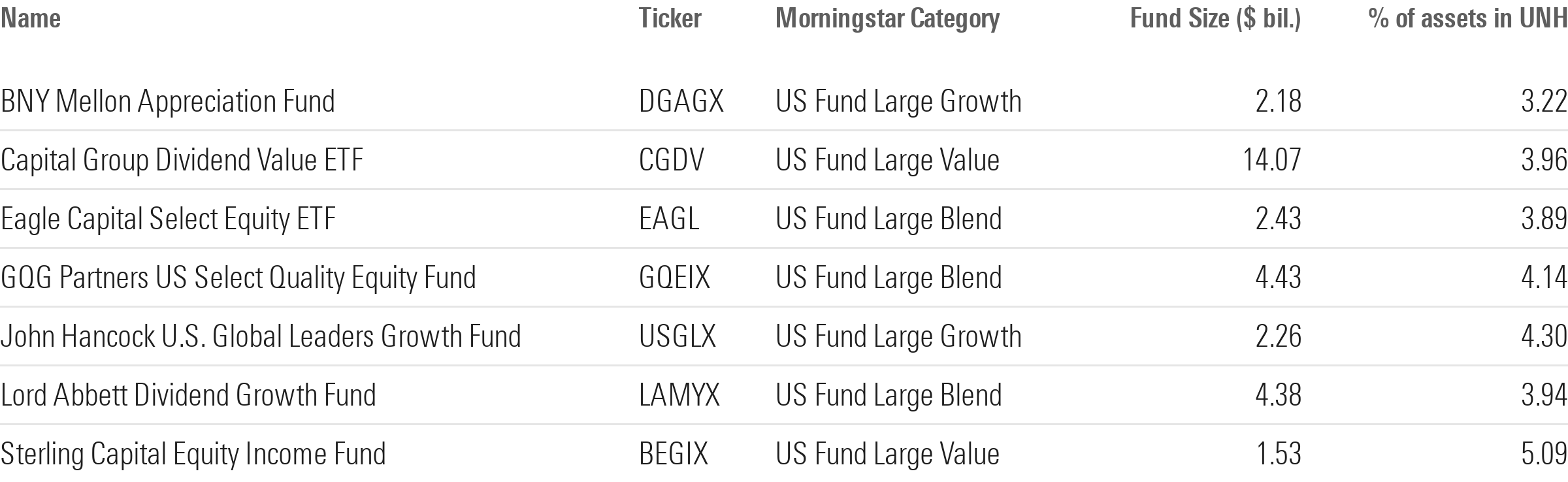
Each had 3% to 5% of assets in UnitedHealth, making the stock a substantial driver of their returns.
Many others will also feel an impact. As of their most recent public portfolios and relative to their respective category indexes, one third of all US large-cap mutual funds and exchange-traded funds were overweight the stock, a level that matches the ownership of Microsoft MSFT and Alphabet GOOGL, which are also popular among value, blend, and growth funds.
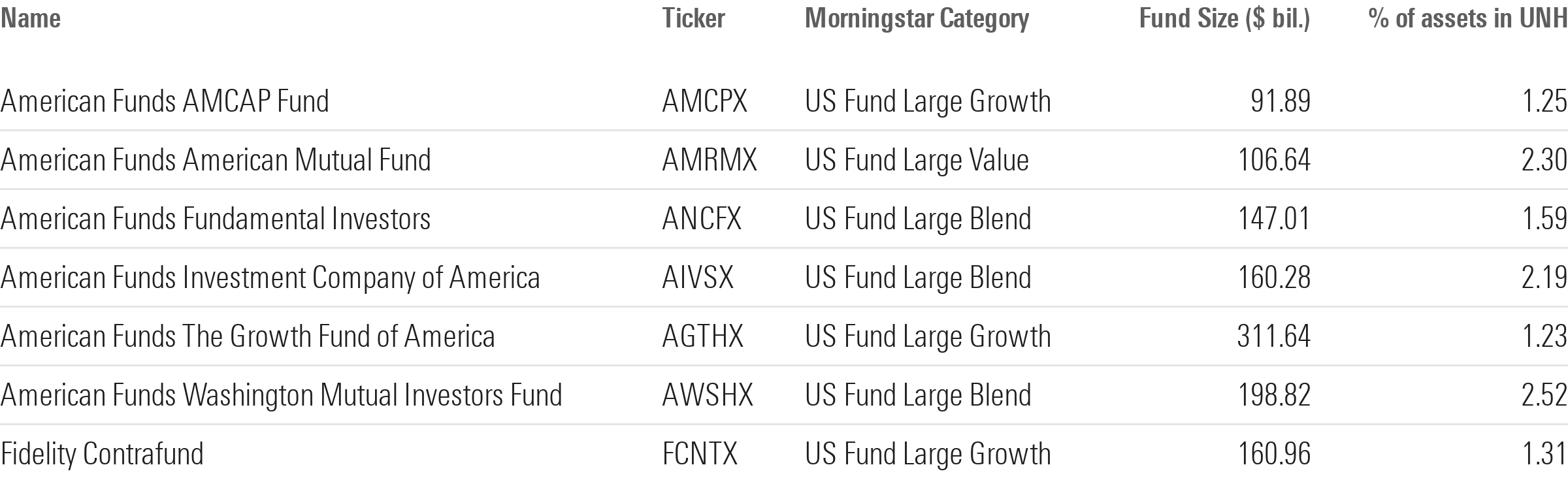
Seven of the biggest actively managed funds, collectively managing over $1 trillion in assets, were also overweight UnitedHealth, though their position sizes were more measured—about 1.2 percentage points more than their benchmark weight.
Stock-Picking Behemoths' Ownership of UnitedHealth Group
This latest stock plunge continues a broader slump for UnitedHealth. The stock had been posting disappointing results even before the DOJ probe. Amid a soaring market, UnitedHealth’s stock was flat to slightly down in both 2023 and 2024, lagging the Morningstar US Market Index’s 25% annualized gains. Adding to regulatory challenges, the rising use of medical services increased UnitedHealth’s costs, and renewed processes of determining individuals’ Medicaid eligibility pressured medical membership rolls.
The Takeaway for Investors
UnitedHealth’s rout serves as a stress test for actively managed large-cap funds. While the stock remains a core holding, its decline reinforces a fundamental truth: Even dominant, blue-chip companies can stumble.
Yet, investors in diversified portfolios may take solace in the fact that even among the biggest funds, UnitedHealth wasn’t a concentrated bet. With position sizes only modestly above index weightings, the fallout should be manageable for most large-cap strategies. With some recovery in the stock’s price on Feb. 21, it ended the day down around 7%.
But for those betting big on UnitedHealth as a low-volatility compounder, this episode is a wake-up call. The stock is still a healthcare juggernaut, but it has failed to provide the stability that many quality- or dividend-oriented portfolio managers are looking for.
The author or authors do not own shares in any securities mentioned in this article. Find out about Morningstar’s editorial policies.

 United States