
There Are Three Paths Forward for the AI Boom. Two of Them Lead to Lower Interest Rates
Mass layoffs or a spending slowdown would likely require hefty Fed rate cuts.


The fate of the better part of the US stock market hinges on one question.
Will the vast sums being spent on artificial intelligence finally show a good return on investment for customers, or will the lack of a payoff cause the investment boom to crash?
We don’t know the answer to this question. But for bonds, we think the answer doesn’t matter.
That is, we think either outcome would have the same effect of pushing interest rates downward. The unwinding of AI’s boost to interest rates is a major factor in why we expect interest rates to fall in coming years. That would generate a windfall of strong returns for bond investors.
Granted, there is a third scenario that would allow interest rates to continue drifting higher: The AI boom steams forward despite the lack of return on investment, turning into a bubble. But this path can only be followed for so long.
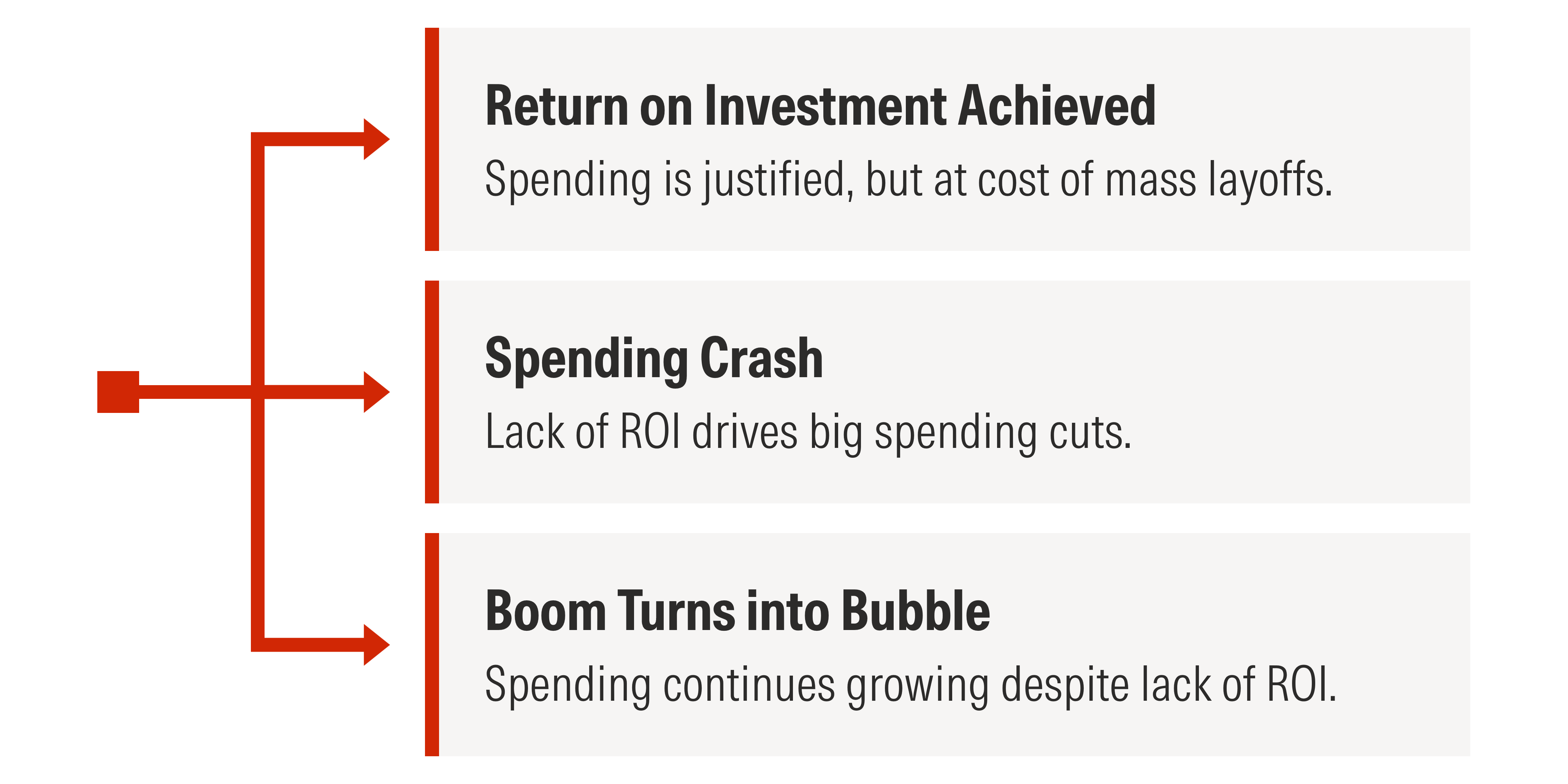
We believe that AI’s path forward will probably look like one of these three scenarios:
Three Paths Forward for the AI Boom
AI Is Pushing Up Interest Rates
We recently argued that the rise in US bond yields is more about the strength of the economy and AI’s appetite for capital than fears of a rising debt load and its inflationary consequences. That is, AI is a classic demand-side shock, and, as is generally the case with such shocks, it’s being offset by monetary policy. That means the main effect of AI is to boost interest rates, rather than boosting inflation.
Bond yields climbed to multidecade highs just a month ago. They’ve since come off those highs but remain very elevated, with the 10-year Treasury yield up nearly 1 percentage point for the year to date.
US Treasury Yields (%)
We expect the Federal Reserve to return to interest rate cuts in 2027, ultimately cutting the federal-funds rate to a target range of 2.5%-2.75% by the end of 2028, down 1.25 percentage points from today. That will help drive the 10-year Treasury yield to an average of 3.5% in 2029 and afterward, down from 5.1% currently.
Path 1: ROI Achieved Via Mass Layoffs
The first path is that AI does begin to show return on investment. By “investment,” we really mean the money being spent by end users of AI. An example would be a consumer goods company paying for an AI model like ChatGPT to automate routine accounting tasks.
A “return” on this investment simply means the user generates enough extra profit to more than offset the AI spending. And this gets us to the crux of the issue: That profit is likely going to come overwhelmingly from labor cost savings via layoffs.
Sorting through all the muddled thinking on this topic would take a whole other article. Some people say that the heaviest AI adopters will increase revenue rather than cut labor. But the end result of labor-light AI adopters displacing labor-heavy AI laggards would still be mass layoffs.
How big of layoffs are we talking about? To take a representative estimate, Goldman Sachs estimates that hyperscaler AI capital expenditure projected for 2026 and 2027 may need to generate some $1 trillion in annual revenue. At $100,000 in payroll saved per job, that’s 10 million jobs. If even half of that (5 million jobs) comes from the US, that’s 3% of total employment.
Mass layoffs need not lead to mass unemployment in the long run. Workers should eventually redeploy to new jobs created by the economic progress enabled by AI. That’s how automation has worked for more than 200 years, since the first Industrial Revolution.
But in the short run, this scenario would lead to millions of workers experiencing a lengthy spell of unemployment. Additionally, those who keep their jobs are likely to boost precautionary savings, especially given that the personal savings rate is very low currently (at just 4%, it’s around 3 percentage points below its prepandemic average).
These two factors—unemployment and precautionary savings—would constitute a large contractionary hit for the economy, which the Fed would have to offset with major interest rate cuts.
Falling interest rates would boost bond returns, but that doesn’t mean one should go all-in on bonds in this scenario. Stock returns would be at least decent in this scenario. The realization of AI’s promise would boost corporate earnings of AI adopters while justifying the continued investment that propels earnings of AI providers.
Still, the scenario would set up for much better bond returns than we’ve seen in the past five years, as returns were weighed down by the surge in interest rates.
Path 2: AI Spending Crash
The second path is straightforward. If AI fails to generate adequate ROI for long enough, then end users curtail their spending on AI.
That means less revenue for AI companies, whether model builders like Anthropic or the data center owners like Amazon.com AMZN. That would likely result in AI companies massively scaling back their spending plans.
Lower AI investment would subtract directly from gross domestic product growth. As we discussed in our latest US Economic Outlook, tech-related fixed investment, fueled by AI, contributed directly around 1 percentage point to GDP growth in the first half of 2026. Additionally, the pullback in AI investment would also weigh on corporate profits and hence cause a large drop in stock prices. The latter would depress consumer spending and other parts of GDP.
In short, a huge drop in AI spending would set in motion a major slowing of economic growth. For the Fed to avoid a recession, it would need to cut interest rates dramatically. The fallout of the dot-com bubble in 2001 led to over 5 percentage points in rate cuts.
The “spending crash” scenario is the one with the clearest investment implications.
Bond returns would be boosted by falling yields, as in the first scenario. But in this scenario, we’d also likely see a sharp drop in stock prices, responding to plummeting AI investment. That’s a very favorable scenario for bond investors.
Path 3: Boom Turns Into Bubble
There is a third path that avoids a large drop in interest rates. In this scenario, the AI investment boom continues despite failing to generate adequate ROI for the end user. By this point, the AI boom would have all the hallmarks of a “bubble,” that is, an unsustainable rise in investor exuberance.
In the short run, this scenario has the opposite implications as scenario number two: Stock prices could continue to rise, and bond yields would rise further, hitting bond returns. That’s a punishing scenario for bond investors.
Admittedly, the bubble could have some staying power before an inevitable collapse.
AI proponents could argue that the gains from AI progress will be so astronomical (with AI even leading to an economic growth explosion) that losses on investment are irrelevant in the short run. But ultimately the bill comes due on every bubble, and we can’t imagine how AI would avoid this outcome.
The author or authors do not own shares in any securities mentioned in this article. Find out about Morningstar’s editorial policies.

 United States