
US Sustainable Funds Suffer Another Year of Outflows
Mediocre performance and high interest rates were the main culprits in 2024.


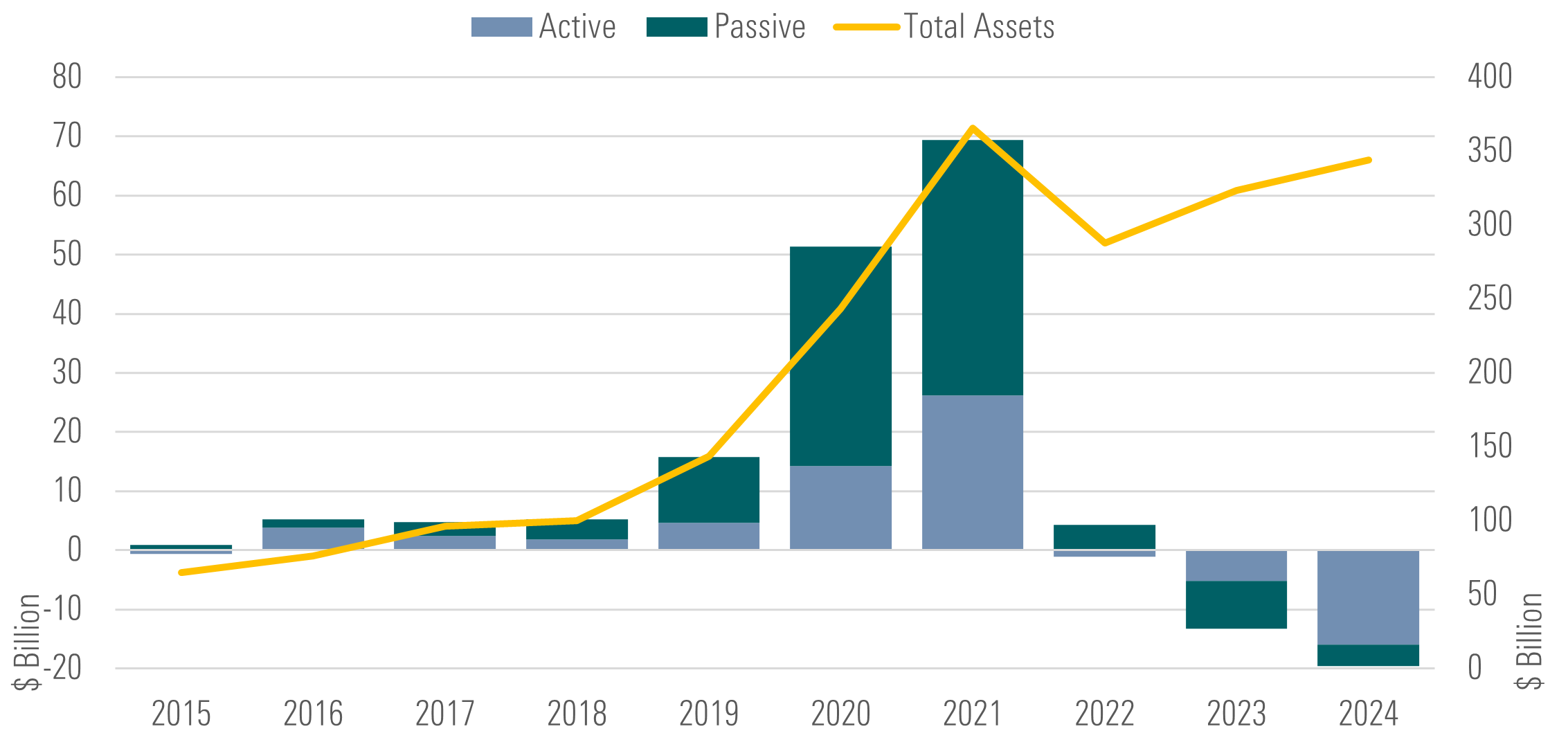
US sustainable open-end funds and exchange-traded funds suffered their second year of outflows in more than a decade, reaching $19.6 billion in 2024 following redemptions of $13.3 billion in 2023. By contrast, conventional fund peers enjoyed significant inflows of about $740 billion, supported by interest-rate cut expectations and an artificial-intelligence-related stock rally.
US Sustainable Fund Flows and Assets
A Turbulent Year for US Sustainable Funds
Sustainable funds faced many headwinds in 2024. They continued to lag conventional peers, with only 42% of sustainable funds landing in the top half of their respective Morningstar Categories. High interest rates continued to penalize some areas of the market, such as clean energy stocks and other growth stocks.
Sustainable Funds' 2024 Return Rank by Morningstar Category Quartile

Sustainable equity funds suffered the most, with just 38% landing in the top half of their respective categories.
Among large-blend equity funds (the largest grouping within the US sustainable funds universe), the median return for sustainable funds was 20.7% in 2024. This was lower than the 21.5% median gain for conventional funds and the 24.1% gain for the Morningstar US Market Index.
Fixed-income funds performed better; 48% of sustainable fixed-income funds landed in the top half of their respective Morningstar Categories.
ESG Backlash, Greenwashing Concerns Also Played a Role
In addition to poor performance, US sustainable funds were also affected by the US political climate. In a critical election year, the backlash against environmental, social, and governance investing intensified, and political scrutiny reached new heights. Some individual states took legal action to limit the incorporation of ESG criteria in investment decisions.
Moreover, greenwashing concerns remained a persistent concern for investors.
The Best- and Worst-Selling ESG Funds
Two of the largest sustainable funds in the US landed among the hardest hit in terms of net annual outflows last year. Parnassus Core Equity PRBLX experienced $3.7 billion in net withdrawals, but it remains the largest US sustainable fund, closing the year with $29.1 billion in assets.
Sustainable Funds With the Largest Outflows in 2024
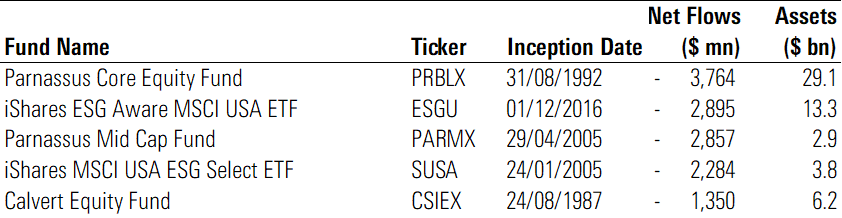
IShares ESG Aware MSCI USA ETF ESGU saw continued redemptions, losing $2.9 billion in 2024, following heavy outflows in previous years. The fund’s total assets stand at $13.3 billion, down from its peak following strong ESG inflows between 2019 and 2021.
Sustainable Funds With the Largest Inflows in 2024
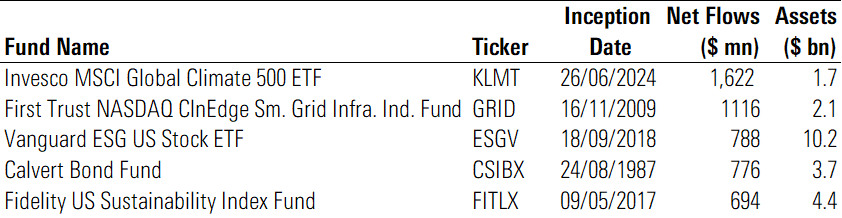
Parnassus and BlackRock BLK, the world’s largest manager of sustainable funds, had the greatest redemptions of $7.3 billion and $6.6 billion, respectively, in 2024. Meanwhile, Vanguard, the US’ second-largest manager of sustainable funds, was the bestselling firm with $1.8 billion in subscriptions.
Sustainable Fund Product Development Dries Up
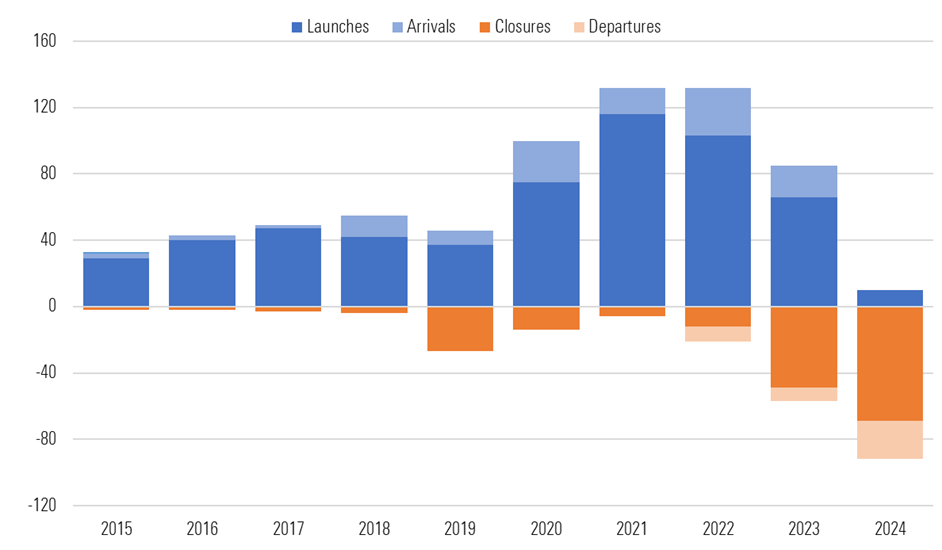
As a result of the aforementioned headwinds, for the first time, the number of funds that closed or dropped their ESG mandates exceeded the number of new fund launches, leading to a contraction in the US sustainable funds universe.
Only 10 sustainable funds came to market in 2024, while a total of 71 sustainable funds were either merged or liquidated and 24 dropped their ESG-focused mandates.
Launches, Closures, Arrivals, and Departures
The largest fund that merged was Nuveen Social Choice Low Carbon Equity, which merged into Nuveen Large Cap Responsible Equity TICRX in December 2024 to streamline the number of offerings. The two strategies were managed by the same team and had the same ESG and low-carbon criteria.
Of the 24 funds that removed their ESG-dedicated mandates in 2024, the largest was NYLI MacKay ESG Core Plus Bond ETF, which became NYLI MacKay Core Plus Bond ETF CPLB.
Meanwhile, in terms of new entrants, Invesco IVZ led the pack as the provider of the two largest new offerings. Invesco MSCI North America Climate ETF KLMN and Invesco MSCI Global Climate 500 ETF KLMT garnered more than $4 billion in combined assets by the end of 2024. Both ETFs invest in leading companies in terms of carbon reduction and climate-focused business practices.
KraneShares Sustainable Ultra Short Duration Index ETF KCSH was the third-largest new offering, reaching $224 million in assets at the end of 2024. The fund invests in investment-grade corporate bonds from issuers committed to net zero emissions by 2050 while excluding companies involved in fossil fuels and unsustainable activities.
At the end of 2024, there were 587 sustainable open-end funds and ETFs, down 9% from 2023.
Meanwhile, Surveys Show Sustainable Investing Interest
The outflows experienced by US sustainable funds in the past couple of years contrast with surveys showing continuous investor interest in sustainable investing. According to a widely watched survey by Morgan Stanley published a year ago, 54% of individual investors planned to increase their sustainable investments in 2024, and 77% were interested in sustainable investing.
In a more recent survey published in December 2024, almost eight in 10 asset managers (78%) and asset owners (80%) expect sustainable assets under management and allocations to rise in the next two years, though a lack of data and greenwashing will continue to be challenging.
Despite the outflows, assets in sustainable funds rose last year to $344 billion, supported by market price appreciation. This represents 6.3% annual growth but a 6.0% decline from the record seen at the end of 2021.
Assets in US Sustainable Funds

Actively managed funds still dominate the sustainable funds landscape, but low-cost passive funds continue to gain popularity, reaching over 40% of US sustainable fund assets at the end of 2024.
This article is adapted from the US Sustainable Funds Landscape. Get the full report here.
The author or authors do not own shares in any securities mentioned in this article. Find out about Morningstar’s editorial policies.

 United States