
Global Commitment to Climate Investing Is Falling, New Survey Suggests
Robeco finds diminishing support for climate investing overall, with significant regional variations.


Interest is waning in climate investing, according to Robeco, an asset manager that has published its fifth Global Climate Investing Survey.
The proportion of institutional and wholesale investors that agreed “climate change is at the center of, or is a significant factor in” their investment policy has decreased by 16 percentage points since last year’s report, falling to 46% from 62%. In addition to increasingly excluding climate considerations from investment policies in 2025, the proportion of survey participants that “plan to invest more in climate solutions, either as a general aim, or via a quantitative target” this year has dropped by 12 percentage points, to 57% from 69%. Robeco has committed EUR 209 billion in client assets to ESG integration.
This shift away from climate investing comes as a growing number of investors fear that the goal to limit global warming to 2 degrees Celsius above preindustrial levels, set forth in the Paris Agreement, is no longer tenable. Investors are not only concerned about the feasibility of achieving widely accepted global warming targets, but 49% of survey respondents also said they “expect a ‘too little, too late’ climate transition scenario in the next decade,” with 11% of respondents even “expecting a ‘hot house’ world.”
Despite these worries, several of Robeco’s findings reflect more optimistic investor attitudes. For example, a third of survey respondents agreed “that the government in their home markets understands the policies needed to encourage investors to support the net-zero transition,” while nearly half of investors—48%—shared the view that “climate adaptation solutions” will be “attractive over the next 3-5 years.”
Robeco surveyed around 300 wholesale and institutional investors in North America, South Africa, Europe, and Asia-Pacific. They included private banks, sovereign wealth funds, pension funds, insurance companies, endowments, and other institutional investors.
Regional Divergence in Climate Investing Attitudes Increases
While Robeco’s findings reflect an overall decrease in commitment to climate investing, survey data also suggests that these figures may obscure substantial regional divergence in attitudes toward climate investing.
Importance of Climate Change to Organization's Investment Policy
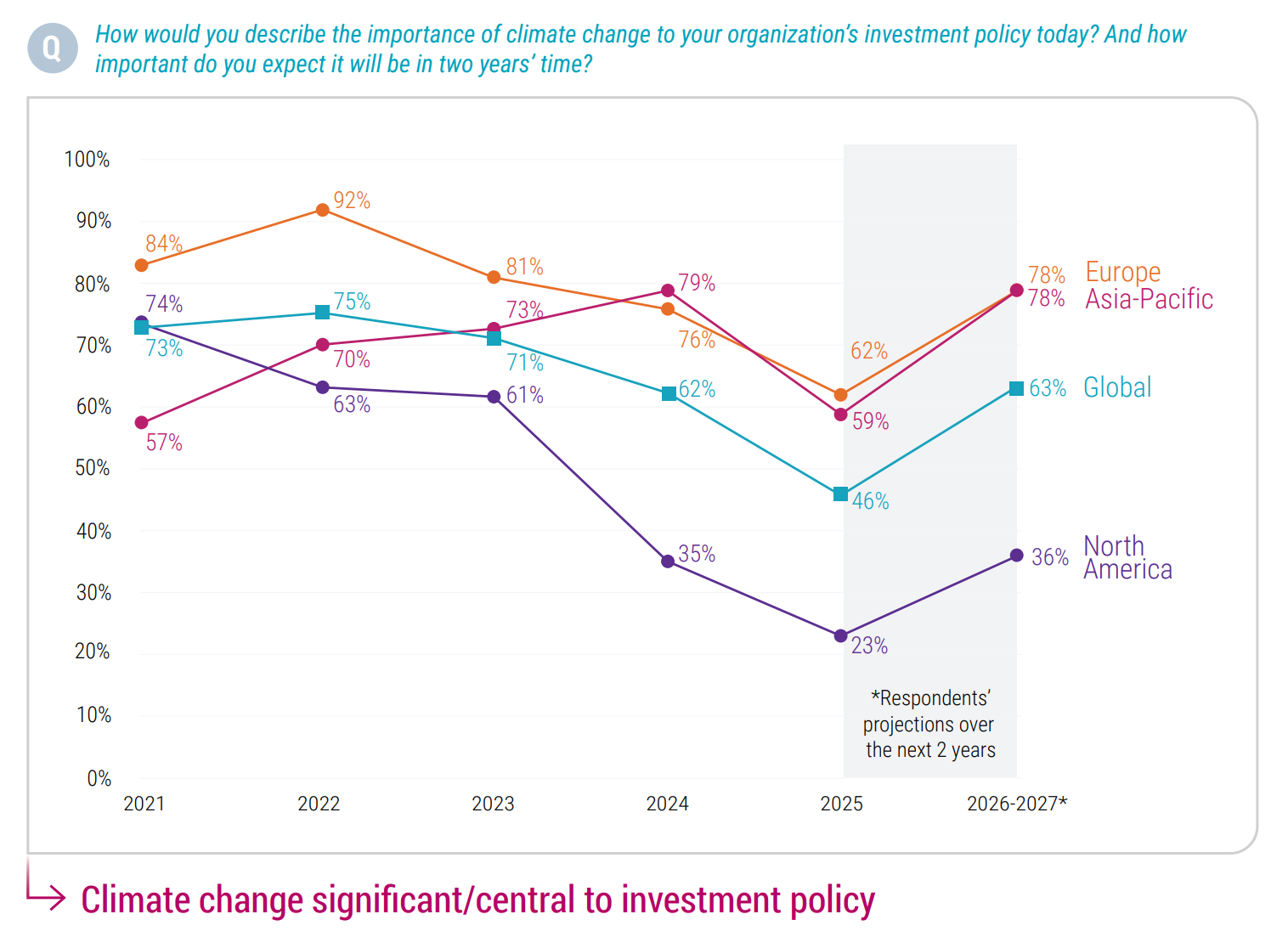
For example, although fewer investors in both Europe and Asia-Pacific identified climate as “significant” or “central” to their investment policies as compared with last year—declines of 14% and 20%, respectively—most investors in both regions still prioritize climate in their investment approach.
In contrast to elevated levels of interest in climate investing maintained by both respondents in Europe and Asia-Pacific, just 23% of North American investors identified climate as significant to their organizations’ investment policies in 2025.
Despite both European and North American participants rating climate investing as less significant to organizational policies each year since 2022, respondents across all regions project that climate’s importance will grow over the next two years.
Progress Toward Decarbonization Varies Significantly by Region
Differing levels of progress on portfolio decarbonization largely track regional patterns in commitment to climate investing. For example, out of organizations not currently prioritizing portfolio decarbonization, 66% are in North America. Conversely, for organizations in advanced stages of portfolio decarbonization, 76% are spread across Europe and Asia-Pacific.
Progress on Portfolio Decarbonization

In 2025, most global investors believe they face a new obstacle to decarbonization, with 56% of surveyed investors saying that the US administration’s energy policies “will cause a temporary setback to global progress to achieving the net-zero transition.”
Beyond shifting politics, Robeco found that reported impediments to decarbonization also “vary depending on how advanced investors are on their journeys … for investors at an advanced stage, the biggest organizational challenge to portfolio decarbonization is data access and quality, while for the other categories … it is balancing decarbonization goals with concerns about potential impacts on performance.”
Respondents Look to Diversify Investments in Climate Solutions
Investors are looking at an array of climate solutions, with 39% of respondents “aim[ing] to invest more” in the future, according to the report. One investor quoted in the report, Maurits Heldring, senior advisor for responsible investment at Dutch firm PGGM, said: “It is not easy to allocate it yet, apart from the climate solutions that are already popular, such as renewable energy or electric vehicles (EVs), but that is not where we want to spend it. We are looking at technologies like battery storage, which we see as an attractive technology to help solving grid congestions.”
Climate Mitigation Solutions
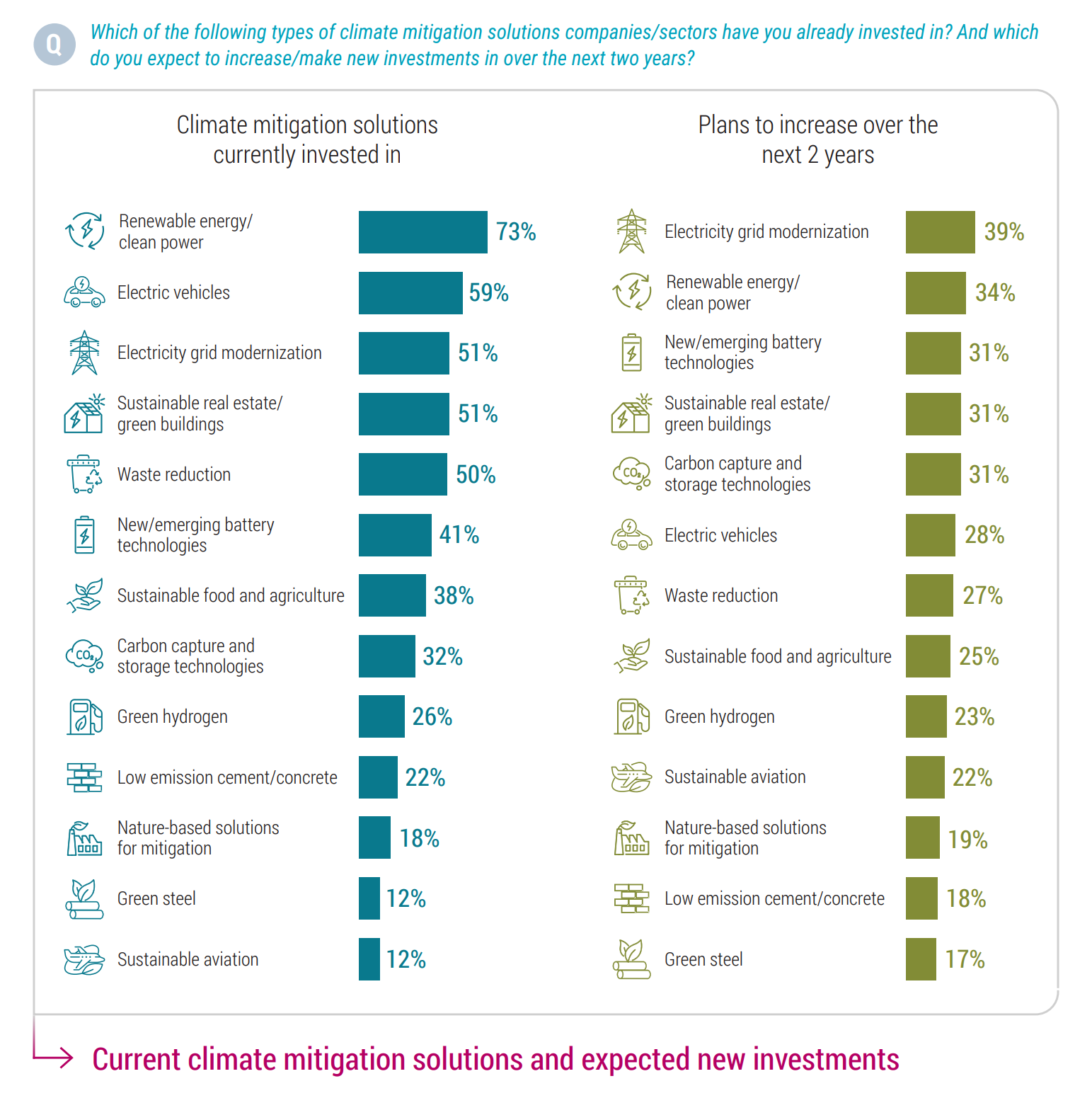
A majority of survey respondents currently invest in renewable energy, electric vehicles, electric grid modernization, and sustainable real estate, while opportunities like nature-based solutions, green steel, and sustainable aviation command less attention.
In the years ahead, investors plan to allocate increased capital primarily to electrification-related opportunities, whether that be grid modernization, renewable energy/clean power, or new/emerging battery technologies. Investors are less likely to be interested in increasing capital allocation in the future to currently popular solutions like electric vehicles and waste reduction.
The author or authors do not own shares in any securities mentioned in this article. Find out about Morningstar’s editorial policies.

 United States