
Global Appetite for Sustainable Investing Persists Through Q1, Survey Says
Morgan Stanley findings contradict data showing outflows from sustainable funds.


Interest in sustainable investing remains strong among individual investors, according to a study by Morgan Stanley’s Institute for Sustainable Investing. Younger investors, in particular, were overwhelmingly interested, with 99% of Generation Z survey respondents describing themselves as either “very interested” or “somewhat interested” in sustainable investing.
The survey results were released during a time that another arm of Morgan Stanley, its wealth management division, found that the proportion of bearish retail investors rose 9% in 2025’s second quarter, according to its quarterly pulse survey.
At the same time, the results fly in the face of data that show investors have been redeeming money from sustainable funds. For US investors in particular, “there is a clear disconnect between the strong appetite for sustainable investing that is reflected in surveys and the continued net outflows from ESG funds we’ve been seeing for the past couple of years,” says Hortense Bioy, head of sustainable investing research at Morningstar Sustainalytics.
“What can explain this disconnect? It may be that the investors that are pouring money into ESG funds (more likely to be younger investors) are putting in less than the money that other investors (more likely to be older and more seasoned investors) are taking out,” Bioy continues. “The outflows we’re seeing are net redemptions. There are still many funds that are gathering fresh capital.”
Jessica Alsford, Morgan Stanley’s chief sustainability officer and chair of the Morgan Stanley Institute for Sustainable Investing, said, “Investor interest and action do not always align. In the case of sustainable fund flows, there could be an element of short-term sentiment being negative given broader market conditions, thereby driving tactical withdrawals even if long-term interest is strong.”
Sustainable Investing Interest by Generation
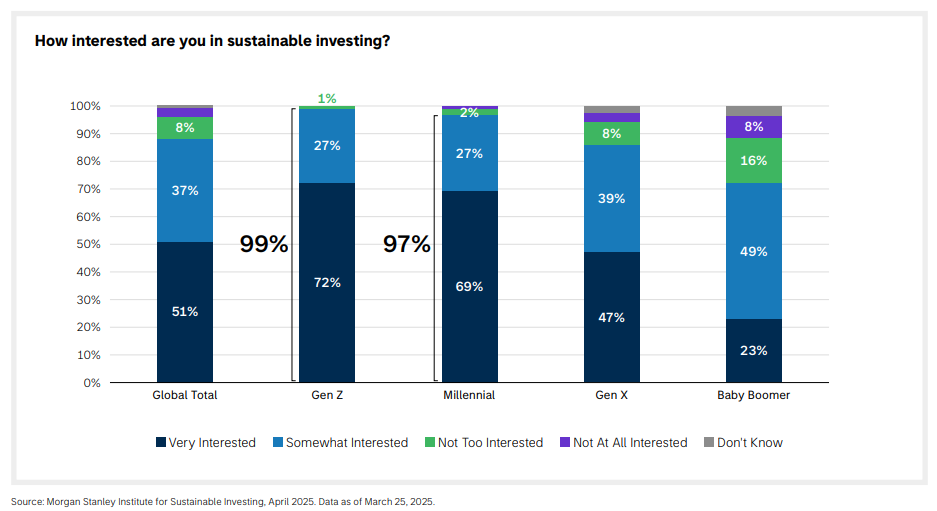
For the past six years, Morgan Stanley has published its Sustainable Signals report to capture shifts in the attitudes of individual investors on sustainable investing practices. It defines sustainable investing as “the practice of making investments in companies or funds that aim to achieve market-rate financial returns while considering positive social and/or environmental outcomes.”
Morgan Stanley’s Survey Methodology
Survey data for the 2025 Sustainable Signals report was collected from 1,765 individual investors in countries in Asia-Pacific, Europe, and North America. Excluding Gen Z participants (aged 18-28), these respondents held at least $100,000 in investable assets, “excluding personal retirement accounts, employer-sponsored retirement accounts, cryptocurrencies, and personal real estate,” and characterized themselves as either “somewhat active” or “active” market participants. To ensure that the survey was representative of North America and Europe, Morgan Stanley selected respondents aligned with the continental populations’ gender and age compositions. (For further details of the survey, please read this link.) All data is as of March 25, 2025.
Generation Gaps in Sustainable Investing Interest and Behavior
Morgan Stanley’s 2025 Sustainable Signals report found that a staggering 99% of Gen Z survey respondents were either “very interested” or “somewhat interested” in sustainable investing. This elevated level of interest in sustainable investing stands in stark contrast to that of baby boomers, of whom only 72% self-identified as either “very interested” or “somewhat interested” in sustainable investing. These disparities are further pronounced when looking only at the population of investors “very interested” in sustainable investing, with 72% of Generation Z respondents “very interested” compared with just 23% of baby boomers.
There is evidence, too, that younger investors’ interest in sustainable investing is translating to real-world outcomes. Morgan Stanley found that 45% of millennials and 51% of Gen Z respondents allocated “between 21% and 50% of their portfolio to sustainable investments,” whereas only 26% of Generation X and 16% of baby boomers reported the same.
Responses also revealed substantial gaps in awareness of allocation to sustainable investments across generations, with nearly half of baby boomers unsure of this metric while just 11% of Gen Z participants and 12% of millennials expressed such uncertainty.
Age may even play a role in the sources of financial advice that members of different generations select, with 96% of Gen Z investors being “very or somewhat likely” to “select a financial advisor or investment platform based on their sustainable investing offerings,” versus 52% of baby boomers.
Interest in Sustainable Investing Is Relatively Stable
Despite growing backlash on the merits of investing based on environmental, social, and governance factors and a shifting regulatory environment in the United States, Morgan Stanley found that interest in sustainable investing in both Europe and the US remained relatively unchanged since the last survey was published in 2024. In the US, for example, the percentage of survey participants who indicated they were “very interested” in sustainable investing only declined by 1% from 2023 to 2025 while remaining consistent in Europe. In the Asia-Pacific region, 70% of investors reported that their interest in sustainable investing had either “significantly” or “somewhat” increased in the past two years, slightly higher than a global total of 64%.
What’s Driving Continued Interest in Sustainable Investing?
When asked to select the top reason for their interest in sustainable investing, 44% of investors in North America and 46% of investors in Asia-Pacific agreed they “want to support positive real-world outcomes alongside a market-rate financial return.” Only in Europe were most investors driven by purely financial incentives, agreeing with the statement, “I believe that sustainable investments could offer stronger financial returns than traditional investments.”
For investors who reported plans to expand their allocations to sustainable investments within their portfolios—87% of Gen Z, 76% of millennials, 56% of Gen X, and 31% of baby boomers—justifications most commonly rested on the idea that sustainable investments could either match or outperform traditional investment vehicles. Baby boomers, however, were most likely to explain that increased allocations to sustainable investments were motivated by modeling the “real-world impacts” of climate change in their portfolio.
Obstacles to Sustainable Investing
Morgan Stanley found that the top three reported barriers to global engagement in sustainable investing practices were “concern about authenticity, or ‘greenwashing,’ lack of transparency and trust in reported data, and concern about investment performance.” Approximately two thirds of global retail investors expressed concern about each of these themes. Gen Z investors reported distinct challenges, however, related to “lack of knowledge, limited product availability, and insufficient financial advice” as compared with those in older generations.
Sustainable Investors’ Priorities for 2025
In 2025, 88% of global retail investors agree that “companies should address environmental issues,” with 69% and 86% of investors saying they are likely to consider a company’s actions across a broad set of sustainability issues when making investment decisions.” Two sustainability issues with broad appeal are energy efficiency and renewable energy.
Across the three regions, sustainable investors’ top hope is for their financial decisions to result in reduced pollution and waste. Other themes include improving healthcare access, ocean conservation, and reducing greenhouse gas emissions. According to the findings, over half of global retail investors would “only invest in traditional energy companies with robust plans to reduce their greenhouse gas emissions and address climate change,” with 84% of respondents worldwide agreeing that “there is money to be made investing in the clean energy transition.”
The author or authors do not own shares in any securities mentioned in this article. Find out about Morningstar’s editorial policies.

 United States