
You Might Think Industry Growth Drives Stock Returns. Here’s Why You’d Be Wrong
Investors, take note: Abnormal growth in earnings is neither persistent nor predictable.


Equities are generally considered to be growth assets, implying that equity market returns show positive correlation with economic growth. That’s the conventional wisdom held by most investors, at least in my experience. Conventional wisdom can be defined as ideas that are so ingrained in our beliefs that they go unchallenged. Unfortunately, much of the conventional wisdom about investing is wrong.
One example of conventional wisdom being wrong is that investors seeking high returns should invest in countries that are forecast to have high rates of economic growth, such as India. It certainly seems intuitively logical that if you could accurately forecast which countries would have high rates of economic growth that you would be able to exploit that knowledge and earn abnormal returns. But relying on intuition can lead to incorrect conclusions.
In this case, the wrong conclusion is reached because it fails to account for the fact that markets are highly efficient in building information about future prospects into current prices—investors fail to understand the difference between information and value relevant information. The empirical evidence on the correlation of country economic growth rates and stock returns demonstrates this point. For example, in their studies, both Joachim Klement, author of the study “What’s Growth Got to Do with It?,” and Jay Ritter, author of the study “Is Economic Growth Good for Investors?,” found no evidence of a positive correlation between stock market returns and real gross domestic product per capita growth. In fact, Ritter, who studied 19 countries with continuously operating stock markets from 1900 to 2011, found that the correlation between stock returns and the growth rate of per capita GDP was negative 0.39 when measured in local currency and negative 0.32 when measured in US dollars. Investors in 1900 would have been better off investing in companies of countries that experienced lower growth of their economies.
Similarly, the conventional wisdom is that companies that grow their earnings faster (growth stocks) outperform those with slower growth in earnings (value stocks). However, that conventional wisdom is also incorrect. Over the long term, while growth stocks have produced higher returns on assets, higher returns on equity, and faster growth in earnings, value stocks have produced higher returns. From July 1926 to September 2024, the Fama-French US value research index returned 12.79% annually, outperforming the Fama-French US growth research index, which returned 10.09%.
Industry Is Not Destiny
We see the same results when looking at industries—the fasting-growing industries have not produced the highest returns. If you asked most investors which industries and sectors have produced the highest returns to investors, my experience is that most believe that it would be technology and healthcare.
Let’s see if that is the case. From July 1926 through September 2024, US stocks returned 10.22% annually. Ken French’s data library shows that while high-tech and healthcare stocks did outperform, returning 11.35% and 11.67%, respectively, telecom stocks underperformed, returning 8.96%, and the highest-returning industries were beer (alcohol), returning 11.88%, and smokes (tobacco), returning 12.34%. We see the same results looking at the more recent period of July 1963 to September 2024. US stocks returned 10.64% annually, high-tech stocks returned 11.35%, healthcare stocks returned 11.99%, and both were outperformed by beer, which returned 12.18%, smokes, which returned 14.56%, and guns (defense), which returned 12.77%. Even shops (wholesale, retail, and some services such as laundries and repair shops) outperformed, returning 11.88%.
There is another issue we need to discuss. While investors tend to project abnormally fast earnings growth out into the future, one of the persistent mistakes that analysts and investors alike make is that they underestimate the power of one of the strongest forces in the universe—reversion to the mean of abnormal earnings growth.
Reversion to the Mean of Abnormal Earnings Growth
Expectations of future earnings growth matter a great deal to valuations because investors, in their collective wisdom, assign higher valuations to companies they expect will grow more quickly in the future (growth stocks). In contrast, firms expected to show slower growth (value stocks) are assigned lower valuations.
An implicit assumption in most forecasts is that growth is persistent. While analysts underwrite high growth for companies that have grown quickly and slow growth for companies that have grown slowly in the past, a large body of evidence demonstrates that reversion to the mean of both positive and negative abnormal earnings growth is the norm.
The Evidence
In their 1997 study, “Forecasting Profitability and Earnings,” professors Eugene Fama and Kenneth French tested whether the theory of profitability reverting to the mean stood up to the historical data. They examined the profits of an average of 2,304 firms per year for the period 1964 to 1995. Here are their conclusions:
- There was a strong tendency for profits to revert to the mean.
- Reversion to the mean was strongest when profits were highest (greatest incentive for competition to enter) and lowest (greatest incentive to leave an industry and reallocate assets, thereby reducing competition and restoring profits).
- Abnormally low earnings tended to revert even faster than abnormally high profits.
- Reversion to the mean occurred at a rate of about 40% per year.
- Real-world forecasts tended to underestimate the speed at which reversion to the mean in profitability occurred.
Beyond Fama and French
Other studies, written long ago, came to the same conclusions in both US and international stocks. Examples are the 1962 study, “Higgledy Piggledy Growth” the 1993 study, “Returns to E/P Strategies, Higgledy-Piggledy Growth, Analysts’ Forecast Errors, and Omitted Risk Factors,” and the 2002 study, “The Level and Persistence of Growth Rates.” In other words, it has long been known that reversion to the mean of abnormal earnings growth exists. That, combined with the high valuations of growth stocks and the low valuations of value stocks, provides at least one explanation (a behavioral one) for the historical value premium. (Another explanation is that the value premium reflects the greater risk of value stocks.)
Further Evidence
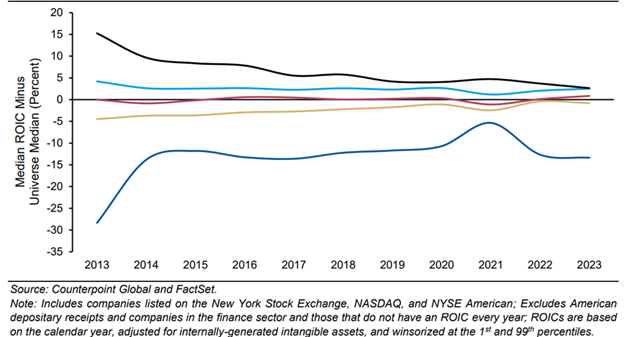
In their October 2024 study, “Measuring the Moat,” Morgan Stanley’s Michael Mauboussin and Dan Callahan provided the following chart showing that abnormal return on invested capital shows a powerful tendency to revert to the mean.
Regression Toward the Mean by Quintile for US Companies, 2013-23
Mauboussin and Callahan also provided the following chart (covering the period 1963 to 2023) showing both the ROIC of each industry and the dispersion of ROICs within an industry. The first chart shows the traditional ROIC; the second shows the ROIC adjusted for intangible capital.
ROICs by Industry, Traditional and Adjusted, for US Companies, 1963-2023
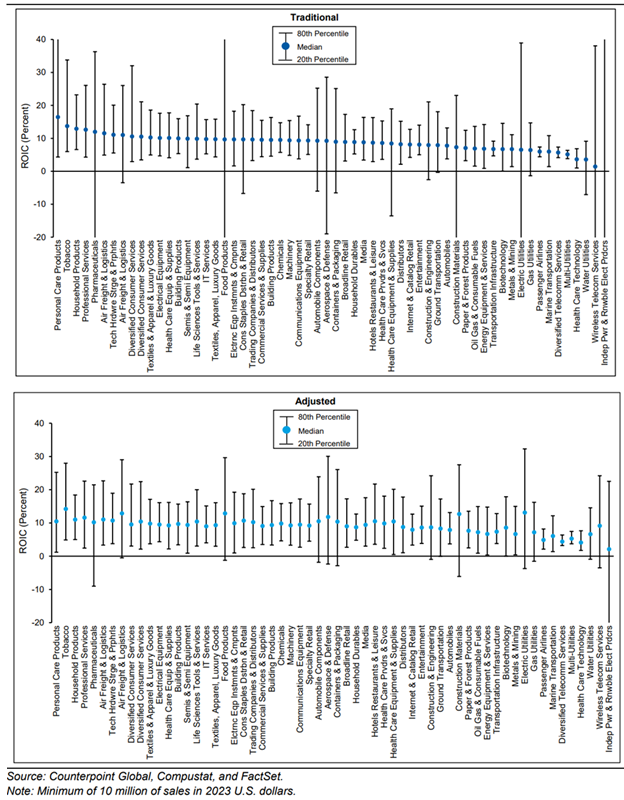
They drew the following conclusions from the charts:
“First, the variance within industries is greater than the variance across industries. This underscores that the industry is important but does not dictate a firm’s destiny. All industries have companies that create and destroy value. The second takeaway is that adjusting ROIC for intangibles tends to pull the very high and very low ROICs toward the middle. The median and average ROICs are similar for both the traditional and adjusted calculations, but the distribution has less variance following the modifications.”
Why Is Conventional Wisdom So Wrong?
Why is conventional wisdom so at odds with the data? There are several explanations. The first is that there is a general tendency for markets to assign higher price/earnings ratios when economic growth is expected to be high, which has the effect of lowering realized returns. Countries, industries, and companies that are expected to have strong economic growth can be perceived as safer investments. That translates into higher current valuations.
The second explanation is that the conventional wisdom fails to account for the fact that the markets price risk, not growth rates. High expected growth rates are built into current stock prices. The only advantage would come from being able to forecast surprises in growth rates. For example, if a country (company) was forecast to have 6% GDP growth (earnings growth), and it actually experienced a rate of growth of 7%, you might be able to exploit such information (depending on how much it cost to make the forecasts and how much it cost to execute the strategy). Unfortunately, there doesn’t seem to be any evidence of the ability to forecast GDP rates (or corporate earnings) any better than do the markets.
The third reason is that, while economic growth is good for people (producing higher standards of living, and those who live in countries with higher incomes have longer lifespans, lower infant mortality, and so on), equity investors don’t necessarily benefit. For example, a country can grow rapidly by applying more capital and labor without the owners of capital earning higher returns. And productivity gains can show up in higher real wages instead of increased profits.
Investor Takeaways
The takeaways for investors are:
- Faster growth in earnings or GDP does not forecast higher returns as markets already incorporate the faster growth into expectations/valuations.
- Industry is not destiny.
- Companies across industries can have higher expected returns.
- Abnormal earnings growth (both good and bad) reverts to the mean faster than the market has historically forecast. Thus, an investment strategy that bets on growth is a strategy likely to disappoint because abnormal growth in earnings is neither persistent nor predictable.
Correction: (March 13, 2025): A previous version of this article misspelled the name of Morgan Stanley researcher Michael Mauboussin.
The author or authors do not own shares in any securities mentioned in this article. Find out about Morningstar’s editorial policies.
Larry Swedroe is a freelance writer. The opinions expressed here are the author’s. Morningstar values diversity of thought and publishes a broad range of viewpoints.

 United States