
US Stocks Have Outperformed the World. History Shows That Success Can Be Fleeting
Why the most prudent strategy for investors is to diversify globally.


A question I get asked about a lot goes something like this: Given that US economic growth has been faster than in the rest of the developed world, and US stocks have far outperformed since 2008, why should we continue to invest internationally? To address this question, we’ll examine the factors that have led to faster economic growth. The following list breaks the factors into two broad categories: economic and policy.
Economic Factors That Led the US to Faster Growth
Innovation and Technology: The US has a strong culture of innovation and entrepreneurship, fostering a vibrant startup ecosystem. This leads to higher levels of research and development investment, driving technological advancements and productivity growth.
Flexible Labor Markets: US labor markets are generally more flexible than those in Europe, allowing for easier hiring and firing, which can help businesses adapt to changing economic conditions. The reason more capital doesn’t flow toward high-leverage ideas in Europe is because the price of failure is too high. A large enterprise doing a significant restructuring in the US costs a company roughly two to four months of pay per worker. In France, that cost averages around 24 months of pay. In Germany, 30 months.
Higher Productivity: US workers tend to be more productive than their European counterparts, partly owing to factors like technology adoption, education levels, and work practices.
Strong Consumer Spending: US consumers have a higher propensity to consume, which drives economic growth through increased demand for goods and services.
Policy Factors That Led the US to Faster Growth
Favorable Regulatory Environment: The US generally has a more business-friendly regulatory environment, with fewer bureaucratic hurdles and less stringent regulations compared with some European countries.
Lower Corporate Taxes: Lower corporate tax rates in the US can incentivize businesses to invest and expand, boosting economic activity.
Strong Intellectual Property Protection: Robust intellectual property rights encourage innovation and investment by protecting the value of new ideas and inventions.
Open Markets and Trade: The US has a more open economy, with lower trade barriers and a greater emphasis on free trade, which can stimulate economic growth through increased exports and imports.
It’s important to note that these are general trends and that individual European countries may have different economic and policy characteristics that affect their growth rates. Additionally, the relative performance of the US and European economies can fluctuate over time owing to various factors, including global economic conditions, geopolitical events, and changes in government policies. It’s also important to recognize that policies can change as countries seek to address the issues of slower economic growth. With that in mind, let’s review the historical evidence.
What You Don’t Know About Investing Is the Investment History You Don’t Know
In the 1980s, Japan experienced a massive investment boom. The Japanese stock market rose every year from 1983 to 1990, dramatically outperforming stocks in the rest of the world. At one point, Japan accounted for almost half of global market capitalization.
The story was simple. Japan was a manufacturing powerhouse, and corporate Japan’s approach to management was simply better than anywhere else in the world. This expertise fueled a transition from middle to high income for what had been a developing country. Foreign investors piled in. However, boom turned to bust, and for 35 years Japan’s stock market has had near zero nominal returns.
Today, the US seems as indomitable as Japan did in the 1980s. US technology companies lead the world. The best and the brightest from India, China, and Europe come to America to innovate. Our venture capital ecosystem is the envy of the world. This has led many US investors to come to the conclusion that international diversification is “diworsification.”
With that said, it’s worth noting the US is now trading at about 2.7 times sales and 4 times book, the same multiple Japan traded at the height of the 1980s bubble. And international markets, in turn, trade at much lower valuations: about 1.2 times sales and 1.6 times book. More importantly, about 75% of the US relative outperformance has come from valuation changes, with only a small percentage of the outperformance coming from the fundamentals that form the essence of the “Buy America” camp’s recommendations, according to research by AQR.
Essentially, the majority of the outperformance is a result of investors becoming more optimistic about US equities, an optimism founded on recent superior historical performance. However, as the Japanese example demonstrates, sentiment can change rapidly. As Warren Buffett has noted, buying when others are selling (as reflected in low prices) has been the winning strategy over the long term.
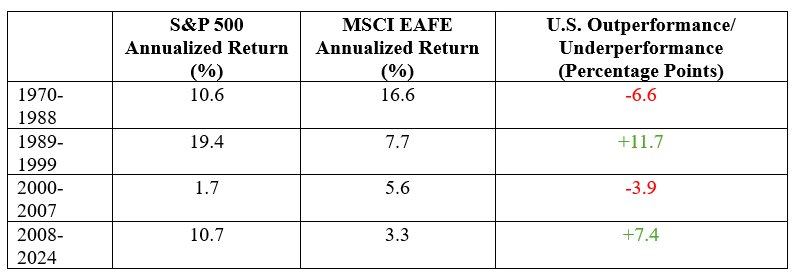
With that in mind let’s go to our trusty videotape to see whether history provides lessons we can learn from. The tables below display the relative performance of US and developed markets and that of the US and emerging markets.
US Versus International Equities
US Versus Emerging-Markets Equities
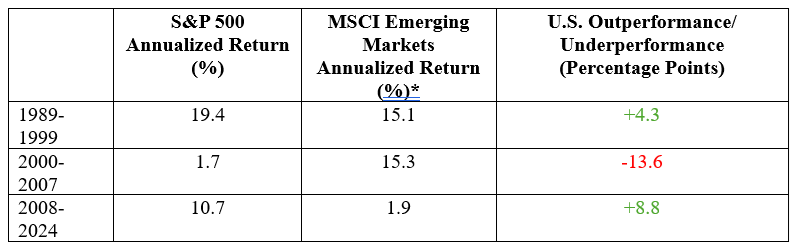
It’s easy to see in hindsight which regions outperformed in the past, but unfortunately, no one can predict in advance which one will outperform the others over any period. As the above tables demonstrate, outperformance over one period has tended to be followed by underperformance over the next. One of the main reasons this occurs is that much of the outperformance of one region during a certain period tends to be a result of rising valuations in that region relative to the others. While rising valuations lead to higher realized returns, they also result in lower future expected returns, at the same time when other regions with comparatively lower valuations can expect to achieve higher future returns, causing the pendulum to swing back again.
While these cycles of out- and underperformance are predictable at a high level, there are no crystal balls allowing us to foresee exactly when each shift will occur. The logical conclusion is that investors should be diversified internationally—that is, holding a mix of both US and international asset classes rather than betting on one to outperform the other—to capture the swings in valuation whenever they occur.
Unfortunately, being subject to recency bias, many investors tend to buy what has performed best in the most recent period (at higher valuations and thus lower expected returns) and sell what has underperformed (at lower valuations and thus higher expected returns)—the exact opposite of the Investing 101 motto of “buy low, sell high.”
For investors, weighing recent results over historical evidence would have resulted in overweighting international stocks in 1990, US stocks in 2000, international stocks again in 2008—all at the wrong time, when each asset class was about to enter a period of underperformance—and once again, US stocks today.
Everything Crashes at the Same Time, So Why Bother?
Historical evidence further supports the idea that while international diversification doesn’t necessarily work in the short term, with markets moving (mostly down) in tandem during systemic crises, it does often prove to work in the long run.
In a 2011 paper published in Financial Analysts Journal, ”International Diversification Works (Eventually),” Cliff Asness, along with coauthors Roni Israelov and John M. Liew, found that over the long run markets don’t exhibit the same tendency to suffer or crash together as they do during short spikes of volatility (when selling is largely driven by fear and panic); rather, they diverge over time based on actual economic factors, meaning that investing in any single country means betting on that country’s economic performance over the long run.
To put it another way, global diversification protects not against the risk of a single worldwide meltdown, but instead against the risk of any single country’s stocks underperforming the global market over a period of decades.
In their 2023 Journal of Portfolio Management paper, “International Diversification—Still Not Crazy After All These Years,” Asness, Israelov, and Liew updated the data from the previous paper through 2022 and concluded that “international diversification does a pretty great job of protecting investors over the long term.”
Their findings are consistent with those of Mehmet Umutlu and Seher Gören Yargi, authors of the May 2021 study, ”To Diversify or Not to Diversify Internationally?,” which concluded that international diversification is still important and has the potential to reduce portfolio risk because of how “correlations jump during recessions with a tendency to revert in stable periods,” even in more recent years when increasing globalization might lead one to expect correlations to be higher in all economic environments.
Investor Takeaways
While US stocks have far outperformed international stocks over the past 17 years, much of the outperformance stemmed from rising valuations of US stocks relative to international stocks. The result is that the US market is at its highest valuation relative to the rest of the world on forward earnings since at least 1988, when data collection began. Thus, the US advantages we have discussed are already built into prices, explaining a US premium. With that said, the valuation gap is now very large, with US stocks trading at about 22 times forecast earnings, a record high. The rest of the world is at about 13 times earnings.
Advisor Takeaways
While economic theory and empirical evidence suggest that the most prudent strategy is to diversify globally, it must be acknowledged that for many investors diversification can be hard. The reason for this is that even a well-thought-out, diversified portfolio will inevitably go through periods of poor performance. And sadly, when it comes to judging performance, it is my experience that most investors believe three years is a long time, five years is a very long time, and 10 years is an eternity.
Yet, as financial economists know, events that take place over 10 years are very likely to be nothing more than noise that should be ignored. Otherwise, instead of following a disciplined rebalancing strategy of buying low (the recent underperformers) and selling high (the recent outperformers), investors chasing recent trends tend to do the opposite, buying high and selling low. Smart investors know that if they are well-diversified, they will almost always have positions that have underperformed. To obtain the benefits of diversification you must be willing to accept that reality and have the discipline to stay the course.
Thus, it is critical for advisors to educate investors about the logic and benefits of global diversification and also explain the “risks of diversification,” what is called “tracking error” risk. Being forewarned about such risk, the investor will be better prepared to stay disciplined. Remember, investors cannot run away from risks, they only get to choose which risks they take. Failing to diversify globally creates the risk that the US might follow in Japan’s footsteps and be the next country to underperform for the next 30 years. Putting all your eggs in one basket is not a prudent strategy, no matter how familiar you are with, or how closely you watch, that basket.
The evidence has demonstrated that although the benefits of a global equity allocation may have been reduced by market integration, they have not disappeared. While global diversification can disappoint over the short term (as has been the case for those who diversified away from US stocks in the last 15 years), over longer periods it is still the free lunch that economic theory and common sense imply.
Before making the mistake of confusing the familiar with the safe, no one knows which country or countries will experience a prolonged period of underperformance. That uncertainty is what international diversification protects against and is why broad global diversification is still the prudent strategy.
The bottom line is that while the prudent strategy is to globally diversify, investors will likely fall prey to recency bias and abandon even a well-thought-out plan, likely at the wrong time—unless the mistake of resulting (judging the quality of a decision by the outcome instead of the decision-making process) can be avoided. Helping to keep investors disciplined is one of the most important roles of a financial advisor.
The author or authors do not own shares in any securities mentioned in this article. Find out about Morningstar’s editorial policies.
Larry Swedroe is a freelance writer. The opinions expressed here are the author’s. Morningstar values diversity of thought and publishes a broad range of viewpoints.

 United States