
Why Are European Auto Stocks So Cheap?
Sales may have jumped, but concerns about chip shortages continue to weigh on the outlook.


European car sales were up 18% in the first half of the year, but that’s not apparent from looking at how cheaply the region’s carmakers are valued.
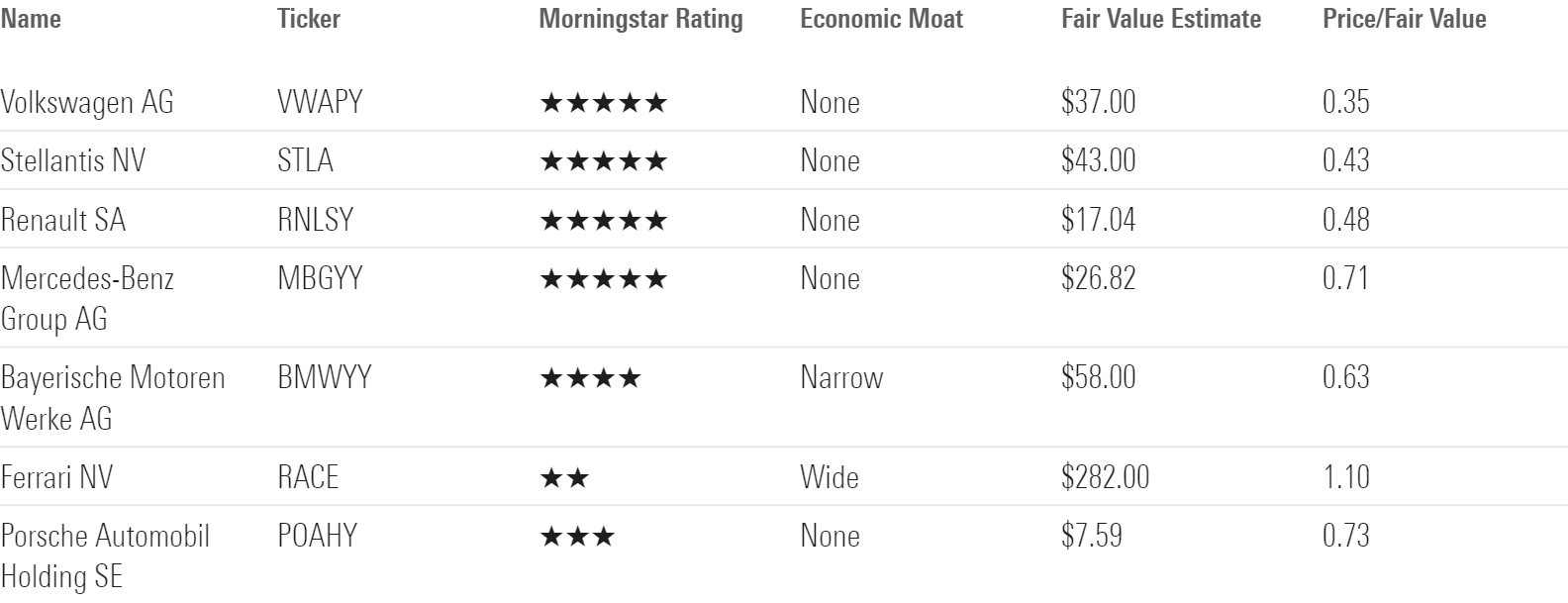
The stocks of most European automotive companies are trading at less than half their fair value estimates assigned by Morningstar analysts. For example, Volkswagen VWAPY is trading at roughly one-third of its fair value estimate, and Stellantis STLA is at almost a 50% discount.
While that may mean the time is ripe for long-term investors to buy quality stocks at a bargain, Morningstar automotive analyst Richard Hilgert says the situation is complicated.
On the one hand, demand for new cars was strong in the first part of 2023, but high inflation and concerns about an economic slowdown are dampening the outlook. At the same time, supply chain challenges linger for semiconductor chip-makers, inhibiting automakers’ ability to deliver. But as those shortages resolve, that will remove reduce headwinds from that direction.
“The market predicts a stronger demand, but we have yet to see that happening,” says Hilgert. “But there is a clear path toward higher demand, and if that materializes, stocks will go up again.”
Automotive Bargain Bin
Auto Sales Looking Softer After the Early 2023 Jump
In the first half of 2021, automotive stocks rallied, anticipating higher demand and production. When that didn’t materialize, a sell-off followed in the first quarter of 2022.
The sentiment behind that sell-off lingers today for original equipment manufacturers such as Volkswagen, which was priced at $12.76 per share while its fair value estimate was $37.00 as of Aug. 11. BMW BMWYY is one of Hilgert’s top picks together with General Motors GM, and its share price was $36.53 on Aug. 11, compared with its $58.00 fair value estimate.
When the industry reaches the point where production and deliveries can match demand, automakers’ revenues and profits should grow to the levels implied by their current fair value estimates, Hilgert says.
That’s despite a jump in first-half auto sales, which he attributes to the delayed delivery of orders that could not be fulfilled until now due to the shortages of chips and other components. Once that delay was overcome, the European Automobile Manufacturers’ Association logged growth in new registrations, ranging from 11.3% in January to an impressive 28.8% in March. That resulted in a 17.9% year-on-year rise in the first half of 2023. Most of Europe’s largest markets grew significantly, with new registrations in Spain up 24%, Italy up 22.8%, France up 15.3%, and Germany up 12.8%.
Now that manufacturers have filled much of the backlog, new demand must replenish the order books, but so far this hasn’t happened. The German industry group Verband der Automobilindustrie observed a decline of 27% in new orders among its members during the first half of 2023. International orders for German manufacturers were down just 5% for the period, but with a downward trend, culminating in a 12% slump in June.
High inflation is making European consumers hesitant to make large expenditures like new cars. Car prices have accelerated at an even faster clip than general consumer prices, with the average price of a new car in the Netherlands now well over 40,000 euros. On top of that, rising interest rates make financing or leasing a car much more expensive.
Demand Seen Improving in 2024-25
Hilgert predicts this slowdown will largely offset the strong first half of the year, resulting in much more muted sales growth of 1%-5% for all of 2023. He expects demand to rise again once recession fears have been allayed and the economic slowdown has bottomed. For 2024-25, he sees demand rising again and registrations increasing from 12.8 million cars in 2023 to 15.8 million in 2027.
Hilgert believes output will rise as well: “Production levels at the car manufacturers are still relatively low at the moment. We are now in the fourth year of constrained production.” Compared to 2019 (the last full year before the COVID-19 pandemic), volumes in the first half of 2023 were 21% lower, according to ACEA data.
Hilgert points out that production constraints stem from semiconductor chip manufacturers remaining unable to deliver the chips needed by the automotive industry. If that industry continues expanding its capacity and strengthens local supply chains, car production can ramp up.
Why Your Portfolio Needs International Stocks
The author or authors do not own shares in any securities mentioned in this article. Find out about Morningstar’s editorial policies.

 United States