
Do AI Labs Like Anthropic and OpenAI Have Economic Moats?
Leading AI labs are building economic moats to stave off commodification threats.



Morningstar is rolling out coverage of artificial intelligence labs ahead of Anthropic’s expected IPO. A key question will be whether the companies have economic moats—sustainable competitive advantages that will help them outpace competitors. In the first part of a three-part series, based on our full research report, we study whether companies such as Anthropic and OpenAI have moats.
In the almost four years since the launch of OpenAI’s ChatGPT, our technology equity research team has heard one alarmingly simple concern time and again: If every large language model can write the same email, summarize the same earnings, and generate a coherent block of code, can the firms building these LLMs really earn outsized profits?
We began hearing this question in 2024 and 2025, concerning whether public cloud vendors—such as Amazon AMZN, Microsoft MSFT, and Alphabet GOOG/GOOGL, which have each poured billions into partnerships with Anthropic and OpenAI—could earn reasonable returns on their large AI-related expenditures. In 2026, with investors eyeing potential IPOs in the AI lab space, the question is aimed more at labs such as Anthropic and OpenAI, as investors try to figure out whether they are on a fast track to commodification or building durable businesses.
If the labs cannot earn profits, the concern spreads well beyond Anthropic and OpenAI. The spending commitments rippling across chips, power, and data centers rest on the assumption that AI can be monetized at attractive returns. This effectively makes the question of commodification about the durability of the entire trade.
Morningstar’s View
We’re on the more bullish side, as we think leading AI labs are building moats. We do not view these moats as fully formed yet. That said, early usage data, product development, and partnerships indicate leading labs will be able to extract economic returns from developing and running cutting-edge LLMs, staving off threats of commodification.
Specifically, we see two moat sources forming: a network effect driven by data and product improvements, and a structural cost advantage built on growing training costs and gigawatt-scale compute discounts.
Network Effects: We See the Flywheel Beginning to Spin
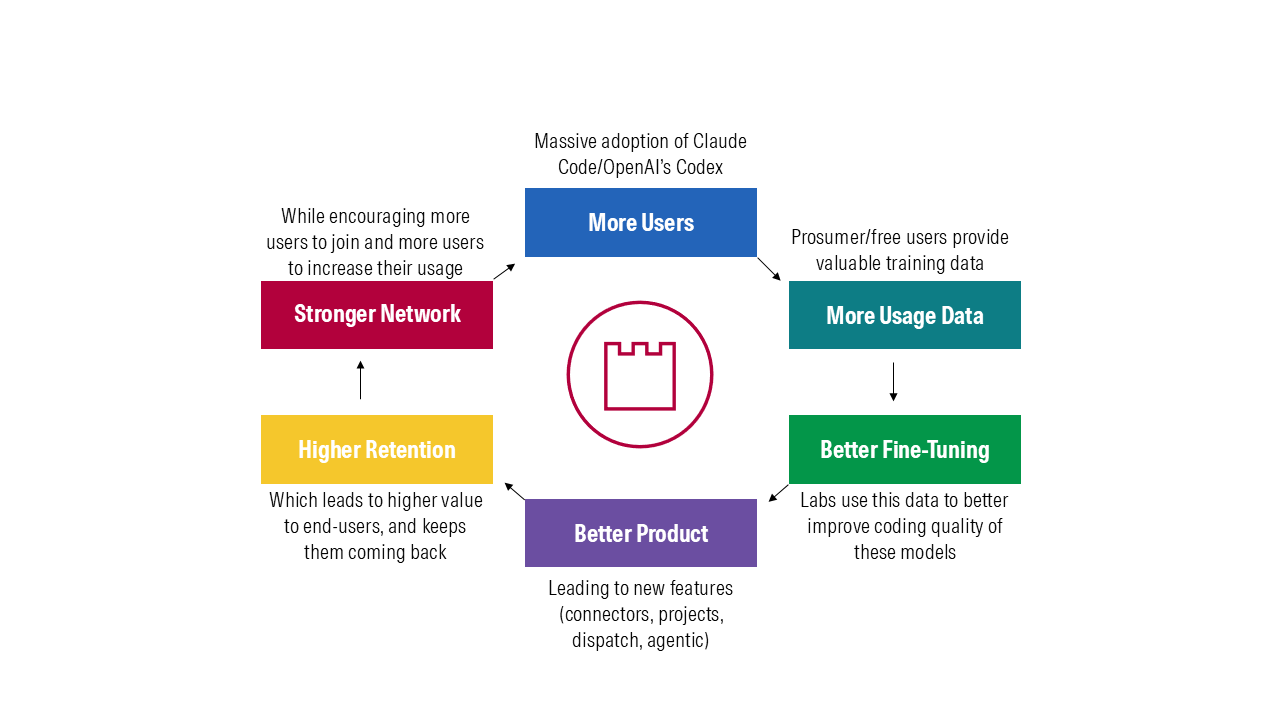
We see the network effect forming around the model businesses as a data-and-product flywheel—an indirect network effect in which the company uses data to improve the product for everyone. The AI labs’ emerging network effects serve as a feedback loop that they can use to iterate faster on both their model and tool development.
The network effect we observe at the leading labs runs through a six-station flywheel, with early adoption of coding products a clear demonstration of this dynamic. We expect this dynamic to ripple across other model use cases and personas as adoption of this technology broadens.
Network Effects
Structural Cost Advantages
We’ve seen Anthropic and OpenAI use algorithmic advancements, custom silicon, and multiyear compute deals to quantitatively reduce their cost to serve these LLMs, putting them at a clear cost advantage over other firms.
Our core thesis on AI lab unit economics is that inference demand (end users leveraging existing models to generate code, text, and answers to questions) is scaling exponentially, with a significantly steeper curve than the training and research costs required to build the initial models. As both inference and training and research costs continue to scale, the gap between the two curves widens, and that is where this industry’s profits will be found. The scalability and amortization of these three distinct costs—training, research, and inference—are key to understanding these firms’ longer-term margin trajectories.
The Three Primary Cost Centers for AI Labs
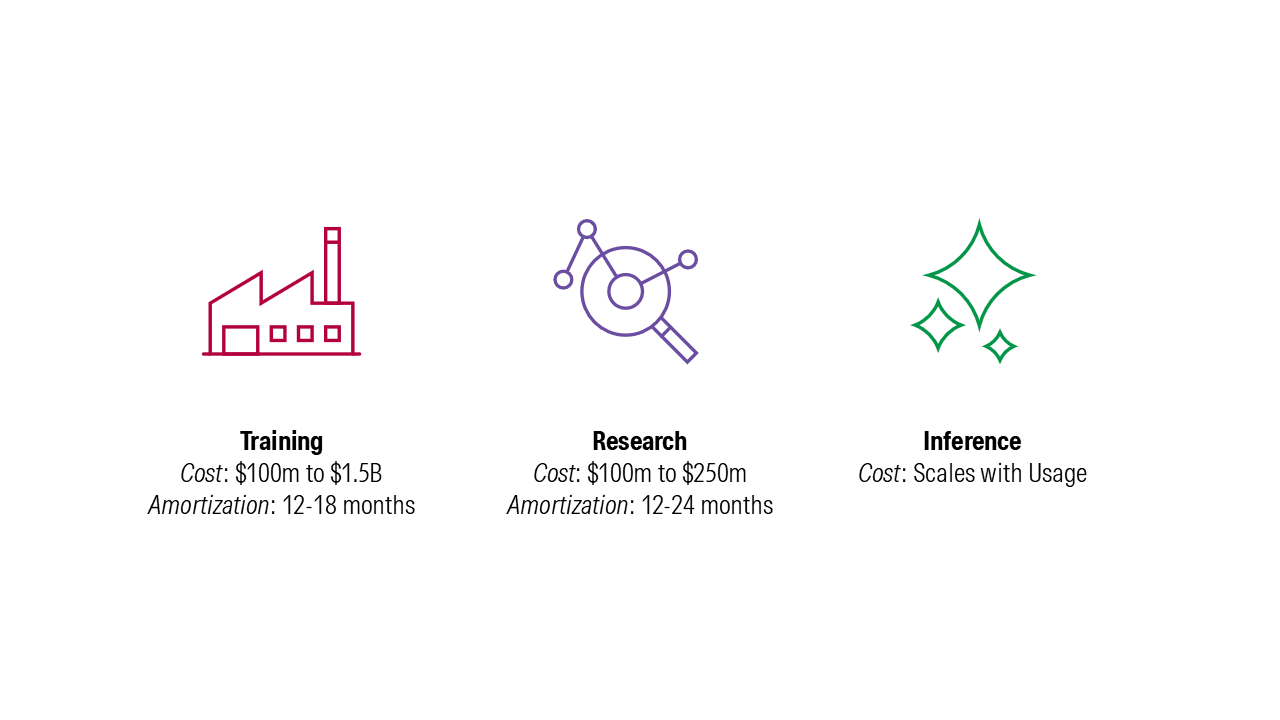
The structure and time scale of these cost centers point to the central asymmetry of the model business. Training and research are lumpy, front-loaded, and generation-bound, while inference is smooth and usage-linked.
Over the past few years, we’ve seen AI labs focus the vast majority of their resources on training and research as they’ve been building core models and the ecosystem to leverage them from scratch. Meanwhile, inference scaling only kicked off in earnest in 2025-26. This inference scaling relied on investments in training and research that made the models and relevant tools useful enough for companies and users to deploy.
So, as investors, the real question about AI lab economics is not whether a lab loses or makes money during training and research (they lose money), but rather what the company’s economics look like as inference becomes a larger part of the overall compute pie, and how much can inference scale relative to training.
Longer-term margins in the model business are driven by inference rather than training. Investors who are over-indexed on high training budgets will continue to miss the fundamental strength of these businesses. As more compute comes online, a disproportionate share will be earmarked for inference, further skewing these businesses’ margin profiles upward. Stated differently, while the initial margins are negative (dominated by training), the incremental margins are closer to 80% (the margin profile of pure inference), and as these companies mature and inference becomes a larger proportion of the overall compute budget, we will shift closer and closer to that 80% mark.
The transition is happening right now. Anthropic reached operating profitability (not gross profitability, mind you) in the first quarter of 2026, posting 5% operating margins on $11 billion in quarterly sales. The firm achieved this milestone as its compute mix shift skewed more toward inference. We’d also note that the firm’s path to operating profitability in the first quarter of 2026 was much faster than the bears’ model, which assumed these labs would remain unprofitable indefinitely.
More About Morningstar’s Economic Moat Ratings
The economic moat rating is a structural feature that Morningstar believes positions a firm to earn durable excess profits over a long period of time, with excess profits defined as returns on invested capital above our estimate of a firm’s cost of capital.
Narrow-moat companies are those that we believe are more likely than not to achieve normalized excess returns for at least the next 10 years. Wide-moat companies are those that we believe will earn excess returns for 10 years, with excess returns more likely than not to remain for at least 20 years. Firms without moats are more susceptible to competition. Morningstar has identified five sources of economic moats: intangible assets, switching costs, network effects, cost advantages, and efficient scale.
The author or authors own shares in one or more securities mentioned in this article. Find out about Morningstar’s editorial policies.

 United States