
Consumer Cyclicals: Stocks Heat Up to Close Out 2024, but Discounts Remain
Our favored stocks in this sector include Under Armour and Polaris.

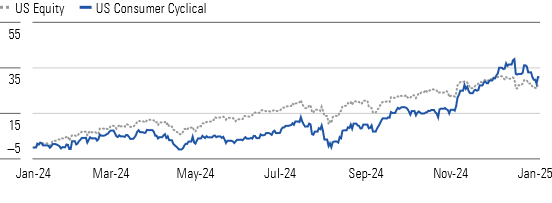
The Morningstar US Consumer Cyclical Index jumped over 10% in the fourth quarter and outperformed the broader market’s 3% rise. The sector’s results moved many stocks closer to our fair value estimates, leaving just around one-third of our coverage trading in a range we’d consider undervalued.
Consumer Cyclical Stocks Soar, Edging the Market's Trailing-12-Month Gains
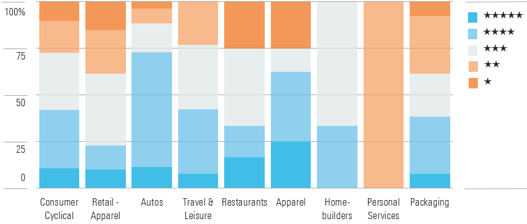
The median stock is now priced at just a 4% discount, versus 11% three months ago. Even against this performance, apparel stocks remain the most undervalued subsector at an almost 30% discount, with 60% of the stocks in our coverage trading in 4- or 5-star territory.
Bargains Shrink, but We Still See Opportunity Among Apparel Names
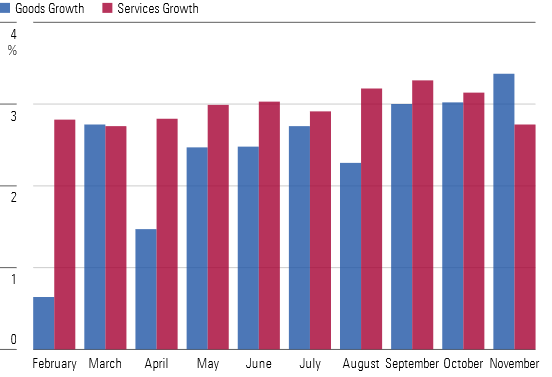
After a period of uneven economic growth and supply chain disruptions following the pandemic, we believe consumer spending on goods and services has normalized. In November, spending on goods grew by 3.4%, a bit better than services spending growth of 2.8%. For comparison, in January 2024, services spending grew 2.5%, but spending on goods was up only 0.6%. Firms in apparel and other consumer-focused industries could record stronger profits while boosting investments in merchandise and marketing. Meanwhile, we don’t anticipate a decrease in spending on services. Rather, we suspect that demand for services, including travel, should persist, just at a more durable low-single-digit clip than the roughly 14% pace that followed the lifting of covid-19 restrictions in 2021.
Services Spending Growth Resilient as Goods Spending Resumes
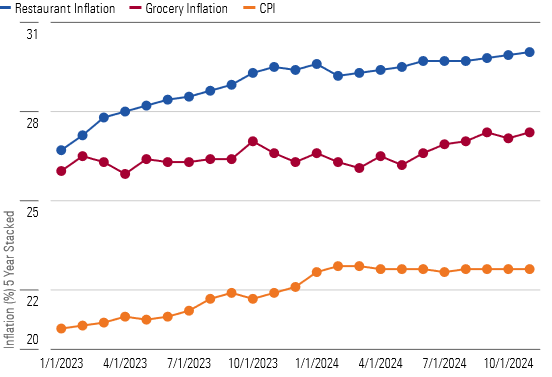
Though inflation has started to moderate, restaurants have still been feeling the effects of food and wage hikes. This has resulted in a 2.7-percentage-point difference between grocery and restaurant inflation as of November. To counter these pressures, restaurants have passed through 30% cumulative price increases since 2019. However, this has weighed on traffic. Even as restaurants have attempted to prompt visits by offering promotions, this has come to the detriment of margins. As such, we expect operational efficiency initiatives will be a priority throughout 2025.
Restaurant Pricing Gap Widens as At-Home Consumption Continues to Grow
Top Consumer Cyclical Sector Picks
Kohl’s
- Fair Value Estimate: $45.00
- Morningstar Rating: ★★★★★
- Morningstar Economic Moat Rating: None
- Morningstar Uncertainty Rating: Very High
We believe Kohl’s KSS, trading at around a 70% discount to our fair value estimate, is an attractive investment opportunity. Although traditional department stores are struggling, the firm has substantial e-commerce, as its large store base allows it to ship directly from stores and encourages customers to buy online and pick up in stores. In addition, its partnership with Sephora has enhanced its beauty business and made it more competitive with other department stores and Ulta ULTA. Recently appointed CEO Ashley Buchanan is expected to maintain Kohl’s focus on its loyalty program, Sephora, inventory management, and debt reduction.
Polaris
- Fair Value Estimate: $110.00
- Morningstar Rating: ★★★★★
- Morningstar Economic Moat Rating: Wide
- Morningstar Uncertainty Rating: Medium
Polaris’ PII shares trade at a roughly 50% discount to our fair value estimate. The company’s favorable brands, innovative products, and lean manufacturing support its wide economic moat. We think the firm will continue to capitalize on its research and development, solid quality, and operational excellence to increase demand. Recently, shares have been pressured by headwinds stemming from slowing consumer conversion and cautious dealer behavior, factors we believe will be transitory. Once dealer inventory is optimized, wholesale shipments should more closely track with consumer demand. We think long-term demand stemming from product launches will support shipment growth and profit improvement beyond 2024.
Under Armour
- Fair Value Estimate: $14.50
- Morningstar Rating: ★★★★
- Morningstar Economic Moat Rating: None
- Morningstar Uncertainty Rating: High
Under Armour UA trades at a 40% discount to our fair value estimate. Controlling shareholder Kevin Plank returned as CEO in early 2024, and he plans to focus on core men’s performance apparel, faster product development, less discounting, and North America. Additionally, the firm has cut $200 million in average annual costs and continues to seek ways to operate more efficiently. Under Armour has room to grow in international markets like China, where it currently has a low market share.
The author or authors do not own shares in any securities mentioned in this article. Find out about Morningstar’s editorial policies.

 United States