
The Best Stock-Picker in Recent Years? The Marketing Department
Stocks chosen for leveraged single-stock ETFs have crushed. There are lessons in that.

The best-performing strategy of recent years wasn’t the work of a portfolio manager ensconced in a corner office overlooking midtown Manhattan, Boston Harbor, or downtown Los Angeles. It was some schlub sitting in a windowless cube over in product development.
Silly as that sounds, it’s not too far from the truth: The stocks chosen for leveraged single-stock exchange-traded funds—vehicles that cater to speculators—have done exceptionally well. And who picked those stocks? Someone whose job it was to know which stocks were the most buzzed-about among retail trader-types at a given time.
I was able to build an equally weighted hypothetical portfolio of these stocks, thanks to a new data point in Morningstar Direct that makes it possible to systematically track them. With each new launch of a leveraged single-stock ETF, I added its reference stock to the portfolio, then tracked the portfolio’s performance from August 2022 through this month.
Growth of $10,000: Leveraged Single-Stock ETFs vs. Leveraged Single-Stock ETF Reference Stocks (August 2022 to October 2026)
This hypothetical portfolio would have crushed the market and left virtually every active fund in its dust. (Its returns also rivaled the ETFs’ themselves, lagging by only 5 percentage points or so a year despite the fact the ETFs employed leverage throughout.)
So, in summary: A hypothetical strategy built around stocks picked based on their appeal to traders, for use in vehicles meant to be held no longer than a day, would have beaten nearly all comers over a four-plus year period, just like no one would have predicted.
Putting on a Stock-Picking Clinic
What drove the outperformance? The first batch of stocks chosen for these ETFs did extraordinarily well: 25 of the initial 35—which included the Magnificent Seven (Alphabet GOOGL, Amazon.com AMZN, Apple AAPL, Meta Platforms META, Microsoft MSFT, Nvidia NVDA, and Tesla TSLA) as well as a host of artificial intelligence- and chip-related names—would have pushed the portfolio past the market.
Hypothetical Leveraged Single-Stock ETF Reference Stock Portfolio: Performance of First 35 Stocks Bought From Initial Purchase Date
There were even cases where the stocks chosen for these ETFs performed in line with the market over the full period but still contributed to the strategy’s outperformance, thanks to fortuitous timing. For instance, the portfolio would have owned larger weights in Coinbase from 2022 to 2024, when it was surging, and smaller weights before it entered a deep drawdown last year.
To be sure, it wasn’t all smooth sailing. The portfolio would have plunged right out of the gate, losing 41% of its value in its first five months of existence amid a tech pullback. Also, it wouldn’t have fared as well lately. To illustrate, here are the stocks’ average excess returns based on the year in which they would have entered the hypothetical portfolio.
Hypothetical Leveraged Single-Stock ETF Reference Stocks Portfolio: Average Excess Returns Based on Year Stock Was Purchased
The average stock purchased in 2022 and 2024 excelled, but names added in 2025 and thus far in 2026 have lagged. (There wouldn’t have been any purchases in 2023 because the leveraged single-stock ETFs launched that year tracked equities that had already been selected as reference stocks for other leveraged single-stock ETFs.)
Flash in the Pan?
Given this, it’s reasonable to ask whether it was just a fluke.
To test that, I ran the hypothetical portfolio’s daily returns through a four-factor regression (that is, market, size, style, momentum) as of Aug. 31, 2026. Not too surprisingly, I found the portfolio was much more volatile than the broader market, with heavy exposure to small-cap, growth, and momentum stocks. What I didn’t find, though, was statistically significant “alpha.”
Hypothetical Leveraged Single-Stock ETF Reference Stocks Portfolio: Four-Factor Regression Coefficients (August 2022 to August 2026)
Thus, while the performance was impressive, it looked a bit less so after accounting for these risks.
When you dig a little deeper, it becomes apparent that chance would have worked in the strategy’s favor. For instance, the stocks chosen for these ETFs had typically posted very strong recent performance: The average stock gained 174% in the 12 months leading up to the ETF’s launch, with only 35 stocks losing money in the year prior to inception.
Hypothetical Leveraged Single-Stock ETF Reference Stocks Portfolio: Distribution of Stocks by Trailing 12-Month Returns at the Time of Purchase
But, as it happens, the first batch of stocks chosen for these ETFs included several that were reeling from losses when the ETFs incepted, including Meta (negative 65%), Nvidia (negative 42%), and Coinbase COIN (negative 62%). Those stocks ended up being some of the biggest contributors to the hypothetical strategy’s outperformance, as they proceeded to rally sharply higher after the ETFs launched and also because they were big weights initially.
You can see this when you break down the stocks’ average contribution to the strategy’s relative performance based on their prior year return. The stocks that had previously lost would have contributed disproportionately to the hypothetical portfolio’s success, while those that had gained over the preceding year contributed far less.
Hypothetical Leveraged Single-Stock ETF Reference Stocks Portfolio: Average Stock's Contribution to Portfolio's Relative Performance, by Range of Return in the 12-Month Period Before Purchase
Had the managers of these ETFs waited until these stocks had spurted to huge gains before launching leveraged single-stock ETFs tracking them, the hypothetical strategy would have missed out on much of the upside. In other words, it appears this hypothetical portfolio did as fabulously as it did because the managers acted very much out of character initially, favoring stocks that had gotten crushed recently instead of those that had excelled.
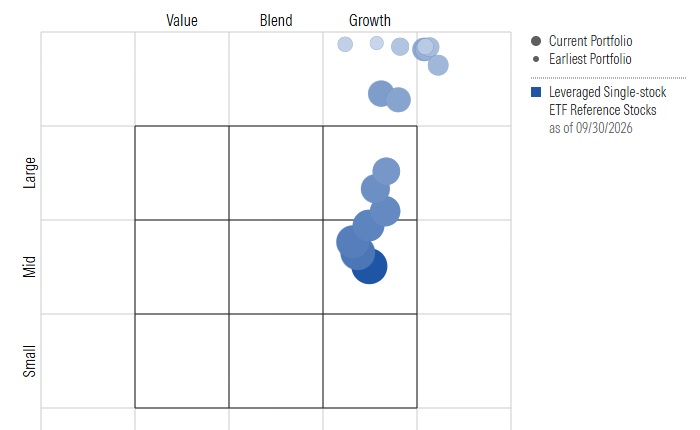
You can see from the hypothetical portfolio’s holdings-based style trail how much the stocks chosen for these ETFs drifted in the direction of fledgling small- and mid-cap names. Even though the strategy would have worked, it was hardly a study in consistency, which raises questions about how durable its success might be.
Hypothetical Leveraged Single-Stock ETF Reference Stocks Portfolio: Style Trail
Takeaways
I think there are a few lessons in this:
- “Success” often defies logic. Imagine me telling you the best-performing active strategy of recent years was one based on stocks chosen for leveraged single-stock ETFs. You’d scoff. But that’s what makes markets. Seemingly daffy things work more often than you’d expect, especially over shorter time frames.
- Standout results are often a risk and luck story. While this hypothetical strategy’s performance was very impressive at first glance, the edifice began to crack the more we scratched at it, that is, once we accounted for the extra risk and idiosyncrasies it entailed. This is often the case with active strategies that excel over shorter periods.
- Seemingly inconsequential choices can add up. Consider how much of the hypothetical strategy’s outperformance hinged on the initial batch of stocks the ETFs’ managers chose to track. Or that there weren’t more leveraged single-stock ETFs that launched in 2022 and 2023, allowing the portfolio to concentrate on the initial outperformers for longer. Or that I rebalanced the portfolio only when it added a new stock, letting winners run in the interim, further bolstering returns. Little things that are hard to assess in isolation but ultimately proved pretty crucial.
- Maybe just own the stocks? As mentioned, the hypothetical stock portfolio’s returns rivaled the performance of the ETFs that track them. This isn’t a huge surprise considering the compounding math breaks down for daily leveraged strategies held beyond a single day, and there’s also the drag from fees and implementation costs. But it’s still startling to see how seemingly little payoff there was to hold the ETFs compared with the stocks themselves. This finding is consistent with research my colleague Bryan Armour did finding the median leveraged single-stock ETF lost 38% from its inception through August 2026.
- Position sizes mattered a lot more than past performance. Yes, this would have been a go-go, high momentum strategy. And it’s true that some of the stocks chosen for the hypothetical portfolio had fantastic recent returns and kept on chugging. But the most decisive factor was choosing the first clutch of stocks after they’d gotten clobbered and owning sizable positions in them for the better part of two years.
- It might succeed, but you probably won’t. This hypothetical initially looked borderline crazy (that is, concentrating in a handful of stocks that were in free-fall), got off to a ruinous start (that is, it promptly lost 40% of its value), and didn’t cease to be hypervolatile or at least unpredictable thereafter. It would have worked grandly, but most people can’t handle an approach as unorthodox and topsy-turvy as that.
Switched On
Here are other things I’m reading and listening to:
- ARK and tokenization
- How to run a prediction-markets book
- A rhapsody to the new Apple AirPods
- When a chatbot has you unwittingly hike something called the “Widowmaker”
Don’t Be a Stranger
I love hearing from you. Have some feedback? An angle for an article? Email me at jeffrey.ptak@morningstar.com. If you’re so inclined, you can also follow me on Twitter/X at @syouth1, and I do some odds-and-ends writing on a Substack called Basis Pointing.
The author or authors do not own shares in any securities mentioned in this article. Find out about Morningstar’s editorial policies.

 United States