
This Unloved Asset Class Looks Attractive Regardless of the Election Results
There are reasons to consider small value stocks today that have nothing to do with politics.


Does anyone else have déjà vu all over again? “We’ve Seen a Postelection Small-Value Rally Before,” I wrote in November 2020. That month saw Joe Biden’s victory and a powerful rally among US small-cap stocks, with value leading growth. The Morningstar US Small Value Index was also the top-performing Morningstar Style Box segment after Donald Trump’s victory in 2016.
Another presidential election, another small-cap rally. Trump was declared the victor on Nov. 6. The Morningstar US Market Barometer following the close of trading that day looked like this:
Morningstar US Market Barometer - 11/6/24
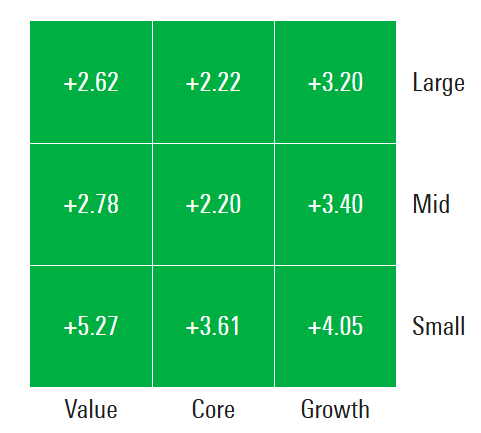
Clearly, small caps are one of this year’s “Trump Trades,” along with the US dollar, cryptocurrencies, and rising bond yields. But this was the third straight postelection small-value rally. “History doesn’t repeat, but it does often rhyme,” as attributed to Mark Twain.
In that spirit, I can’t help but wonder whether the current postelection small-cap rally will fizzle just like its predecessors did. Yet there are reasons for investors to consider this unloved asset class that have nothing to do with politics. Sometimes it is different this time.
What’s the Deal With Small-Cap Value Stocks?
Small caps overall tend to be economically sensitive, but of Morningstar’s nine style box segments, small-value is the most cyclical. More than 65% of the Morningstar US Small Value Index’s weight is currently in sectors like financial services, basic materials, consumer cyclicals, and real estate. Among the index’s top constituents are East West Bancorp EWBC, Alcoa AA, Tapestry TPR, and Jones Lang LaSalle JLL.
Why does the market see small-value stocks as big beneficiaries of the election results? It is clearly betting on the unleashing of what John Maynard Keynes called “animal spirits”—an infusion of economic energy. Tax cuts, deregulation, and pro-business policies are all expected from President Trump and the Republican majority in Congress.
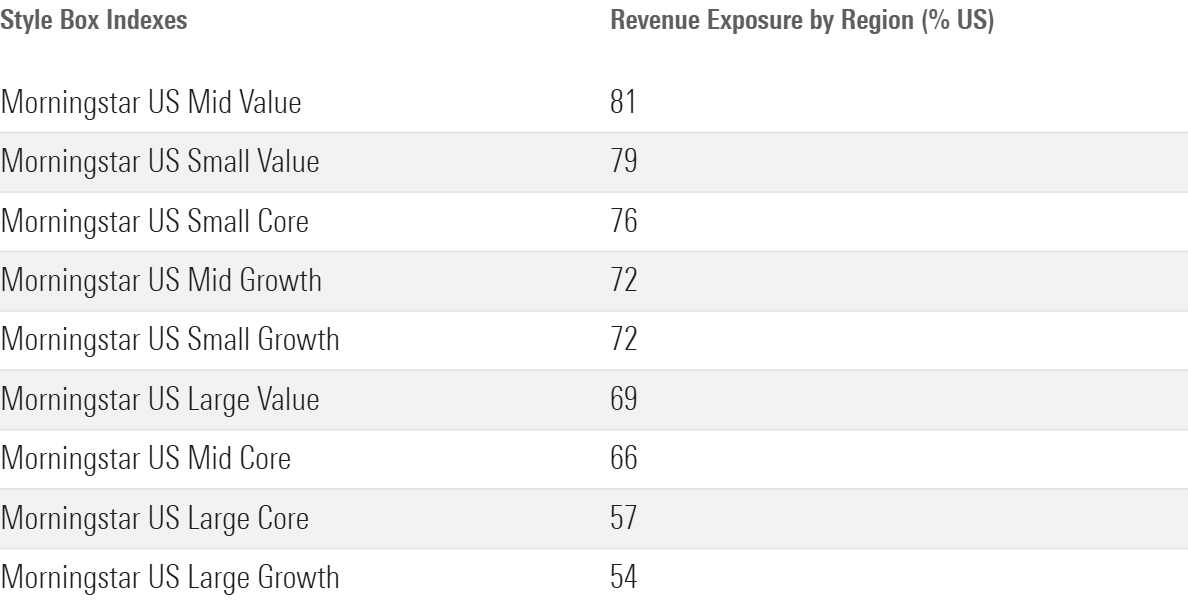
Trump’s proposed tariffs are also key to the small-value rally. The goal of slapping tariffs on imported goods is to protect American industry. Businesses in the small-value section of the US equity market tend to be domestically focused. The Morningstar US Small Value Index is shown to earn an estimated 79% of its revenue in the US, when company-level Global Geographic Segment data is aggregated to the portfolio level, second only to the Morningstar US Mid Value Index.
At the other end of the spectrum are large-growth stocks, which are the most global in nature. Nvidia NVDA, the largest constituent of the Morningstar US Large-Cap Growth Index at the end of October, earned just 44.2% of its revenue in the US as of its last 10-K.
Domestic Revenue Exposure by Style Box Segment
So, What Happened to Small-Value Rallies After the Last 2 Elections?
In November and December 2016, small-value stocks rallied for the same reasons as today. The “Trump Bump” lifted stocks that were perceived beneficiaries of candidate Trump’s platform of tax cuts, regulatory rollbacks, infrastructure spending, protectionism, and turbocharged growth. Stocks like US Steel X soared.
On the flip side, investors were uneasy about technology stocks under Trump. Remember, that tech themes had been leading the market prior to the 2016 election. The FANG acronym, for market leaders Facebook, Amazon.com AMZN, Netflix NFLX, and Google GOOGL, was popularized in 2013. But Trump’s stances on immigration, trade, and regulation were perceived as negatives for Silicon Valley. The Morningstar US Technology Index lagged the broad market in November and December 2016, while sectors like financial services and energy skyrocketed.
By 2017, the small-value rally had died. “Expectations for the Trump presidency reset as parts of his agenda, such as infrastructure spending, failed to advance,” I wrote. The Morningstar US Small Value Index was the worst performing of the nine style box benchmarks in 2017, as large-growth returned to dominance. Earnings, profits, and investor sentiment favored the tech sector.
5 Surprising Stocks to Buy After Trump’s Win
In November 2020, small-cap value stocks rallied, too, but it was less about Biden’s victory and more the “reopening trade.” Excitement around coronavirus vaccines raised hopes for an end to societal lockdowns. The pandemic’s “economic losers seemed to cluster on the value side of the Morningstar Style Box and lower down the capitalization spectrum,” I wrote. So, it stood to reason that small-value would benefit most from a return to normalcy.
This rally lasted a bit longer, as the Morningstar US Small Value Index topped the performance charts in 2021, a big up year for all segments of the market. In the selloff of 2022, small-value was down, but far less than the broad equity market and its worst-performing segment large-growth. Then along came the artificial intelligence trade. Large-growth stocks like Nvidia were the biggest winners in 2023 and most of 2024. Small-value has brought up the style box’s rear for the past two years.
Will the Current Small-Value Rally Last?
How policy takes shape from here is a big question mark. The conventional wisdom holds that the Trump administration will more effectively advance its agenda the second time around. Yet, as my colleague Aron Szapiro points out, policy predictions immediately after the election are mostly hot air. The margins in Congress are thin.
More importantly, history shows that the impact of politics on markets is typically overestimated. In the immediate aftermath of such an all-consuming election, it’s natural that investors can think of little else. Time will march on, though. Over the long term, fundamentals like earnings, cash flows, and valuations will drive markets. Policy will have an impact, but so will lots of other factors.
Valuation is worth homing in on. My colleague Philip Straehl of Morningstar Investment Management writes, “Our analysis of presidential cycles since 1881 shows starting valuations play a larger role in returns than the party in the White House.” On that point, small-cap stocks score well. Morningstar Investment Management’s positioning in US Small Cap is “Overweight.”
This view is shared by my colleagues on the Morningstar Equity Research team. “Small-cap stocks and the value category remain the most attractive,” wrote our chief market strategist David Sekera before the election. The outlook wasn’t predicated on policy but on company-level price/fair value estimates aggregated to the segment level. I put more weight on that valuation work than on politics.
The author or authors do not own shares in any securities mentioned in this article. Find out about Morningstar’s editorial policies.
Morningstar, Inc., licenses indexes to financial institutions as the tracking indexes for investable products, such as exchange-traded funds, sponsored by the financial institution. The license fee for such use is paid by the sponsoring financial institution based mainly on the total assets of the investable product. A list of ETFs that track a Morningstar index is available via the Capabilities section at indexes.morningstar.com. A list of other investable products linked to a Morningstar index is available upon request. Morningstar, Inc., does not market, sell, or make any representations regarding the advisability of investing in any investable product that tracks a Morningstar index.

 United States