
Ask the Analyst: Why Don’t Good Returns Guarantee a 5-Star Rating?
Amy Arnott explains how Morningstar’s ratings work and how they’re different for funds and stocks.


In this Ask the Analyst series, I’m answering your questions about investing, personal finance, and retirement planning. Today’s question:
Why does a stock, ETF, or fund with a 10+% return have a 3-star rating?
The way Morningstar’s star ratings work depends on the type of vehicle being rated.
For funds (an umbrella term that encompasses both mutual funds and exchange-traded funds), the star rating is a backward-looking measure based on a fund’s past record of risk-adjusted returns.
The Morningstar rating for stocks is a forward-looking, analyst-driven measure that compares a stock’s current market price to its estimated intrinsic value.
Because the two ratings are fundamentally different, I’ll discuss them separately here.
The Morningstar Rating for Funds
The Morningstar Rating for funds (often known as the star rating) compares funds based on risk-adjusted returns within specific Morningstar Categories, ensuring that they’re evaluated against comparable peer groups. For example, we rate Vanguard Real Estate Index VGSIX relative to other real estate-focused funds.
To evaluate funds within a category, we look at previous total returns (including the impact of loads, or sales charges), but we also incorporate risk, specifically downside risk. Morningstar’s risk measure evaluates how much a fund’s historical returns have varied, with greater emphasis on losses than on gains. Unlike many volatility measures (such as standard deviation), it penalizes downside fluctuations more heavily than upside fluctuations.
After calculating a risk-adjusted return, we assign star ratings based on a fixed distribution within each category, with the top 10% of funds rated 5-stars, the next 22.5% 4-stars, the middle 35% 3-stars, the next 22.5% 2-stars, and the bottom 10% 1-star. For each fund, we calculate ratings over three different periods (three, five, and 10 years) and use a weighted average for the overall rating.
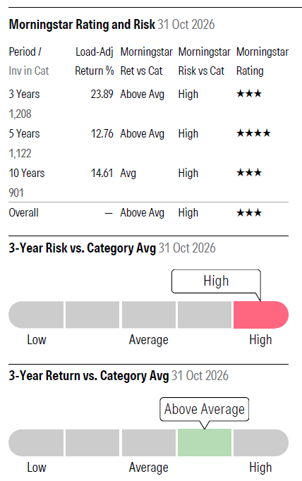
Why can a fund with good returns end up with a 3-star rating? Let’s look at Primecap Odyssey Stock POSKX as an example. As shown in the ratings snapshot below, the fund has generated above-average returns compared with the large-blend category over the trailing three- and five-year periods. However, those returns have come at the cost of relatively high levels of downside risk, leading to an overall 3-star rating.
Morningstar Rating and Risk for Primecap Odyssey Stock Fund
A fund could also end up with a 3-star rating if its returns were good in absolute terms but not as strong relative to the category average, or if it had good risk-adjusted returns over recent periods but a weaker long-term record.
The Morningstar Rating for Stocks
The Morningstar Rating for stocks (also called the star rating) is a forward-looking, analyst-driven measure of a stock’s current price relative to the analyst’s estimate of what the shares are worth. Stock star ratings indicate whether a stock is cheap, expensive, or fairly priced compared with the analyst’s assessment of intrinsic value.
To rate a stock, an analyst estimates what they think it’s worth (also called the Morningstar Fair Value Estimate) using a detailed, long-term cash flow forecast for the company. A stock’s star rating depends on whether its current market price is above or below that fair value estimate. Those stocks trading at large discounts to their fair value estimates receive the highest ratings (4- or 5-stars). Stocks trading at large premiums to their fair values receive lower ratings (1- or 2-stars). A 3-star rating means the current stock price is fairly close to the analyst’s fair value estimate.
The ratings also incorporate our assessment of a company’s level of uncertainty. For companies that are riskier or less predictable, we require a larger discount to fair value (also known as margin of safety) for a favorable rating.
Here’s how to interpret each star rating:
- 5-stars: We believe appreciation beyond a fair risk-adjusted return is highly likely over a multiyear time frame. Our analysis indicates that the current market price represents an excessively pessimistic outlook, which limits downside risk and maximizes upside potential.
- 4-stars: We believe appreciation beyond a fair risk-adjusted return is likely over a multiyear time frame.
- 3-stars: We believe investors are likely to receive a fair risk-adjusted return (approximately cost of equity).
- 2-stars: We believe investors are likely to receive a less than fair risk-adjusted return.
- 1-star: We believe there is a high probability of undesirable risk-adjusted returns from the current market price over a multiyear time frame. Our analysis indicates that the market is pricing in an excessively optimistic outlook, which limits upside potential and leaves the investor exposed to capital loss.
Because the Morningstar Rating for stocks is forward-looking, a stock could end up with a 3-star rating even if it historically generated decent returns. For example, Microsoft MSFT has been one of the most successful software firms in history, and the stock has generated annualized returns of 24.7% per year for the trailing 10-year period through October 2026. However, the current stock price of about $545 per share is fairly close to analyst Eric Compton’s fair value estimate of $600 per share.
Price vs. Fair Value for Microsoft
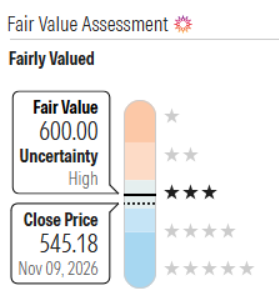
In addition, the stock carries a Morningstar Uncertainty Rating of High, reflecting questions about whether the company will generate high enough returns on its investments in artificial intelligence infrastructure, how long it can continue monetizing its core software business, and long-term cash-flow generation. This High Uncertainty Rating means the stock would need to trade at a bigger discount to fair value to garner a better rating.
Overall, Morningstar ratings are a useful starting point for investment research, but they shouldn’t be the only factor. Before investing in a stock or fund, it’s best to conduct additional research (Morningstar’s analyst commentary and extensive supporting data can help) and make sure it’s a good fit for your own financial situation and risk tolerance.
Have a Question for Me?
In this monthly column, I answer questions from readers about investing, personal finance, and retirement planning. (Note: I’m focusing on questions that are of general interest to many of our readers, not personalized tax advice or portfolio recommendations.) You can submit a question by filling out this quick survey.
Smart Moves for Bond Investors and Tackling Too Many Investments
The author or authors own shares in one or more securities mentioned in this article. Find out about Morningstar’s editorial policies.

 United States