
Americas Telecom Industry Update: Growth Slows, but Financial Performance Holds
Increased competition amid weakening industry growth has modestly hit profitability.



Wireless and broadband growth showed some weakness during the first quarter of 2025. However, we believe the long-term outlook for the telecommunications industry remains fundamentally stable.
While telecom stocks weren’t fully immune to April’s market turbulence, the group has generally held up well, with less volatility than average.
In the Telecom Americas: 2025 Q2 Industry Pulse, we dig into the pockets of opportunity for this space. Here’s what we found.
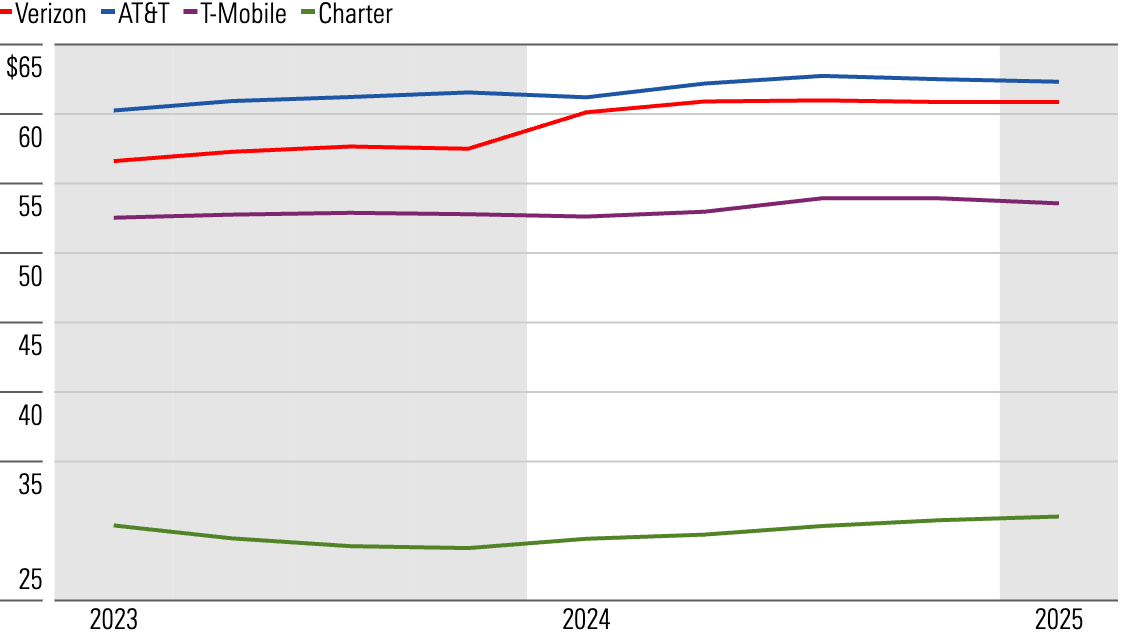
Total Monthly Postpaid Revenue Per Phone Customer, Excluding Broadband
US Broadband Customer Growth Appears to Have Bottomed
Broadband can refer to various types of high-speed internet connections, including DSL, cable, and fiber. Alternatively, fixed wireless internet uses radio signals transmitted from a base station to a receiver on your property.
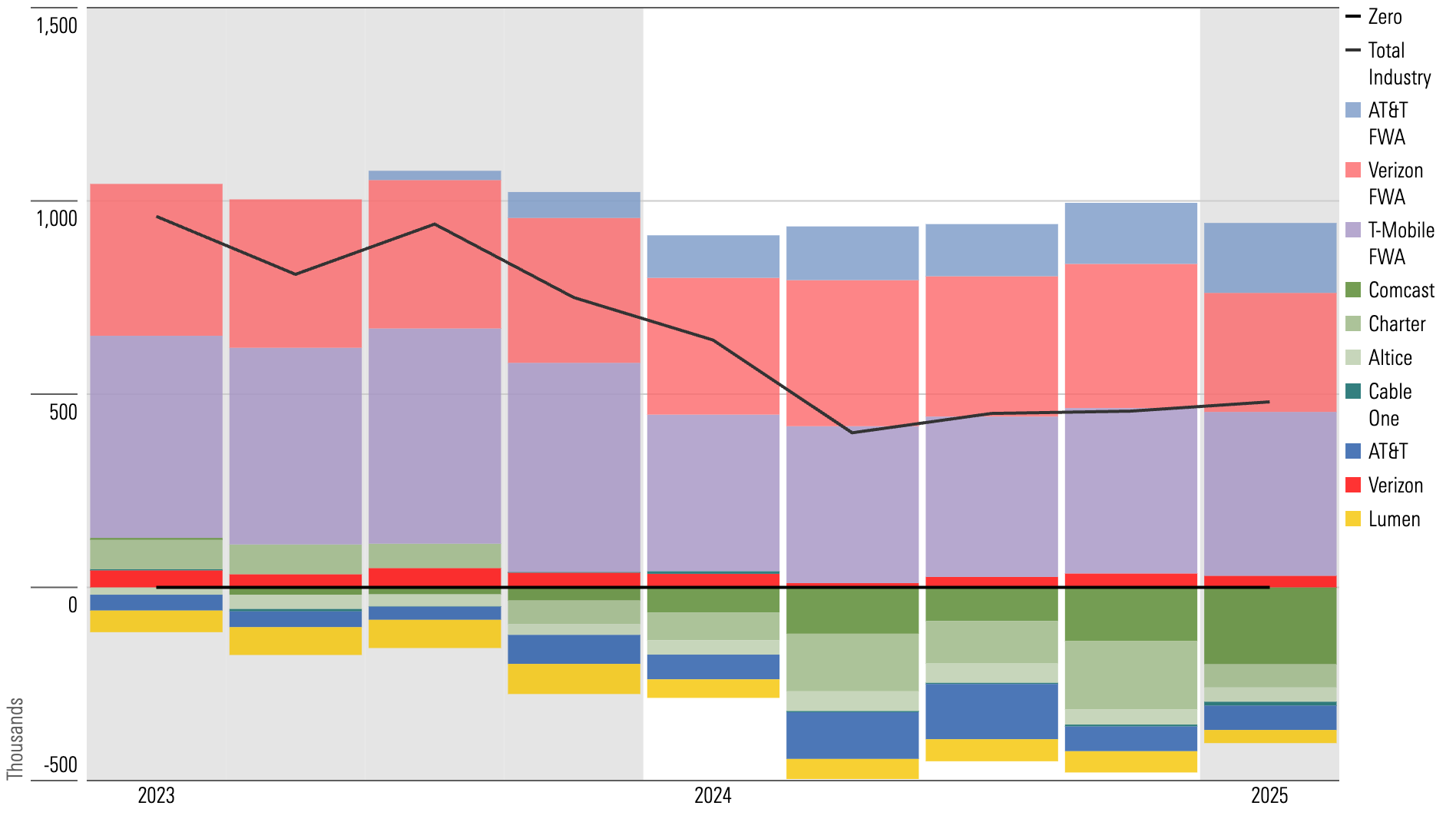
The US broadband market remains depressed, with the industry adding fewer than 500,000 new customers in recent quarters after hovering around the 1 million mark each quarter from 2020 into 2023. Fixed-wireless providers have taken all available market growth and then some.
The cable companies have been hurt as a result, but we don’t believe the situation is as bad as it appears.
Quarterly Residential and Small-Business Broadband Customer Net Additions
Comcast CMCSA and Charter CHTR control about 80% of the cable networks in the United States, with the remainder divided among a variety of smaller firms. We suspect the benefits of scale have increased over the past two or three years as broadband competition has ratcheted up.
Comcast and Charter enjoy somewhat lower network and overhead costs and can market services efficiently. The two firms also have the leverage to negotiate the best terms for wireless network access and television content, enhancing their ability to offer service bundles. These considerations likely factored into Cox’s decision to merge with Charter after 20 years as a private company.
We expect that fiber network competition will steadily increase for the cable companies over the next few years. AT&T T unveiled plans in December to reach 45 million customer locations by the end of the decade, up from about 30 million currently. The firm will also continue to invest in partnerships to build fiber outside its traditional phone markets.
Also, in addition to its planned acquisition of Frontier FYBR, Verizon VZ now plans to reach around 650,000 new locations with fiber annually, rather than the 500,000 it has built in recent years.
To find companies with a durable competitive advantage, advisors should compare the Morningstar Economic Moat Rating of portfolio holdings. Comcast, Charter, and Verizon all maintain narrow moats, which means we anticipate they will maintain their competitive edge for 10 years.
Wireless Subscription Trends by Region: Canada, Mexico, and Brazil
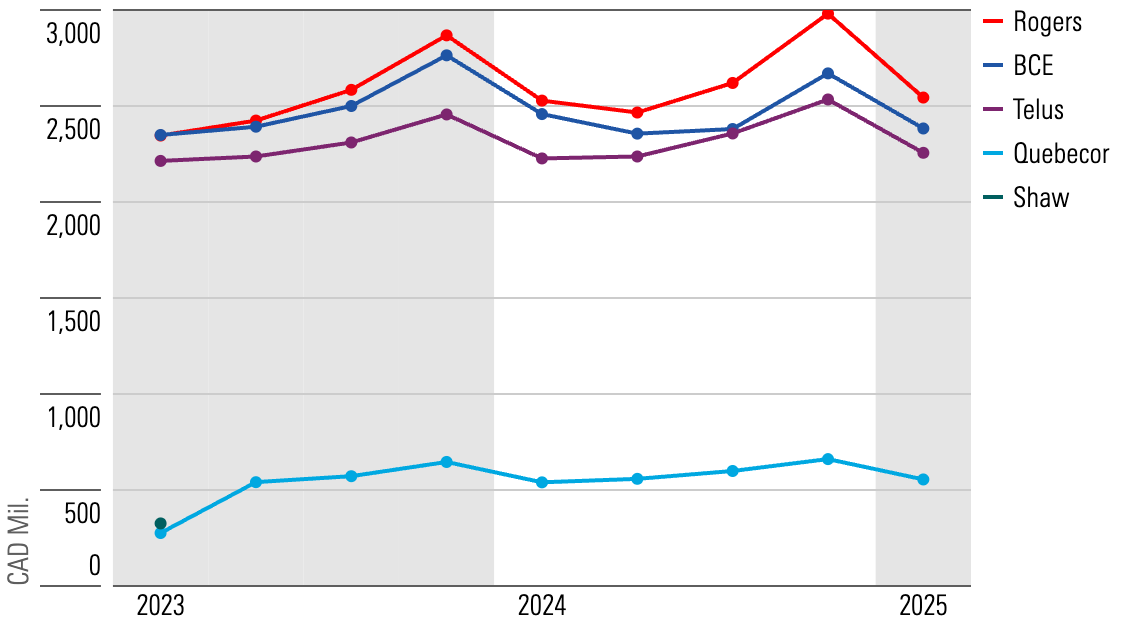
Competition in Canada’s wireless market remains intense. Canada has curbed its immigration targets for 2025 through 2027, so the carriers will fight for a smaller pool of new potential customers. Further, Quebecor QBCRF continues its push to become the fourth major wireless carrier in Canada, which has elevated churn rates for the Big Three relative to the past two years.
However, wireless penetration rates are still below those of other developed countries, which should support reasonable subscriber growth for the Big Three.
Total Wireless Revenue—Canada
Walmart WMT was likely the only carrier to post customer growth in Mexico during the first quarter, but we suspect its figures are overstated. The firm counts any user active over the prior six months in its customer base. Other carriers have similar policies, but consumers are more likely to be trialing Walmart’s offering, given that it is fairly new.
Movil AMX and AT&T added net postpaid customers during the quarter, and both firms generally have gained prepaid customers in recent quarters despite Walmart’s incursion, indicating the economy has played a role recently.
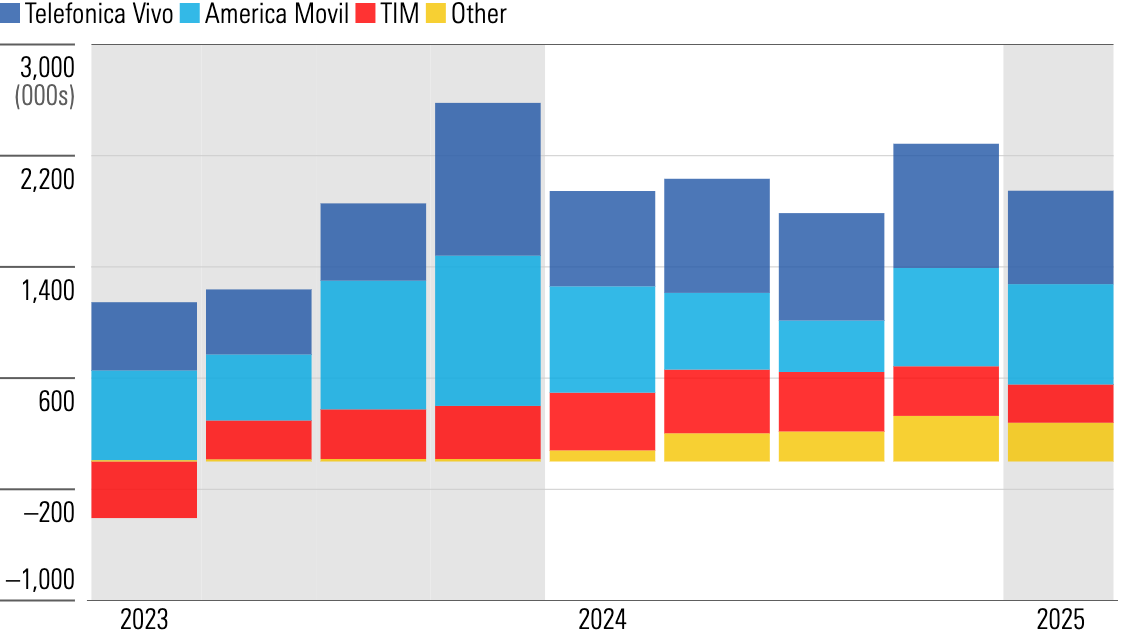
The Brazilian prepaid business, which has been in decline as customers migrate to postpaid plans, deteriorated further during the first quarter amid growing economic weakness.
The three major Brazilian carriers lost nearly 2 million net prepaid customers, offsetting most of the postpaid phone customer gains during the quarter. A reasonably rational competitive environment has enabled revenue growth to outpace inflation for all three carriers. Telefonica Vivo VIV appears to be the most aggressive of the three, but stated it raised prices in April.
Quarterly Net Wireless Postpaid Phone Customer Additions
US and Brazilian Tower Stocks Still Look Attractive
Tower stocks remain sensitive to moves in interest rates, but the shares of all three firms in this group have held most of their gains for the year to date despite rates ticking higher in recent weeks. We believe the group has shown improved capital allocation discipline, especially with Crown Castle CCI selling its fiber business.
Latin American telecom stocks have staged a sharp rally since the early April tariff announcements, but we still see opportunities, especially in Brazil. Finally, Canada remains in the basement amid a currently challenging competitive environment, but we view the country as very cheap.
The author or authors do not own shares in any securities mentioned in this article. Find out about Morningstar’s editorial policies.

 United States