
Saluting a Mutual Fund Pioneer
Ab Nicholas, rest in peace.
Walking Softly Ab Nicholas died last month, at the age of 85. Nicholas was not nationally famous. He did not disrupt the mutual fund business, as did Jack Bogle. He did not run a star mutual fund, as did Peter Lynch. He did not exit his company in a widely covered scandal, as did his fellow Milwaukeean, Dick Strong. (His charitable contributions, on the other hand, were large and well known within his adopted state of Wisconsin.)
Quietly, though, he fashioned a legacy that should be remembered with pride.
The Nicholas Funds were never destined to become an empire. Fund empires require a broad, deep product line; substantial supporting services, such as brokerage capabilities and advice; and substantial brand marketing. The Nicholas Funds were not that. Nor were they cutting-edge. The public might want index funds, or target-date funds--but they weren’t getting them from Ab Nicholas.
They also weren’t getting what they didn’t need (but perhaps thought they did). They weren’t getting Internet funds, or tactical-allocation funds, or option-writing bond funds, or any other flavor of high-cost, high-concept fund that came to market at the wrong time and tempted the unfortunate into buying for the wrong reasons. Ab Nicholas would only offer investments that he thought his firm could run effectively.
In the 47 years since Nicholas Fund opened its doors, that has meant two options: U.S. stocks and high-yield U.S. bonds. Stock funds come in a few varieties--large company for the flagship Nicholas Fund NICSX, mid-cap for Nicholas II NCTWX, small company for Nicholas Limited Edition NCLEX, and equity-income for Nicholas Equity Income NSEIX--but they are all variations on a theme. The Nicholas organization follows a blend-style strategy, buying shares in companies that have healthy ongoing businesses (Nicholas funds avoid cigar butts) and are selling at moderate stock-price multiples. That is what the organization does.
And it does so well. The bond fund hasn’t been anything special. (Perhaps Ab Nicholas should have settled for a single asset class, rather than expanded to two, but 47 years is a long, long time to face temptation.) The stock funds, however, have been uniformly solid. Nicholas and Nicholas II each carry a 4-star Morningstar Rating, while Nicholas Equity Income and the institutional share class of the small-company fund, Nicholas Limited Edition, score 5 stars.
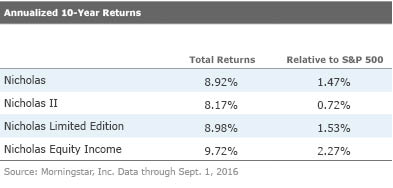
Those unimpressed with peer-to-peer measurements such as the Morningstar Rating (which compares a fund’s risk/return profile against those of other funds in the Morningstar Category) will wonder how the Nicholas funds fared against the real competition of index funds. Quite nicely, thanks much. All four funds have outgained the S&P 500 over the trailing 10 years. (As we shall later see, their longer-term records are also competitive, although not quite at that level.)
As is usually the case when active management succeeds, the Nicholas funds have relatively low expenses. Nicholas II’s institutional share class can be had for a modest 0.61% per year, and Nicholas Fund’s retail shares charge 0.72%. While not cut-rate--Vanguard’s stock funds run about half that amount--such costs are well below the average for the industry. Also, the Nicholas funds have never carried front- or back-end sales charges.
From the shareholder’s perspective, a rare misstep occurred when Nicholas added a 0.25% 12b-1 fee to the retail share classes of three of its four stock funds. That decision was understandable given the demands of discount brokerage firms, which require ongoing payments from fund companies that sell through their no-transaction programs. Nonetheless, the move cannot be considered shareholder-friendly. However, the company did resist adding the 12b-1 charge to its flagship fund, and it did add institutional share classes to the other funds.
As they say, nobody's perfect. Particularly when having almost half a century's worth of history in which to make a mistake. But more than most, Ab Nicholas kept to the side of the angels. He offered a good product, priced fairly, and he delivered no surprises. His funds did what they claimed to do. The Nicholas funds did their part to make the mutual fund industry the trusted, mainstream colossus that it has become.
In a small way, my memory of Ab Nicholas is personal, as well as professional. In 1988, one month into my Morningstar career--which essentially meant one month into my working career--I made my first investment, placing the princely sum of $300 into a Milwaukee-based fund called Nicholas II. Twelve months later, having not spent my entire $18,000 salary (Morningstar pays somewhat better today, but I am also more profligate), I sent the fund another $1,000.
That $1,300 has since become $13,000. That tenfold growth owes to the power of the markets--in the nomenclature, to beta rather than alpha. Had I purchased
did
beat those of the S&P 500 before expenses--but its higher expenses consumed the difference.
Live some, learn some. Nicholas II was not the single best investment that I could have made. It did not earn me the single highest profit. But it was far better than most choices that I could have made. Ab Nicholas grew my money tenfold, while never giving me any problems along the way or reasons for regretting my decision. How many financial-services companies can say something similar?
John Rekenthaler has been researching the fund industry since 1988. He is now a columnist for Morningstar.com and a member of Morningstar's investment research department. John is quick to point out that while Morningstar typically agrees with the views of the Rekenthaler Report, his views are his own.
The opinions expressed here are the author’s. Morningstar values diversity of thought and publishes a broad range of viewpoints.

 United States