
Japan Follows ECB Down Monetary Path to Negative Interest Rates
Healthcare rocked by political rhetoric.

Like Pavlov's dogs salivating to the dinner bell, most asset markets across the globe rallied last Friday in response to the surprise interest rate cuts by the Bank of Japan. The BOJ lowered the rate on excess reserves (the amount a bank holds at the central bank greater than the required amount of reserves) to negative 0.1% and reduced the rate on required reserves to 0%. This was a surprise to the market, as the governor of the BOJ as recently as a week ago had said Japan would not follow the lead of the European Central Bank into negative interest rate policy. The BOJ has now joined a growing club of central banks that have entered the world of negative interest rates, including the ECB, Swiss National Bank, Sweden's Riksbank, and Denmark's Nationalbank. The intent of the negative rate is to spur banks into lending excess reserves as opposed to paying the central bank to leave those reserves on deposit. The hope is that the additional lending will stimulate economic activity. Additionally, the negative interest rates will effectively debase the yen in order to import inflation from across the world.
Sovereign bonds across the developed markets rallied, with the bonds of many countries reaching all-time highs and pushing yields down to their historically lowest rates. For example, the yield on the Japanese 10-year bond dropped to 0.10% (that is not a typo), the 10-year German bond dropped to 0.33%, and the Swiss 10-year bond dropped even further into negative territory at (0.25)%. According to the Financial Times, there is now a record $5.5 trillion worth of government bonds across the world that trade with a negative yield. Even the 10-year debt of countries such as Spain and Italy, which just a few years ago were thought to be near insolvency, are trading at 1.51% and 1.42%. U.S. Treasury bonds rallied, but compared with other sovereign bonds, the yields appear attractive. The 5-year bond ended the week at 1.34%, the 10-year at 1.93%, and the 30-year at 2.76%.
Among the equity markets, the S&P 500 rose 1.7%, paring back some of its year-to-date loss, and is now down only 5.1% for the year. Commodity prices rose across the board and oil increased $1.50, ending the week at $33.75 a barrel, as rumors surfaced that Russia and OPEC were planning on meeting to discuss production cuts.
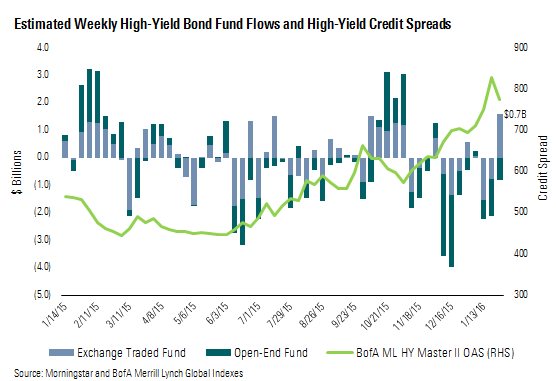
While most asset classes rallied hard last week, the corporate bond market was skeptical that monetary policy action will be the panacea for economic ills. The average spread of the Morningstar Corporate Bond Index (our proxy for the investment-grade corporate bond market) continued to widen last week, rising 5 basis points to +197. The spread of the Bank of America Merrill Lynch High Yield Master II Index tightened slightly, decreasing 13 basis points to +774. In high yield, the tightening was driven by the energy sector, which seemed to be more correlated with the increase in oil prices than expectations that the stimulus measures will meaningfully affect global economic growth.
After two weeks of solid outflows, investors returned to the high-yield asset class as a net $700 million of funds flowed into the category. However, the funds flows were uneven as exchange-traded funds were the beneficiary of inflows, rising $1.6 billion, whereas open-end mutual funds continued to experience outflows of $0.8 billion.
Economy Ends 2015 on Weak Note; We Reiterate 2.0%-2.5% Growth in 2016 The news out of Japan overshadowed domestic economic news last week. The Federal Reserve held monetary policy steady following the Federal Open Market Committee meeting, core durable goods orders fell, and fourth-quarter GDP was especially lackluster. In addition to the dour economic news, earnings releases last week and 2016 guidance continued to indicated soft economic expectations among high-profile companies such as Apple AAPL (rating: AA-, narrow moat) and Amazon AMZN (rating: BBB+, wide moat).
Changes to the language in the FOMC meeting statement revealed that the Fed is concerned that the recent global economic turmoil and market declines could hurt the domestic labor markets and inflation. The Fed was tight-lipped about what its next move could be, keeping its options open for the March meeting. Depending on how economic and market activity pans out over the next two months, the Fed could stand pat, raise rates, or decrease rates. Economic activity ended the year on a dreary note as core durable goods fell 4.3% sequentially in December and declined 7.5% on a year-over-year basis. Fourth-quarter GDP was reported a disappointing 0.7%. However, Robert Johnson, Morningstar's director of economic analysis, cautioned investors against reading too much into the GDP report. He pointed out that the more reliable full year-over-year growth rate was up 2.4% in 2015. This matches the same growth rate for 2014 and is actually slightly better than the average growth rate over the past six years of 2.1%.
In Johnson's weekly column, he dissects the quarterly data in the headline GDP report that led to the disappointing report and urges investors to concentrate on the annual data instead. While he said he thinks economic growth in 2016 is more likely to come in at the low end of his forecast range, he reiterated his expectation that U.S. real GDP will grow between 2.0% and 2.5% this year. For greater detail, please see Robert's column this week, "Data Quirks—and a Gift From Japan—Take Sting Out of Lackluster GDP."
Healthcare Rocked by Political Rhetoric Contributed by Julie Utterback, CFA Volatility surrounded the healthcare industry last week as political rhetoric rose in the United States and emerging-market risks were highlighted. The U.S. political debate currently surrounds expanding pricing controls versus allowing consumer choice of pharmaceuticals. Starting in earnest in mid-2015, many politicians questioned big price increases on recently acquired products by specialty pharmaceutical companies. For example, in September, Hillary Clinton's tweet about Turing's dramatic price increase on a recently acquired drug created a firestorm in that niche. This week, executives from Turing and Valeant Pharmaceuticals VRX (rating: BB-, narrow moat), among others, are scheduled to testify before Congress, which could intensify the debate around drug pricing. Large pharmaceutical firms may be negatively affected by pricing concerns, too. For example, Eli Lilly's LLY (rating: AA, wide moat) stock came under pressure after fourth-quarter results were reported last week, with many headlines criticizing its price increases on diabetes products. We maintain an underweight recommendation on Lilly's bonds. For investors wanting to dive deeper into pricing issues, Morningstar's equity team recently analyzed reform efforts in "Low Odds of U.S. Drug Pricing Reforms Create Favorable Valuations," published Jan. 21. That report suggests that of the reforms being considered, the U.S. government is most likely to obtain Medicaid-level drug rebates for Medicare participants that qualify for both government programs. Covered firms with the highest percentage (10%-15%) of earnings at risk related to dual-eligible reform efforts are Celgene CELG (rating: A-, narrow moat), Eli Lilly, and Gilead Sciences GILD (rating: A+, wide moat).
In more political rhetoric last week, Clinton tweeted against managed-care organizations and pharmacy benefit managers that limit patient choices in order to control healthcare costs. While we think it would be difficult to effectively control healthcare costs without limiting patient options somewhat, it did create an opportunity in Express Scripts' ESRX (rating: A-, wide moat) bonds, in our opinion. We have changed our recommendation on Express Scripts' bonds to overweight based on recent spread widening related to political concerns and a contract dispute with Anthem.
Additionally, overseas results remain a headwind for many multinational healthcare firms. The strong U.S. dollar relative to other currencies appears likely to constrain reported growth through 2016. Positively this reporting season, China remains a solid performer for the healthcare firms we cover, despite its slowing economic growth. However, an unlikely point of concern--commodity price declines--emerged in Abbott Laboratories' ABT (rating: AA-, narrow moat) 2016 outlook. Abbott's guidance significantly disappointed investors last week in large part because of foreign currency movements and, of all things, the impact of low oil prices in Venezuela. Without both of those factors, the firm's adjusted earnings per share outlook would have been for double-digit growth in 2016, rather than flat. Venezuela's oil-based economy is being ravaged by inflation, and Abbott's operations (particularly its nutrition and established pharmaceutical businesses) in that nation are being negatively affected by related price and margin controls, regulations on imports, and slowing demand for its goods. This may be an anomaly, but in general, the downturn in commodity prices may have a longer reach than we had anticipated, given this spread to at least one participant in the typically immune healthcare industry. While Abbott's management noted that operations in other oil-dependent countries such as Russia and Saudi Arabia remain solid so far, we will keep a close eye on emerging markets. Demand for healthcare products and services, particularly elective treatments, could slip in commodity-dependent states if key prices remain low in 2016. That dynamic could create growth headwinds for multinational healthcare firms.

 United States