
How to Invest in Green Bonds
The cash flows underlying green bond projects are attractive to investors.



Once a tiny corner of the bond market, the market for green bonds has been growing swiftly. These are bonds whose proceeds are targeted toward environmental themes, such as building solar generation or bolstering the efficiency of power generation and transmission.
Even as municipal bonds sagged in April amid greater supply and worries that trade wars would boost inflation, the green bond market held steady. That’s because green bonds and their relatively safe cash flows look attractive to investors, according to Steve Liberatore, head of ESG/Impact for global fixed income at Nuveen.
Today, green bonds have a market value of around $2.9 trillion globally, up nearly sixfold since 2018, according to a March 2025 report in the Bank for International Settlements quarterly review.
They’re issued by a variety of entities, including corporations and municipalities. But they’ve been overlooked, partly because of the recent backlash against environmental, social, and governance approaches and outflows from sustainable equity funds.
What Are Green Bonds?
Green bonds raise capital to fund environmental-specific projects. Proceeds are used to support environmental outcomes. Issuers include both public and private entities.
One example is California Community Choice bonds, which finance prepayment of electricity from renewable sources including solar, geothermal, and wind turbine facilities throughout California. Even as the US government steps back from goals around decarbonization, the bonds help California decarbonize its power sector and reach statewide goals, says Bill Delahunty, a municipal portfolio manager at Morgan Stanley Investment Management, who manages Calvert Responsible Municipal Income CTTLX. Delahunty predicts continued demand for these bonds.
Since 2016, Apple AAPL has issued a total of $4.7 billion in green bonds. The proceeds fund projects to support low-carbon product design, energy efficiency, renewable energy usage, carbon mitigation, and carbon sequestration.
Green bonds are part of a larger universe of sustainable bonds, often called “labeled bonds,” that fund specific project outcomes. Social bonds, for example, finance projects seeking to address social issues such as education or healthcare access. Blue bonds focus on water-related efforts, such as enabling sustainable fishing practices or restoring marine biology. Green bonds are the biggest bucket of sustainable-bond vehicles and have existed in the marketplace the longest.
Because green bonds provide the market with not only investment returns but also positive impact, maintaining transparency is important for investors. Not only are issuers encouraged to clearly define the projects being funded but also provide regular updates to investors describing the project details, use of proceeds, and expected outcomes to support environmental impact. Increasingly, issuers contract with a second-party opinion provider to deliver an external assessment on the bond’s framework, helping investors trust that funding will be used as stated, that the issuer will deliver transparent updates, and greenwashing will be avoided. (Morningstar Sustainalytics is one such provider.) This external assessment helps build investor confidence.
What Does the Green Bond Market Look Like?
The market for green bonds has existed for nearly two decades, with the first green bond issuance taking place in 2007 by the European Investment Bank. Issuances have grown steadily since, with the market exploding most rapidly in 2021 with over 4,000 new green bond issuances taking place that year, nearly double the number of issuances the year prior. This trend closely correlated with the “ESG-boom,” when annual global ESG fund flows peaked in 2021.
The market for green bond funds continues to grow. According to research from Environmental Finance, green, social, sustainability, and sustainability-linked bonds had $46.3 billion in assets under management in 2024, up 4% from 2023 and up 39% from 2022.
Mara Dobrescu, a fixed-income analyst at Morningstar, says that “issuance in green bonds has continued to grow, and emerging markets are increasingly represented in addition to traditional developed-markets issuers. Green bond funds have now become a fixture of the fixed-income universe, with more than 150 vehicles globally.”
Dobrescu says green bond funds are best for longer-term investors, partly because of the long time horizon needed for such projects. Because they have longer duration, they also tend to be more sensitive to variations in interest rates. But longer-term investments may also align well with millennial and Generation Z investors, who show an increasing appetite for environmentally friendly investments.
A Few Caveats
Historically, green bonds are more expensive, commanding what’s called a “greenium,” according to a study by Rex Wang Renjie and Shuo Xia. That makes them less attractive to bargain-hunters but more attractive to borrowers. Moreover, there is no universally accepted legal and commercial definition of a green bond, and the quality of reporting varies.
Reporting can be spotty, particularly on progress in reducing pollution or greenhouse gas emissions. “There are no quarterly financials for green bonds, so there’s not really transparency of progress,” says R. Paul Herman, CEO of HIP Investor, an investment advisor that provides sustainability ratings and data analysis and whose data is used in the VanEck HIP Sustainable Muni ETF SMI.
Then there’s the effect of physical climate risk on the underlying projects. That may create opportunities for investors.
Consider the following two bonds, both rated Aa3 by Moody’s. One is a Gainesville, Florida, 5% green bond maturing in 2046, where the local utility will use proceeds to recharge Florida aquifers with high-quality reclaimed water and replace water infrastructure. However, Herman notes, Gainesville faces rising climate risk. Even though Gainesville is inland, it’s increasingly vulnerable to severe hurricanes. At the same time, it faces the intensifying pressure of extreme heat, which drives significantly higher electricity demand for air conditioning and reduces the efficiency of the grid.
Contrast that with a similarly Aa3-rated, 5% University of Wisconsin green bond due 2046, that will use proceeds for a hospital expansion that will include an energy-efficient HVAC system, a solar-ready roof, and a stormwater retention pond. While Wisconsin also faces climate risks, Dane County is “more resilient” and “less risky” than the national average, according to Herman.
How to Invest in Green Bonds
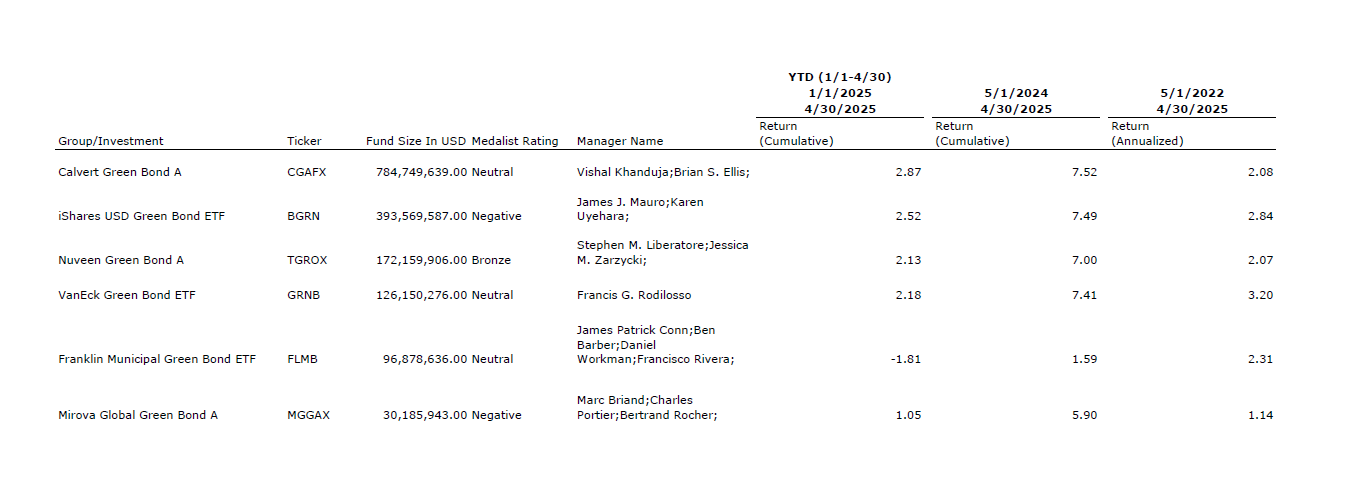
Many sustainable bond funds own green bonds. But a number of specialist funds also confine themselves to green bonds. You can see them below.
6 Green Bond Funds
The author or authors do not own shares in any securities mentioned in this article. Find out about Morningstar’s editorial policies.

 United States