
These 3 Climate-Related Proxy-Voting Proposals Had Strong Shareholder Backing
Goals include following through on climate commitments and testing if targets can withstand business growth.


Climate targets and commitments were the focus of the three most successful climate-related proxy votes in the most recent proxy season.
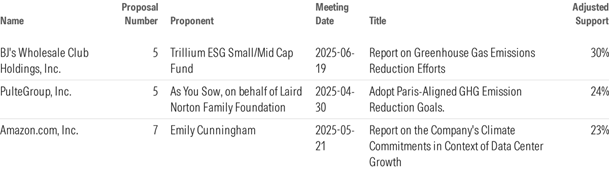
The votes took place at BJ’s Wholesale Club Holdings BJ, PulteGroup PHM, and Amazon.com AMZN. While addressing the distinct climate risks of three different sectors, the three center on climate commitments: following through on earlier commitments; setting Paris-aligned emissions goals; and questioning whether net zero targets can withstand business expansion.
All failed to achieve an outright majority but received at least 23% of the adjusted vote, which commands attention. (The adjusted vote excludes the votes controlled by company insiders). It’s commonly expected that support of 20% or so merits a company response. A survey by proxy solicitor Georgeson found that “if a shareholder proposal not supported by management receives 20% or more support but does not pass, investors will expect to see a formal response from the company to shareholders.” Indeed, the UK Corporate Governance Code expects a company to take certain actions if 20% or more of votes are cast against the board recommendation.
Overall, some 40 climate-related resolutions came to a vote at US companies. Generally, support for them slid again, along with general support levels across environmental and social proxy ballot votes. Shareholder requests ranged from emissions target-setting and progress updates to scrutiny of climate plan assumptions and assessments of climate-related risks to business operations and investment portfolios.
ESG Voting Policy Overlay
BJ’s Wholesale Club: From Commitments to Accountability
At BJ’s Wholesale Club, 30% of shareholders backed a resolution seeking a report on whether and how the discount retailer could accelerate its emissions reduction efforts. The proposal asked BJ’s to outline strategies, milestones, and time-bound targets, using frameworks like the Science Based Targets initiative.
The context of this resolution added to its appeal. BJ’s committed, in 2022, to set a science-based target by the end of 2024 but has not yet done so. In addition, BJ’s has not set time-bound greenhouse gas emissions reduction targets for its scope 1 and 2 emissions, which represent a relatively small and more manageable portion of its overall carbon footprint.
BJ’s has taken steps to reduce emissions, such as installing solar rooftops, upgrading lighting, and improving fleet efficiency. However, the proponent argued that BJ’s climate strategy lacks the structure and transparency investors expect. The proposal highlighted that peer companies have already set measurable goals for refrigerants and renewable energy, underscoring that BJ’s current pace of action lags behind industry standards.
It appears that such a report would close a critical information gap and help shareholders assess whether BJ’s is prepared for regulatory and market shifts. The strong vote reflects how proposals focused on practical, decision-useful disclosure continue to attract broad support.
PulteGroup: Aligning With Paris Goals in Homebuilding
At PulteGroup’s 2025 shareholder meeting, 24% of shareholders supported resolution 5, asking the homebuilder to adopt Paris-aligned greenhouse gas reduction targets. The case for support was clear: The residential construction sector faces growing regulatory and physical risks. PulteGroup itself acknowledges in its 10-K that climate regulation could increase costs and restrict land development. Nonetheless, Pulte’s current approach—ensuring homes meet ENERGY STAR 3.1 standards—does not amount to a comprehensive transition plan, the proposal said.
The proposal argued that science-based targets covering scopes 1, 2, and 3 would provide a road map for managing risk and seizing opportunities in a low-carbon economy. It pointed out that competitors are already marketing net-zero-ready homes and that policy incentives such as those in the Inflation Reduction Act reward early-movers.
It appears that while PulteGroup has improved transparency and reduced emissions in recent years, the absence of time-bound, value-chain targets has left investors without a benchmark to assess progress. This explains why the proposal resonated: It asked for a step that is now widely viewed as a minimum expectation.
Amazon.com: Climate Credibility Amid Data Center Growth
Resolution 7, voted at Amazon’s 2025 shareholder meeting, was supported by 23% of shareholders. The resolution questions whether Amazon’s climate strategy remains viable as the company invests nearly $150 billion to expand data centers over the next 15 years. These facilities are energy-intensive, and their rapid growth is straining electricity grids. The International Energy Agency projects that global data center electricity demand could more than double by 2030, rivaling that of an industrialized nation.
Amazon has made significant climate-related progress. For example, in 2023, it matched 100% of its electricity use with renewables. It is also exploring advanced technologies like small modular nuclear reactors to power its data centers. However, the proposal suggests that these measures may not be enough, as many clean energy solutions will not scale until the 2030s, while demand is surging now. For example, the proponent highlights that, in regions like Virginia, utilities are extending fossil fuel assets to meet load growth, undermining decarbonization efforts.
In addition to this, the proponent is concerned that Amazon’s reliance on renewable energy certificates masks the real challenge: whether Amazon can maintain net zero alignment in a carbon-constrained grid.
It appears that this proposal resonated with investors because it addressed a systemic issue, one that affects the entire tech sector and could redefine how investors evaluate climate credibility.
Why These Climate-Related Proposals Resonated With Investors
Together, these three cases are important examples of shareholder engagement on climate.
At PulteGroup and BJ’s, investors showed strong support for proposals calling for clearer targets and stronger accountability, expectations that are now seen as basic requirements for companies. These kinds of resolutions still resonate because they provide investors with the essential information they need to assess if a company is prepared for the low-carbon transition.
The Amazon proposal, however, signals a shift in focus. Investors are no longer satisfied with knowing that companies have climate goals on paper—they want confidence that those goals can withstand real-world pressures. The next wave of investor scrutiny will likely test the credibility of climate strategies, not just whether they exist.
The 2025 proxy season is an important step in this evolution. Disclosure and target-setting have become more routine, and as those practices mature, investor attention is likely to move toward the harder question: Can companies deliver on their promises in the face of rapid growth and tightening regulation? This shift is set to change climate proposals in the coming years, moving the conversation from transparency to execution.
The author or authors do not own shares in any securities mentioned in this article. Find out about Morningstar’s editorial policies.

 United States