
Sustainable-Investing Performance Struggled Again for Q3
Despite a tough 2022, long-term ESG returns remain competitive.


The headwinds continued for sustainable-investing strategies in the third quarter, extending a rough year for environmental, social, and governance investing.
Throughout 2022, losses in technology and other growth stocks that tend to dominate many ESG strategies have dragged down performance when compared with the broader stock market. And even though growth stocks held up relatively well during the third quarter when measured against value stocks, sustainable-investing strategies struggled.
Still, longer-term results for investment strategies aimed at finding the stocks of companies with the best sustainability profiles remain highly competitive with broad market returns.
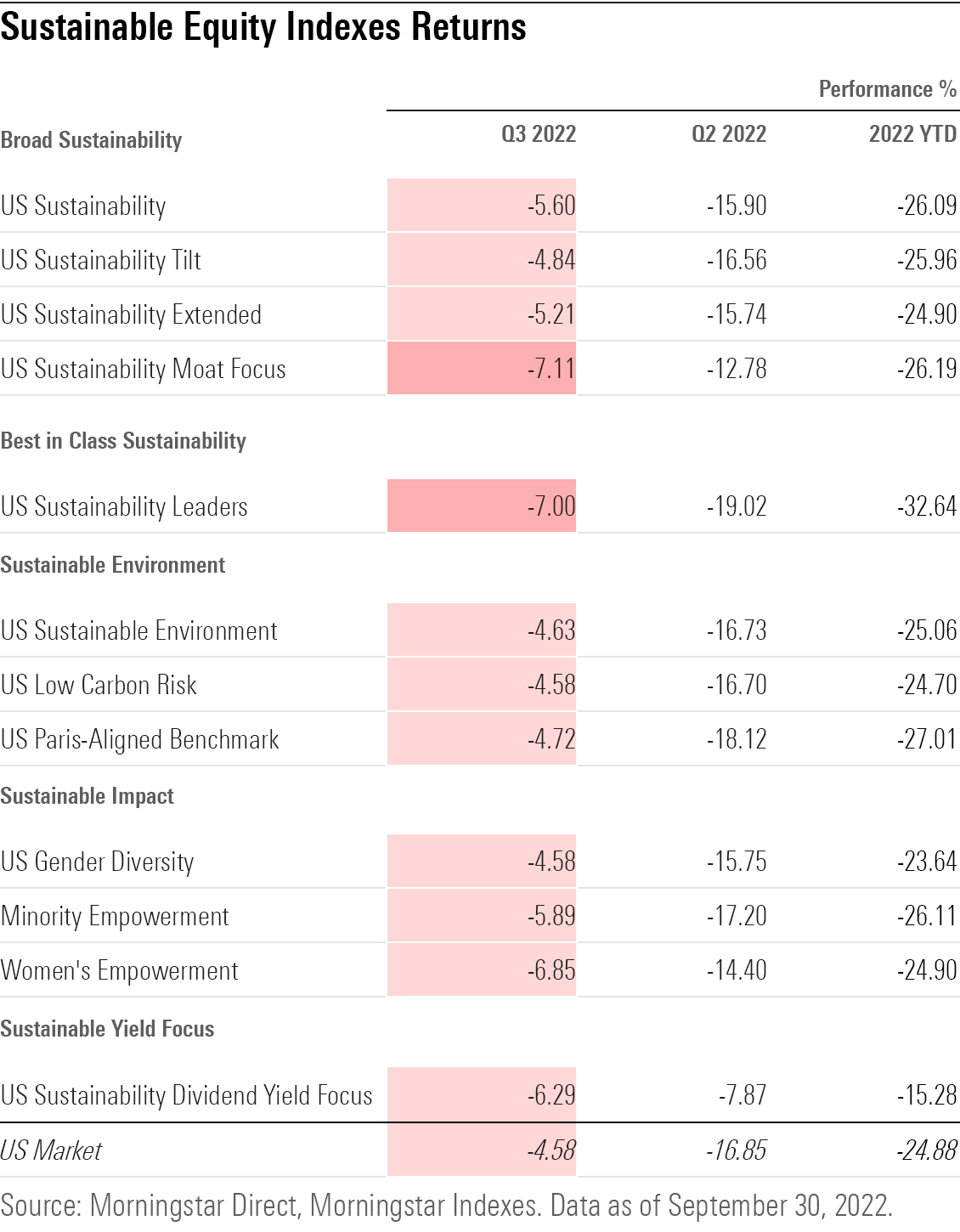
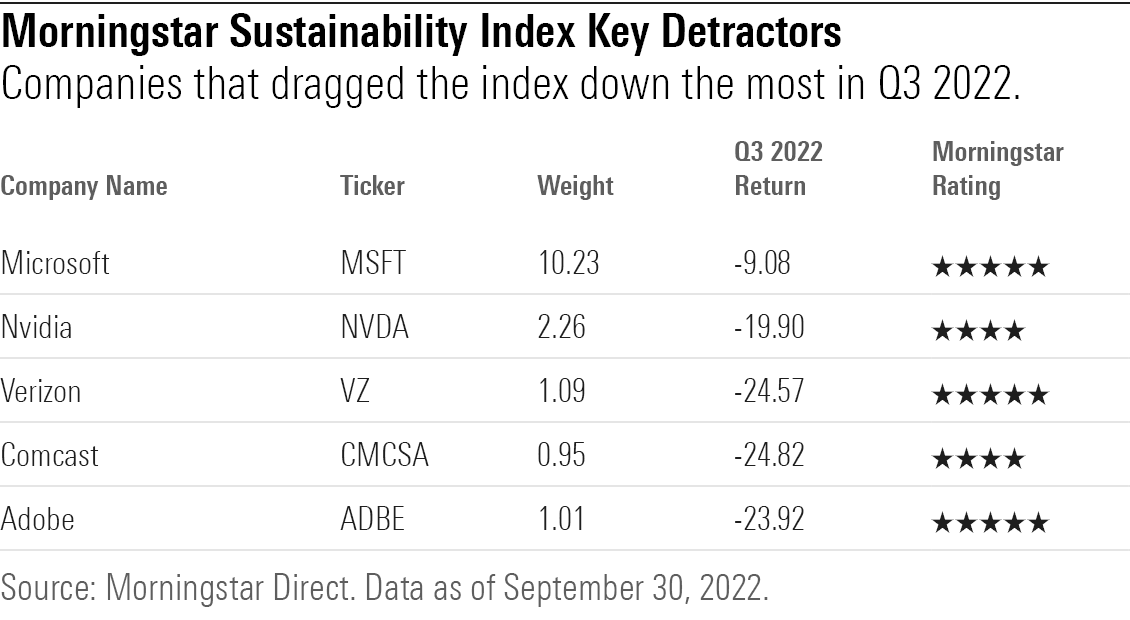
Morningstar’s broadest measure of sustainable stocks, the Morningstar US Sustainability Index, lost 5.6% for the quarter, hurt by declines in stocks such as Microsoft MSFT, Nvidia NVDA, and Verizon Communications VZ. That made for the third consecutive quarter where the Sustainability Index has lagged behind the Morningstar US Market Index, which fell 4.6% during the July-September quarter.
For the year, the US Sustainability Index, which tracks the U.S. equity market but screens out companies with the highest ESG risk, is down 26.1% while the Morningstar US Market Index has lost 24.9%.
“It was certainly a challenging quarter on top of a challenging year,” says Anthony Eames, managing director of responsible investment strategy at Calvert Research and Management.
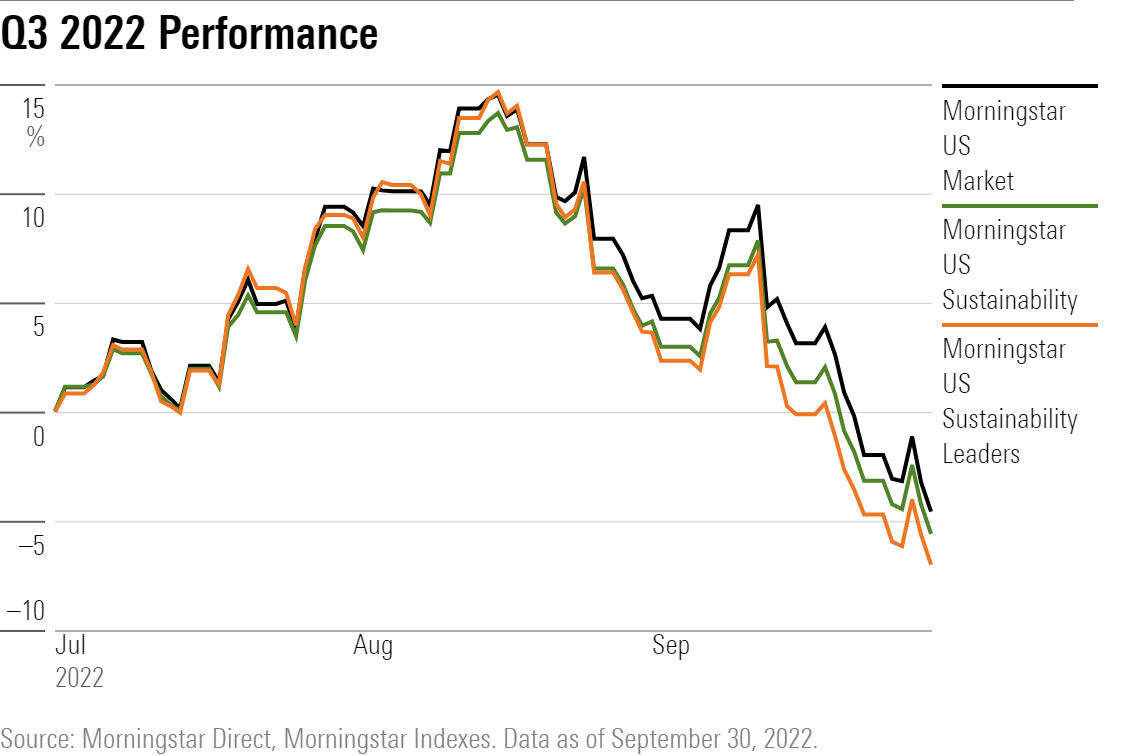
Among U.S.-based sustainable-investing stock strategies, none of the 12 standard Morningstar sustainability indexes outperformed the Morningstar US Market Index in the third quarter. However, three essentially matched the overall U.S. market: US Low Carbon Risk Index, US Gender Diversity Index, and US Sustainable Environment Index.
Globally and across markets, just two of the 21 Morningstar standard sustainability indexes, broad-market indexes for the respective regions with overlays that screen out companies with higher ESG risk ratings, outperformed their non-ESG market benchmarks during the third quarter.
Sustainable-Investing Strategies’ Long-Term Performance
This year has seen a change in fortunes for sustainable-investing. Heading into 2022, ESG strategies had outperformed the broad market for several years running, lifted by big gains in large- or mega-cap, high-growth, technology companies that often have a heavy weighting in sustainable-investing portfolios. But that dynamic changed with the growth-stock led bear market.
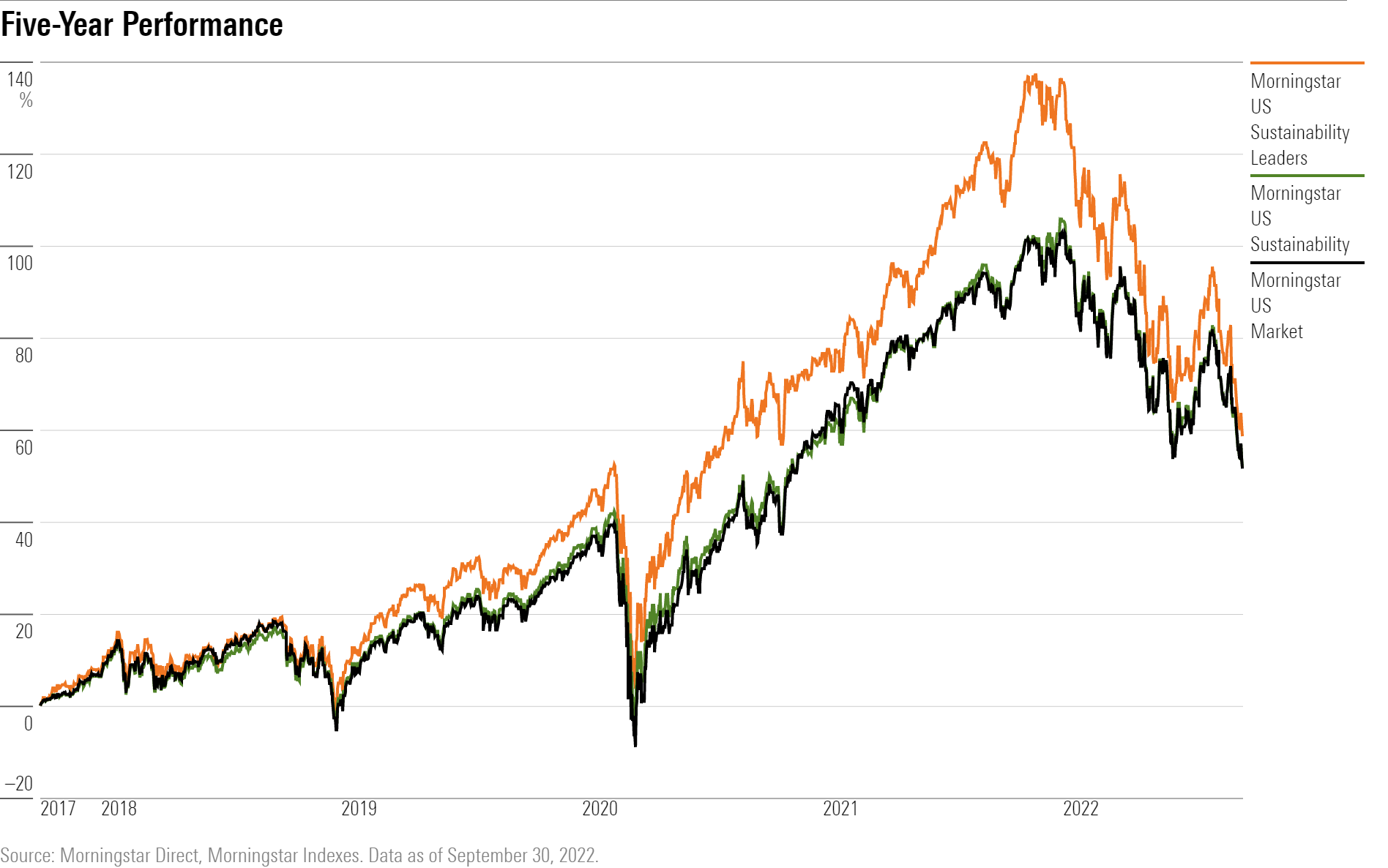
Still, looking at longer-term performance, sustainable strategies continue to hold their own. The sustainability index averaged an 8.7% return per year for the last five years, essentially even with the US Market Index.
The Morningstar US Sustainability Leaders Index, a collection of 50 U.S. large-cap stocks with the very best sustainability scores, has also seen its fortunes erode, but still has outperformed the broad market benchmark. At the end of 2021, the Sustainability Leaders Index had beaten the US Market Index by more than 3 percentage points a year for the previous five years. As of the end of the third quarter, that advantage had fallen to an average of about 1 percentage point per year.
“As I look across portfolios, the three-year and certainly the five-year and the 10-year returns are still quite competitive,” says Calvert’s Eames.
Why Did Sustainable Strategies Lag in Q3?
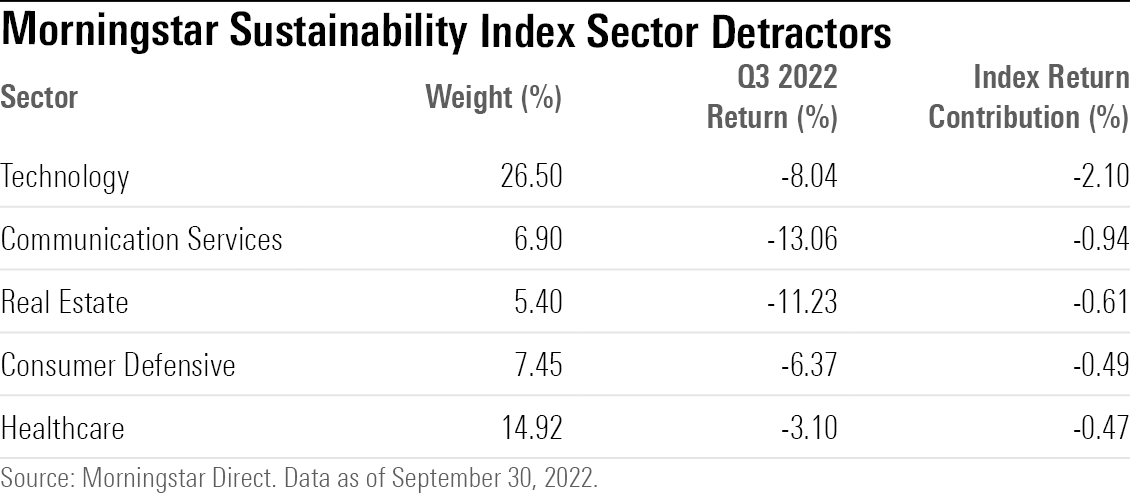
As has been the case throughout 2022, performance among technology stocks was the largest detractor from performance in the third quarter thanks to a combination of continued declines in tech-stock prices and the sector’s heavy weighting in sustainability strategies. The technology sector lost 8.0% during the third quarter, subtracting 2.1 percentage points from the Sustainability Index’s returns, according to Morningstar Direct. Communications services, which comprise 6.9% of the index, lost 13.1% in the third quarter and subtracted 0.9 percentage points from returns.
Another continuing headwind for sustainable strategies when compared with broad market trends is the outperformance of energy stocks. Many sustainable strategies completely avoid fossil fuel companies, or at the very least, hold much lower weightings in the sector than is found in the overall stock market.
In the Sustainability Index, for example, energy stocks comprise just 2.6% of the index, so a 1.3% return on the sector contributed just 0.03 percentage points to the index’s returns.
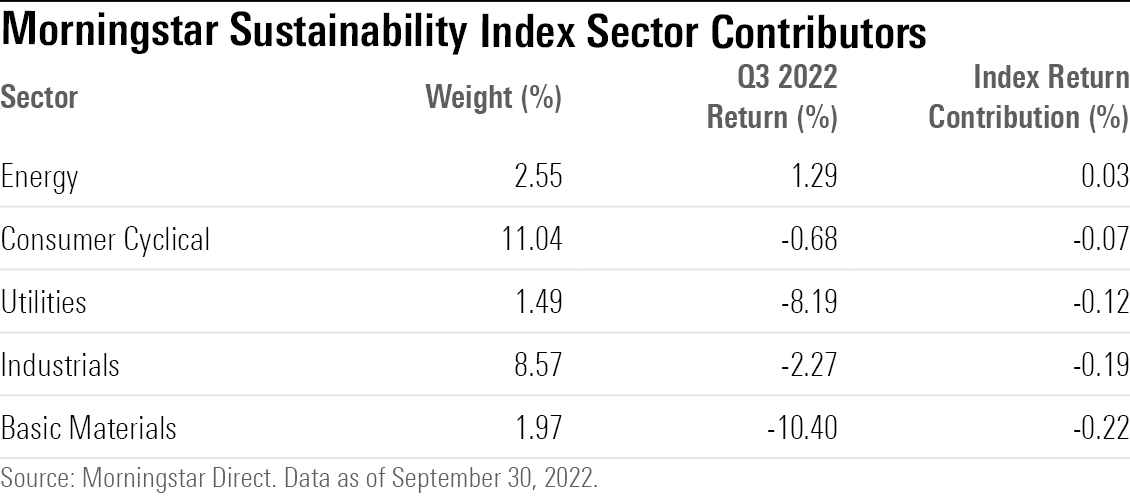
As sustainable-investing strategies have lagged in 2022, attention has often been on the underweighting of energy stocks. However, as Jon Hale, Sustainalytics’s director of sustainability research for the Americas wrote, -the focus on energy stocks is misplaced. “The bigger story of this year’s performance has to do with the growth tilt of so many sustainable equity funds,” Hale says.
Calvert’s Eames agrees. “The underweight of energy has been a bit of a headwind, but not as much a factor as style,” he says.
“It had been a market that was dominated by large-cap, technology-oriented companies that tend to have strong ESG performance,” Eames says. Growth stocks “have lighter environment exposure, do a good job with human capital and generally strong diversity. They don’t have the (ESG) risks that heavy industries like energy, materials and utilities tend to have.” Stocks in those sectors tend to fall more in the value bucket and have held in better during the 2022 selloff than growth stocks.
At the individual stock level the biggest detractor was Microsoft, which has the highest weighting in the Sustainability Index. Also dragging the index down was Verizon. The stock has a relatively small weight in the index, but after collapsing on a disappointing earnings outlook, it posted a decline large enough to have a material impact on performance.
The author or authors do not own shares in any securities mentioned in this article. Find out about Morningstar’s editorial policies.

 United States