
In Periods Including Market Stress, ESG Provides Protection, Sustainalytics Study Shows
Firms with lower ESG risk demonstrate greater financial resilience, particularly during periods of heightened market uncertainty.


One common misconception about sustainable investing is that it yields lower financial returns compared with traditional investments. That’s not the case, however, during periods of market stress, according to a study by Morningstar Sustainalytics.
Since 2019, financial markets have experienced substantial volatility, including three periods of market stress. Sustainalytics analysts Bin Dong and Kasey Vosburg investigated whether Low Sustainalytics ESG Risk Ratings could function as a protective instrument during market downturns by signaling superior ESG risk management practices.
The analysts found that “low ESG risk scores have a positive yet modest effect on stock excess returns (also commonly known as alpha). The direction and size of the effect varies across the three periods, signaling a nuanced relationship between ESG Risk Ratings and financial performance and the importance of scenario-specific analysis.”
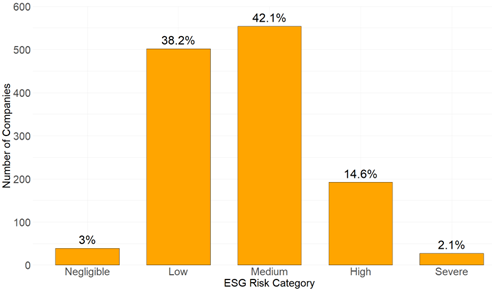
Specifically, the study examines financial performance and ESG Risk Ratings from January 2019 to April 2025, during key uncertainty periods including the covid-19 outbreak from March to December 2020, the beginning of the Russian-Ukraine war from February to July 2022, and the introduction of US tariffs in April 2025. In the study, the analysts created five portfolios sorted into ESG Risk categories, ranging from Negligible to Severe, and using a value-weighted methodology (weighted by market capitalization). The exhibit below shows the distribution of S&P 1500 companies across the ESG Risk categories.
Distribution of S&P 1500 Firms Across ESG Risk Categories
ESG Risk Score Methodology
According to Morningstar Sustainalytics, the ESG risk score measures the degree to which a company’s economic value may be at risk due to material ESG factors. The score is based on criteria that evaluate a company’s exposure to subindustry-specific ESG risks and its effectiveness in managing those risks. ESG risk scores are reported on a scale from 0 to 100; higher scores indicate more severe risk.
Negligible ESG Risk (Score ≤ 10): Indicates minimal unmanaged ESG risk, reflecting strong sustainability practices and limited exposure to ESG-related controversies or operational disruptions.
Low Risk (10 < Score ≤ 20): Suggests a low level of material ESG risk that is generally well managed within the context of the company’s industry.
Medium Risk (20 < Score ≤ 30): Reflects a moderate level of ESG-related risk, with exposure to potentially material issues that may not be fully mitigated.
High Risk (30 < Score ≤ 40): Implies significant ESG concerns that could adversely affect the company’s long-term financial or operational performance.
Severe Risk (Score > 40): Signals substantial unmanaged ESG risks, potentially associated with major controversies or weak governance structures, which may materially affect stakeholder value.
Study Findings and Implication
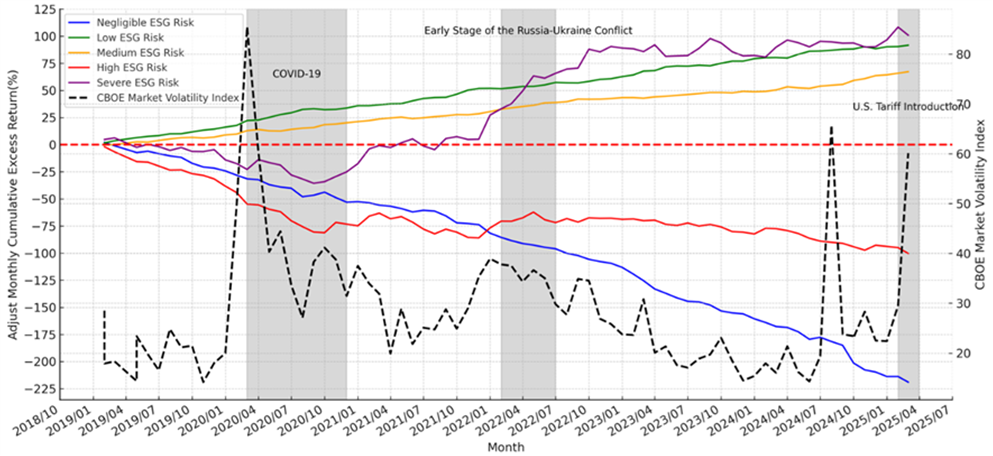
Using the Low ESG Risk Portfolio as a benchmark, Morningstar Sustainalytics compared the monthly cumulative excess returns from January 2019 to April 2025. The Low ESG Risk Portfolio consistently demonstrated strong performance and delivered positive adjusted excess returns (alpha), as seen in the next exhibit. Notably, a 5-point decrease in the ESG risk score was associated with an annual increase of 0.990% in excess returns.
However, the study highlights that the effect of ESG Risk on improved stock financial performance was relatively small.
- Covid-19: Investors placed greater emphasis on ESG risk considerations amid crisis conditions. This was prominently seen in the beginning of the pandemic.
- Russian-Ukraine War: Firms with lower ESG risk underperformed companies with higher ESG risk. “Russia’s designation as one of the largest global exporters of fossil fuels (e.g., coal, crude oil and natural gas) meant the supply disruptions and subsequent sanctions following the invasion of Ukraine had an outsized impact on global energy markets,” the analysts wrote, boosting energy prices and causing higher ESG Risk categories to outperform. The surge in energy prices at the onset of the Russia-Ukraine war resulted in higher excess returns for firms with High or Severe ESG Risk over the short term, primarily driven by higher performance of energy firms. However, over the longer term, higher ESG Risk firms significantly underperformed across key financial indicators, ranging from volatility to returns. In the exhibit, the analysts note, you can see that Low and Medium ESG Risk firms have consistently positive excess returns and lower volatility, while High ESG Risk firms have consistently negative excess returns.
- Introduction of US tariffs: Investors had a preference for firms with lower ESG risk, as they are believed to be more resilient under high tariff conditions.
Cumulative Trend of Adjusted Monthly Excess Return by ESG Risk Categories
The authors concluded that incorporating ESG Risk Ratings provides an advantage. Considering ESG risk into investment decision-making “supports the alignment of sustainability goals with effective risk management, while also contributing to the preservation of financial performance,” the analysts wrote.
The author or authors do not own shares in any securities mentioned in this article. Find out about Morningstar’s editorial policies.

 United States