
What Corporate Tax Rate Hikes Could Mean for Stocks
We expect a mid-single-digit impact to average U.S. equity valuations.

President Joe Biden has unveiled an infrastructure plan to spend around $2 trillion over the next 10 years and plans to pay for it with corporate tax increases--raising around $2 trillion over the next 15 years. The plan proposes increasing the corporate tax rate to 28% from the current 21%, which is still lower than the 35% before the Tax Cuts and Jobs Act of 2017.
While there are other plausible sources of revenue, these will likely be needed for other spending priorities outlined in the bill, so we believe there is a high probability that Congress will raise taxes on corporations this year, effective in 2022. We laid out why we think this is very likely in a previous article.
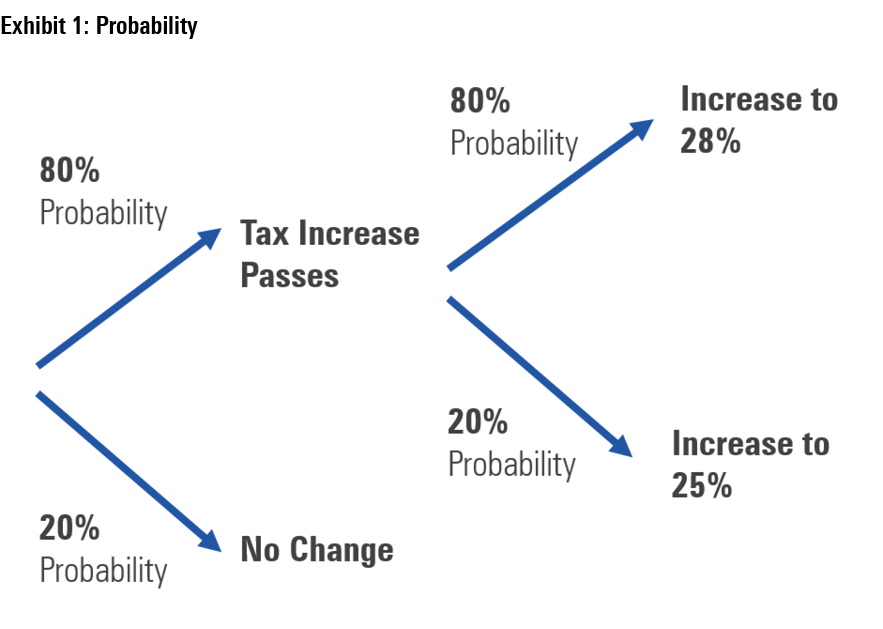
Our probability-weighted estimate is a new corporate business tax rate of 26%. As shown on the chart below, this estimate incorporates an 80% probability that any tax increase is passed at all. If an increase does pass, we see an 80% probability that it passes at Biden's proposed rate of 28%, versus a 20% probability that it is limited to 25%.
Exhibit 1: Probability
- Source: Morningstar.
Additionally, Biden has proposed large increases in taxes on U.S. corporations' foreign income, including changes to global intangible low-taxed income (GILTI) taxes, as well as a repeal of the foreign-derived intangible income (FDII) deduction. We expect these measures to generate at least as much federal revenue as the increase in the statutory corporate tax rate. However, there's still a lot of uncertainty as to how the details for this part of the bill will play out.
Tax Changes Will Likely Deliver Mid-Single-Digit Impact to Average Equity Valuations
How will the likely tax changes affect U.S. equity valuations? We outline several scenarios for the impact to our average covered U.S. equity, using a streamlined form of the discounted cash flow models used by our equity analysts.
First, we note that effective tax rates are key to determining the change to equity valuations. Consider that when the 2017 tax cuts were passed, the average effective tax rate on S&P 500 companies fell by about half as much as their statutory rate: 1,400 basis points in the statutory rate versus 700 basis points in the effective tax rate. This difference is accounted for by U.S. companies' foreign income not being subject to U.S. tax rates (although the act did include some measures targeting this foreign income, such as the GILTI tax).
We'd expect a similar impact from this tax change, meaning that the effective tax rate would increase about half as much as the statutory rate. So, a 700-basis-point statutory rate increase (reflecting the 28% corporate tax rate scenario) should lead to a 350-basis-point effective rate increase, and our probability-weighted 500-basis-point increase should lead to about a 250-basis-point effective rate increase.
With these factors in mind, we mapped out the following scenarios:
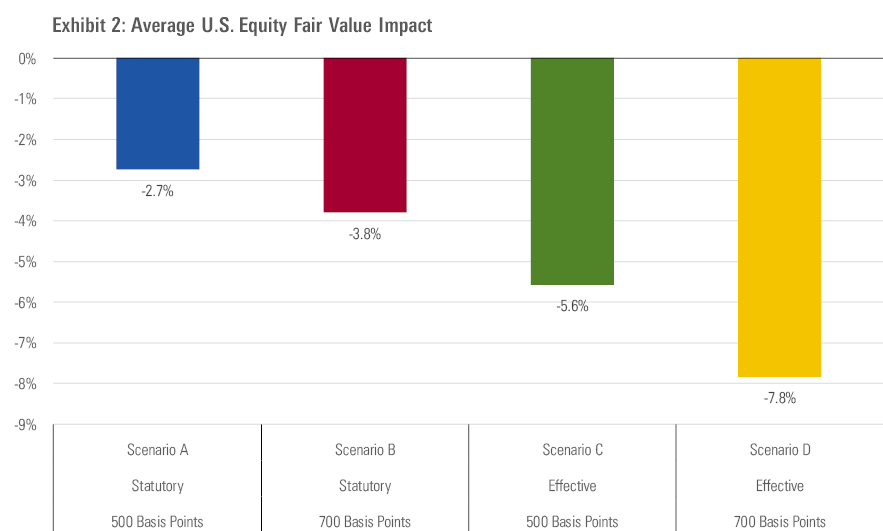
- Scenario A: Here and in Scenario B, the change in the effective tax rate equals the change in statutory rate times the company's U.S. share of revenue (about 50% on average). This, plus our probability-weighted forecast of a 500-basis-point statutory rate increase, leads to a 2.7% decrease in average U.S. equity valuations.
- Scenario B: The other potential change in the statutory rate, a 700-basis-point increase, leads to a 3.8% decrease in valuations.
However, Scenarios A and B don’t take into account the aggressive changes to taxation of foreign income, which are part of the new tax plan (including GILTI and FDII). While the details of these foreign income tax changes remain to be determined and are fairly uncertain, we attempt a rough analysis in Scenarios C and D.
Here, we assume the change in the effective tax rate is equal to the change in the statutory rate (unlike Scenarios A and B, where it's about half the change). This doubling of the impact of Scenarios A and B makes some sense, as the foreign income tax provisions are projected to raise about as much revenue as the statutory tax hikes alone.
- Scenario C: A 500-basis-point statutory and effective tax-rate increase leads to a total 5.6% decrease in average U.S. equity valuations.
- Scenario D: A 700-basis-point increase leads to a 7.8% decrease.
Exhibit 2: Average U.S Equity Fair Value Impact
- Source: Morningstar.
Higher Government Spending Won't Offset the Negative Impact of Corporate Tax Rate Increases
Some investors may be wondering whether the negative impact of higher corporate taxes will merely be offset by higher spending via the infrastructure package and other proposals. In aggregate, however, we think there is likely to be no offset from higher spending, though there will be relative winners and losers across sectors.
The reason there's no aggregate offset from higher spending is that we see no impact on U.S. real gross domestic product (beyond the very short run) from the new spending. Therefore, unless the spending increases the pretax corporate profits as a share of GDP (we have no reason to think this will be the case), no offset will occur.
In turn, our view that U.S. real GDP won't be affected by the higher spending is driven by the views we laid out in a previous article, “Why More Stimulus Can Do Only So Much for the U.S. Economy.” Even if the infrastructure spending (net of the impact of the tax hikes) acts as a net fiscal stimulus, stimulus is only effective in sustainably lifting up the economy if GDP is below its potential level, meaning there's still slack in the economy. We already think the U.S. economy may be brushing up against its potential by the end of 2022 or so, with labor markets getting quite tight by then.
It may seem unintuitive that $2 trillion in proposed infrastructure spending is unable to provide any aggregate offset to the impact of the tax hikes, but it’s inevitable given our assumptions above.
If GDP is already at its potential level, then higher federal investment spending simply means lower spending elsewhere in the economy. This could come from lower consumption as shareholders respond to the wealth hit from the corporate tax hike. State and local governments may dial down their own infrastructure spending as their needs are met by higher federal spending. And ultimately, higher federal spending would marginally increase the equilibrium interest rate, causing lower private investment and consumption.

 United States