
Housing Outlook: Our Top Stock Picks in the Sector for 2025
Despite uncertainties about interest rates and immigration and tariff policies, we see reason for optimism in the housing industry.



As the US housing market enters 2025, homebuilder confidence is on the upswing. The housing industry expects regulatory relief under the Trump administration and a Republican-controlled Congress, leading to improved market conditions. However, immigration and tariff policies, which could have implications for construction costs, are notable uncertainties, along with the interest-rate outlook.
Owing to these uncertainties, many of the housing-related stocks Morningstar tracks have underperformed our broader US equity coverage since the presidential election in November 2024.
However, the landscape looks different for homebuyers or for housing industry investors, for whom there are few bargains available. Among the housing industry stocks under Morningstar’s analyst coverage, as of Jan. 22, 37% were undervalued, 30% were fairly valued, and 33% were overvalued.
Going into 2025, we project 1.5% growth in total starts in 2025 (3.5% growth in single-family, partially offset by a 4.0% loss in multifamily starts). Repair and remodel spending is projected to grow 2.5%.
Morningstar director of industrials equity research Brian Bernard writes, “We think homebuilders will closely manage unsold home inventory in 2025 and will pull back on starts if the spring selling season disappoints. Still, we’re optimistic that attractive sales incentives from homebuilders and improved homebuyer sentiment will result in a steady sales pace this spring.”
Our housing forecast centers on these key themes:
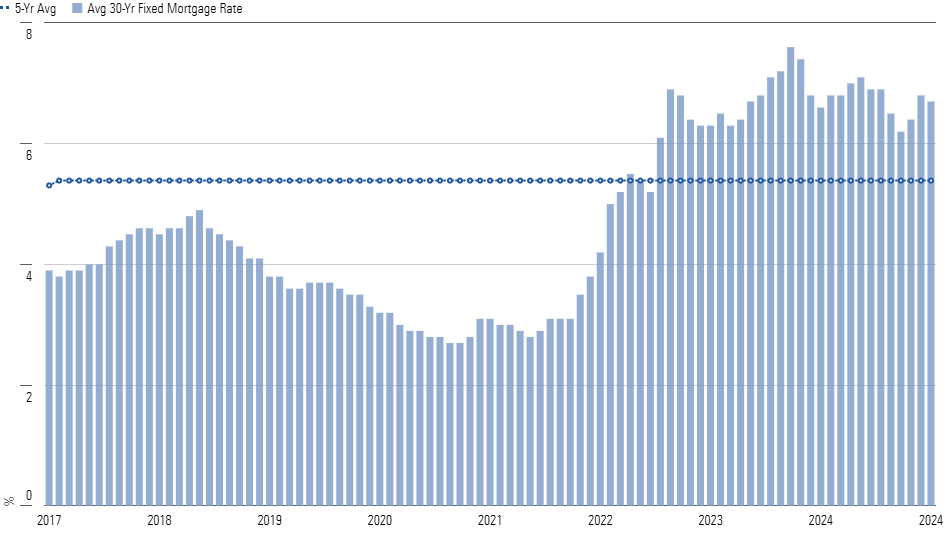
- Mortgage rate relief has yet to arrive, and the path for interest rates continues to be uncertain.
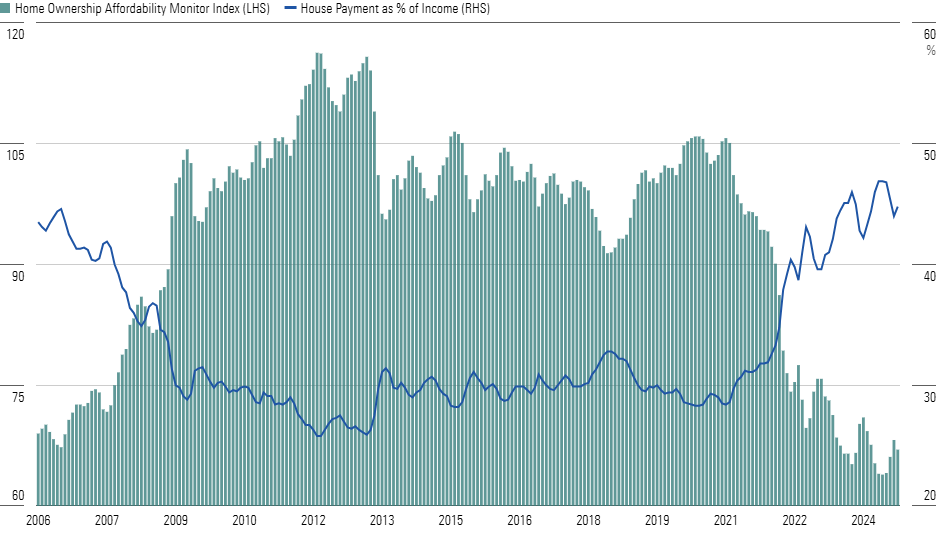
- The majority of outstanding home mortgages currently carry favorable rates (that is, below prevailing market rates), creating a “lock-in” trend that can discourage potential sellers from putting existing homes on the market. In response, demand for new builds has risen, and homebuilders have responded with sales incentives and spec building. Yet, housing affordability remains a key challenge for homebuyers.
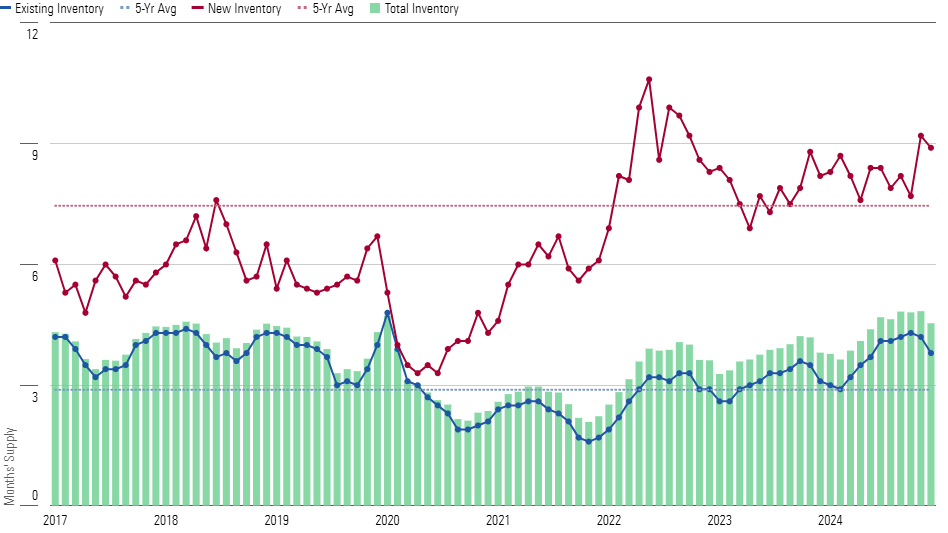
- Inventory of both new and existing homes has risen, and an increased supply of homes for sale should curb home price appreciation.
Housing Supply and Demand: Increased Supply Should Be Met With Persistent Demand
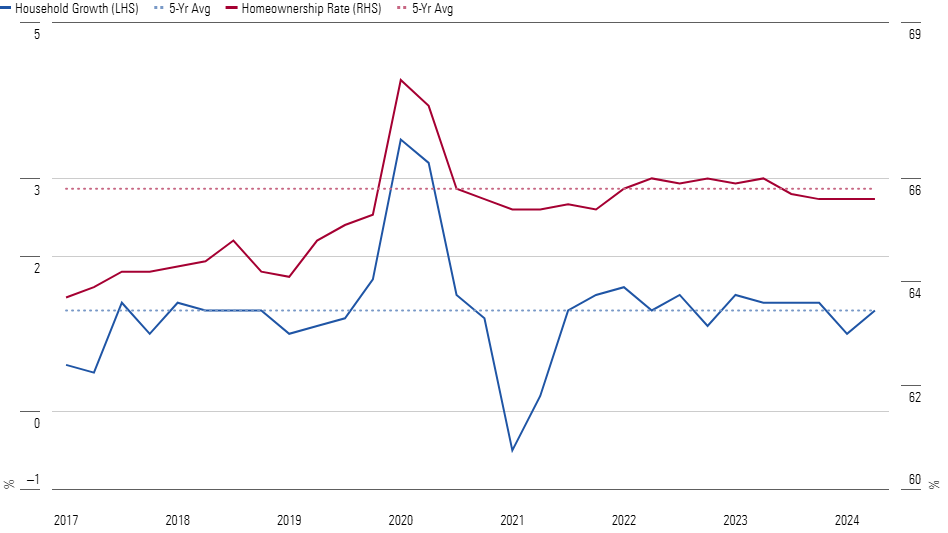
The homeownership rate remained steady at 65.6% for most of 2024, but higher mortgage rates in October and November likely sidelined prospective buyers and sellers of existing homes, reducing housing turnover. This trend has continued through January. The average 30-year fixed-rate mortgage is near 7% again.
As a result, homebuilders ramped up their production of spec homes and their use of sales incentives, leading to abundant new-home inventory. New-home sales continued to gain share in 2024, with year-to-date new-home sales up roughly 2.5% compared with a 1.5% decline in existing home sales.
Household Formations Continued in Q3; Homeownership Rate Steady at 65.6%
There Is More Inventory of New and Existing For-Sale Homes
We anticipate the demand for new homes and less multifamily development amid higher rental vacancy rates, moderating rents, and elevated construction and financing costs will mean single-family starts will grow about 3.5% in 2025, while multifamily starts will decline 4%. The steep decline in multifamily starts over the last two years has shrunk a record multifamily construction backlog. Meanwhile, the rental vacancy rate stands at 6.9%—the highest it’s been since the first quarter of 2020, although still below the 50-year historical average of 7.4%.
Affordability and Construction Costs: Housing Affordability Remains a Key Market Headwind
With higher interest rates holding back supply of for-sale existing homes, homebuilders have responded by building more quick-move-in homes. Homebuilder pricing strategies like sales incentives, base price reductions, and smaller floor plans and lot sizes have made homes more affordable, attracting more buyers. According to the National Association of Home Builders, the share of builders offering incentives (such as mortgage-rate buydowns) in January was 61%, and 30% of homebuilders reported lowering base prices by 5% on average.
The median asking rent has increased at about a 9% compound annual growth rate since the start of 2019. Nevertheless, the national median mortgage payment exceeds the national median rent, indicating that renting is more affordable than homeownership on the national level.
Bernard says, “Assuming a 20% down payment and the prevailing 30-year fixed mortgage rate as of late January (6.96%), we estimate the median existing-home price would need to decline by approximately 28% to achieve a neutral mortgage/rent ratio.”
Meaningful Mortgage Rate Relief Has Yet to Materialize
Housing Affordability Remains a Key Challenge for Homebuyers
Homebuilders: Improved Confidence Following US Election Results
Homebuilder confidence rose in November, in the aftermath of the presidential election. According to the NAHB, large public homebuilders see housing market conditions as improving under the Trump administration and a Republican-controlled Congress. Confidence was unchanged in December but edged higher in January.
Larger homebuilders have greater access to financing and are better able to absorb lower net selling prices and a higher cost of capital. However, about 60% of the market is controlled by private builders, many of which are small local and regional players. So we see the broader industrywide view as more tempered. Even as sales incentives and higher selling, general, and administrative expenses have pressured profit margins, those incentives have helped buoy sales. In light of the plentiful spec-home inventory, those incentives will likely need to be maintained this year.
“While we can appreciate the merits of a disciplined spec-building strategy in a supply-constrained environment, it’s still a riskier venture, in our view,” says Bernard.
3 Stocks to Buy if the Economy Stalls—and 3 Stocks to Buy if It Doesn’t
5 Top Housing Sector Picks
Housing sector bargains are in short supply for now. Of our housing industry coverage, 13% remains undervalued (4 or 5 stars), as of December 2024. Our top picks in the housing sector are:
Lennar LEN
Lennar, one of the largest homebuilders in the US, has an excellent balance sheet with more homebuilding cash than debt. With the upcoming spinoff of over $5 billion of land assets to Millrose Properties, Lennar will become more asset-light, which should help the company realize better returns on invested capital and cash flows over the housing cycle.
A.O. Smith AOS
A.O. Smith is a pure-play water technology firm and the largest manufacturer of water heaters in North America. Outside of the mature North America water heater market, expansion in foreign markets and water treatment products provide runways for growth. Despite a recent slide in the stock price, we expect sales will rebound roughly 4% in 2025 as demand for water heaters strengthens in North America and the Chinese market recovers.
Wayfair W
Despite the uncertain home furnishing environment, Wayfair has recently shown continued demand stabilization and ongoing improvements in its cost structure, and we think it could be finding its new baseline for growth. Despite recent industry declines, Wayfair appears to be holding its own in a languishing market.
Sun Communities SUI
Sun Communities owns manufactured housing communities, recreational vehicle communities, and marinas in desirable locations. The company has leaned on acquisitions for growth, making it more sensitive to interest-rate movements, and the stock price has reflected that. However, most of Sun’s segments have produced strong same-store growth since 2020. We believe the market will recognize the company’s strong internal growth story when interest rates stabilize.
Canfor TSE: CFP
Canfor is one of the largest softwood lumber producers in the world, with lumber accounting for roughly 85% of its revenue; its portfolio consists of various construction and specialty-grade dimensional lumber. Canfor has a significant presence in Canada but has purchased lumber capacity in the Southeastern US recently to amplify its exposure to the US market. While we expect some near-term housing pressures to persist, moves in 2023 and 2024 to remove some of its highest-cost capacity should benefit profit margins.
| Stock | Ticker | Morningstar Rating | Moat Rating | Fair Value Estimate (as of Jan. 28, 2025) | Price/Fair Value Estimate (as of Jan. 28, 2025) | Uncertainty Rating |
|---|---|---|---|---|---|---|
| Lennar | LEN | 4 stars | NA | $170.00 | 0.81 | High |
| A.O. Smith | AOS | 4 stars | Wide | $82.00 | 0.87 | Medium |
| Wayfair | W | 4 stars | NA | $70.00 | 0.70 | Very High |
| Sun Communities | SUI | 4 stars | NA | $172.00 | 0.76 | Medium |
| Canfor | TSE: CFP | 4 stars | NA | CAD 20.00 | 0.77 | High |
The author or authors do not own shares in any securities mentioned in this article. Find out about Morningstar’s editorial policies.

 United States