
Financial Services: Stocks Continue to Outperform on Regulatory Support, Recovering Deal Activity
Charles Schwab and LPL are some of our top picks in this sector.

Financial services are heterogeneous, so different industries experience different drivers, but it would be challenging to think of a better setup for the sector. Regulators have exhibited a willingness to revisit capital requirements that were at times punitive, announcing reforms to the enhanced supplemental leverage ratio in June. Michelle Bowman, vice chair for supervision of the Federal Reserve Board of Governors, has announced an intention to consider bank regulations holistically, which many observers have interpreted to mean less overlapping regulation, lower compliance costs, and lower required levels of common equity Tier 1 capital—pointing toward an increase in bank profitability.
Trade regulators have taken a more permissive stance toward sector mergers and acquisitions, and the prospect of lower interest rates points toward a recovery in sponsor activity after a muted period of alternative asset transaction activity. Against this backdrop, it’s little surprise that the Morningstar US Financial Services Index’s 22.9% gain over the past year comfortably exceeds the 17.5% return delivered by the broader market, even with modest underperformance during the most recent quarter.
A Slew of Industry Tailwinds Has Driven Strong Returns for the Financial Sector
Still, we see risks as generally lying to the downside and believe the market is getting over its skis regarding valuations. As of Sept. 12, US banks traded at a market-cap-weighted premium of 20% to our valuation, consumer finance companies at 24%, exchanges at 16%, asset managers at 7%, and insurers at 9%. The economy continues to hold up better than many expected. Still, fissures are emerging in the labor market, and with inflation that we’re not convinced is fully priced in, particularly with Morningstar chief US economist Preston Caldwell’s expectations for slowing real GDP growth until the second half of 2026.
We View Risks as Skewing to the Downside From Here
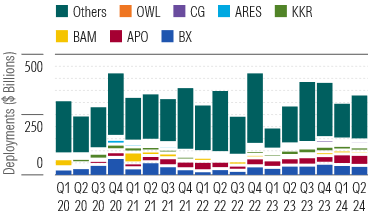
The average investment bank and alternative asset manager trade at a 24% and 10% respective premium to our valuations as of Sept. 12, reflecting our view that deployment (purchase) and realization (sale) activity by sponsors may not recover as quickly as the market seems to expect. Momentum from recent quarters is positive, but firms continue to struggle to exit prior investments and return capital to investors, with Goldman Sachs estimating that $4 trillion in investments remain “in play” as of September 2025.
Deployments Improving, but Have Room to Run
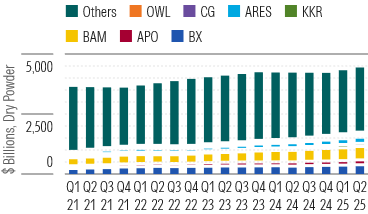
With $4.4 trillion in dry powder, by our math, at the end of the second quarter of 2025, the expected uptick in deal flow will be significant when it does come, but we find ourselves penciling in a recovery closer to the back end of Goldman Sachs CEO David Solomon’s estimate of 12 months to 24 months for that market unlocking.
Sponsors Are Holding $4.4 Trillion in Dry Powder
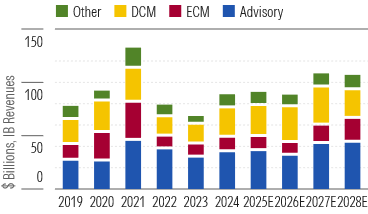
Our forecasts call for a significant recovery in investment banking revenue in 2027, largely driven by M&A advisory and equity underwriting, two categories that are particularly sensitive to sponsor activity. In the meantime, trading and financing businesses continue to perform at peak cycle levels for the trading banks, offsetting cyclically lower investment banking revenue.
We Expect a Surge in Activity in 2027
Top Financial Services Sector Picks
LPL Financial Holdings
- Fair Value Estimate: $504.00
- Morningstar Rating: ★★★★
- Morningstar Economic Moat Rating: Wide
- Morningstar Uncertainty Rating: High
We recently upgraded LPL’s LPLA economic moat rating to wide from narrow, reflecting our view that the firm is poised to emerge as a long-term winner in the quickly growing independent broker dealer channel within the US wealth management landscape. Driven by a competitive technology platform, strong advisor payouts, a solid product shelf, and good adviser service, LPL has emerged as the platform of choice for transitioning financial advisors. The firm has led the industry in advisor recruiting over each of the past 8 years, and we now expect nearly 12% annual growth in client assets over the next decade, up from 8% previously, a view that is not reflected in current market prices.
Charles Schwab
- Fair Value Estimate: $105.00
- Morningstar Rating: ★★★
- Morningstar Economic Moat Rating: Wide
- Morningstar Uncertainty Rating: High
Schwab SCHW is a high-quality name that sits at the confluence of two growth trends in financial services; retail investing and independent wealth management. We view most of the market’s misunderstanding as tying to the firm’s cash sweeps business, and by extension, its prospects for growing its base of net interest income. Driven by modestly higher projected client cash balances, a likely decision to return to its asset-heavy investment approach (rather than sweeping those deposits to third party banks), and recovering yields on its securities portfolio, we expect the firm to generate outstanding 16%, 23%, and 25% annual growth in revenue, operating profit, and EPS over the next five years.
Jack Henry & Associates
- Fair Value Estimate: $191.00
- Morningstar Rating: ★★★★
- Morningstar Economic Moat Rating:
- Morningstar Uncertainty Rating:
Unlike peers Fiserv and FIS, Jack Henry JKHY has largely stuck to its bank technology roots, with core processing and ancillary bank technology services comprising more than 60% of the firm’s sales. Core processing is extremely sticky, and we estimate retention rates generally exceed 99%, adjusted for acquisitions. The high-quality name rarely trades at a discount to our fair value estimate, continues to grow its revenue at a 6%-7% annual clip, and should be relatively insulated from systematic risks outside of its processing business.
The author or authors do not own shares in any securities mentioned in this article. Find out about Morningstar’s editorial policies.

 United States