
Anthropic and OpenAI Face Commodification Threats. Here’s What to Watch For
Frontier AI labs face a three-pronged set of challenges.

The economic moats that we believe frontier AI model companies are building can differentiate leaders like Anthropic and OpenAI over the long term. That said, there is a non-zero chance large-language models could commodify, becoming largely interchangeable.
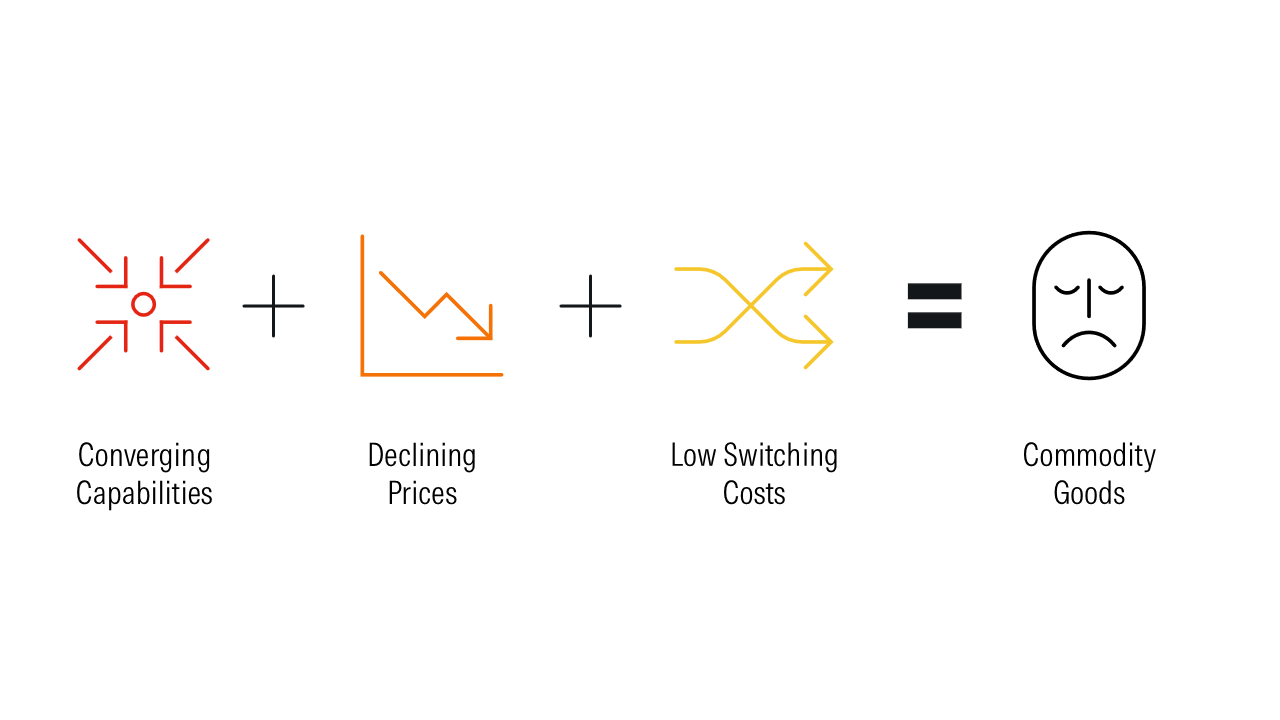
Bears say the capabilities of competing LLMs, including those from leading labs such as Anthropic and OpenAI, are already starting to converge. Chinese open models are a clear competitive threat. On top of that, per-token prices are on a downward trend, and users can easily switch between models without friction.
Should all three challenges stay pertinent in the long run, models become interchangeable inputs, with pricing power transferring from model builders to firms that control the scarce inputs (chips, power, cloud infrastructure, and distribution). Competitive advantages and differentiation can help overcome these challenges.
The Bear Thesis: LLMs Exhibit Properties of Commodity-Like Goods
Bear Leg One: Converging Capabilities and the Chinese Open-Model Risk
Data shows the performance gaps between LLMs are narrowing. At the same time, the order of who has the best model is also regularly shuffling. Barring some AI lab unlocking recursive learning (which enables its models to self-improve rapidly), we expect this compression dynamic to remain intact.
Leading AI Models' Capabilities Are Converging
Adding complexity is the rapid rise of Chinese open-weight models, which have shown clear progress relative to US models over the past year. The fact that open-source, cheaper versions of frontier models can appear months after seemingly every new frontier model launch supports the claim that capability differentiation is truly difficult to protect.
The Chinese open-model bear case is certainly top of investors’ minds, as we saw in investor worries about frontier model companies following the release of DeepSeek’s R1 model in January 2025 and Moonshot’s Kimi K3 model in July 2026.
Our view is that Chinese models will continue to lag US frontier models for structural reasons. First, Chinese labs develop models in a hardware-constrained ecosystem, lacking access to the latest AI chips. Second, Chinese labs have used outputs from Claude models, as well as the thinking traces Claude provides, to refine and improve their models—a process known as distillation. If Chinese model roadmaps rely (at least in part) on leveraging frontier US models for improvement, then by definition, they cannot meaningfully surpass US labs.
Further, the rise of open models capable of taking over low-value tasks will create greater demand for orchestrators and frontier models to efficiently manage these utility-tier models. Finally, we think it is highly unlikely that US enterprises/government agencies will standardize their workflows on Chinese open models for a variety of reasons, including national security and cost-related factors.
Performance of Top US and Chinese Models on the Arena
Bear Leg Two: Price Compression
When models are grouped into intelligence cohorts, and we track price per cohort over time, we see material price compression. Intelligence that commanded $17 per million tokens in late 2024 can be purchased for $0.50 per million tokens in 2026—a 97% decline.
We have seen a similar downward trend in the months following release even with frontier models. Models scoring above 40 on the Intelligence Index have seen prices compress from roughly $5.00 toward $0.25 per million tokens within a handful of quarters of release.
While it can be easy to look at these price charts and jump to the side of commodification, we’d urge readers to reserve judgment. Paired with exploding volumes, falling unit prices can spur high sales growth—Anthropic has already had meteoric sales growth. Even if the price per token falls by 90%, the total amount spent on tokens still goes up, as long as token usage keeps increasing at the rate it has.
Additionally, AI labs’ ability to efficiently serve models has also increased dramatically over the past few years. As a result, these labs can effectively maintain margins while the price per token declines for certain models within their model families.
Language Model Inference Price, by Intelligence Index Band
Bear Leg Three: Low Switching Costs
When using cloud platforms such as Microsoft Azure or AWS Bedrock, or coding tools such as Antigravity or Cursor, users can pick a different model from a drop-down menu. This dynamic makes sense—especially when it comes to the hyperscalers such as Microsoft MSFT and Amazon AMZN—as these firms benefit from a competitive and interchangeable model layer.
While we agree the cost of switching a model endpoint, such as a model on Cursor, is near zero, the cost of switching an enterprise AI deployment is not. Enterprises investing in areas such as prompt engineering, evaluation harnesses, fine-tuning models, and building agentic scaffolding do so by modeling these tasks after a specific model or model provider. If they switched models on the fly across their entire organization, they’d run into a ton of quality control issues, as many of the processes they’d developed won’t simply port over.
While competition will increase on the model layer, companies will offer different models with varying intelligence and speed at different price points. If you want the cheapest model for a simple, repetitive task, that will be an option, and vice versa, all offered as a complete menu within each model company.
This ecosystem point also previews what we view as a structural conflict between the model companies and the software industry. The value that sits outside the model weights, including harnesses, company context, workflows, and integrations, is precisely the layer software firms have historically been built to capture.
We see two plausible equilibria: Either software firms become the distribution and final integration layer for the model companies, with the model acting as a tolled input, or the model companies vertically integrate and effectively become software firms themselves. The same tension runs through the labs’ relationships with public cloud providers, as hyperscalers benefit from an interchangeable model layer, while model companies work to deepen lock-in around their own ecosystems.
A Wider Take on the Broader Bear Thesis: Public Opinion Could Slow Down AI Labs’ Growth
AI has a serious public opinion problem; surveys say the general population ranks AI’s popularity below that of Congress. This matters because local governments and councils have considerable power and influence over data center construction. If, due to public backlash, US data center construction meaningfully slows, we believe AI labs will grow more slowly, but they won’t miss out on profits.
The incremental gross margin earned on inference should hold regardless of how much capacity is added in a given year. If anything, constrained supply relative to sustained high demand could firm up prices and improve unit economics for a time, even as it hamstrings the growth trajectory on which these firms’ valuations depend.
The author or authors do not own shares in any securities mentioned in this article. Find out about Morningstar’s editorial policies.

 United States