
PIMCO CEF Cuts Distribution, Shares Plummet
The risk of buying CEFs at huge premiums comes to fruition.


Last month, we wrote about
On Oct. 3 (after the market closed), PIMCO announced a 20% cut to PGP's distribution, lowering it by $0.04 per share to (a still very high) $0.15 per share. The next day, the premium dropped to 71% from 106%, creating a steep one-day trading loss for investors. That premium has bounced back somewhat (it was 83% as of Oct. 7), but shareholders have lost a fair amount in a few short days. The falloff in share price quickly dragged the fund's near-term price return well below its net asset value return. For the three months through Oct. 7, for example, PGP's share price was down 7%, but its NAV was up 9%. This is a huge disconnect--investors are essentially speculating on other investors' future sentiment about the fund, not the ability of the fund's manager (Dan Ivascyn) to outperform.
Investors using the z-statistic as a primary tool for valuation of CEFs should also be warned against the z-statistic for funds trading at super-high premiums. As background, the z-statistic measures how many standard deviations a fund's discount/premium is from its average discount/premium over the stated time period. For instance, a fund with a three-year z-statistic of positive 2 would be two standard deviations above its three-year average discount/premium. Funds with the lowest z-statistics are classified as relatively inexpensive, while those with the highest z-statistics are relatively expensive. We consider funds with a z-statistic of negative 2 or lower to be "statistically undervalued" and those with a z-statistic of 2 or higher to be "statistically overvalued."
PGP's 1-year z-statistic as of Oct. 7 was negative 0.36, indicating the fund was trading at fair value. Notably, the six-month z-statistic was negative 3.40, which indicates that the fund was undervalued over that time frame. It's difficult to rationalize an 80%-plus premium as "fairly valued" much less "undervalued."
The z-statistic is a valid tool for assessing a fund's current valuation based on historical trading patterns, but investors need to be sure they understand what's going on behind the scenes. Blindly buying or selling based on a z-statistic is not recommended.
Most Undervalued CEFs
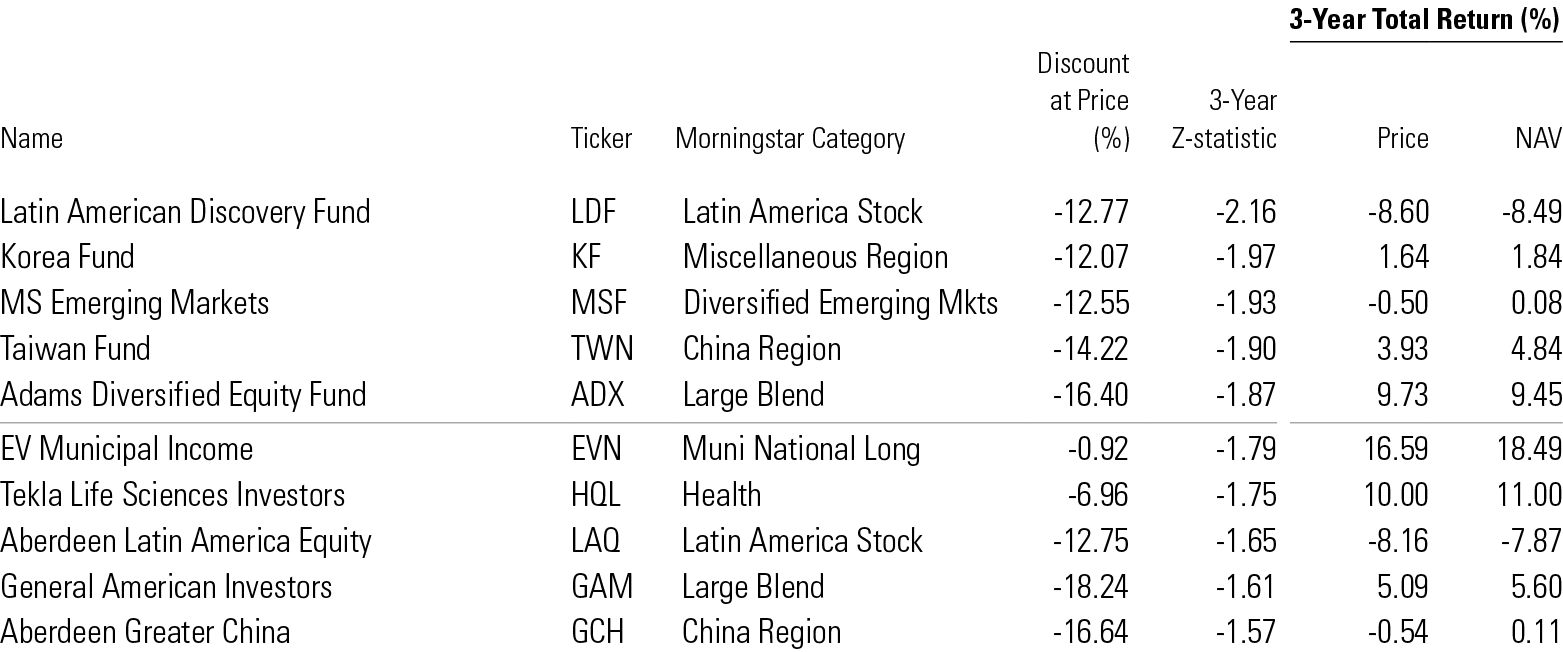
The table below shows the 10 most undervalued CEFs as of Oct. 5 (those with lowest three-year z-statistics). Only one met the "undervalued" threshold of negative 2 or below--
- source: Morningstar Analysts
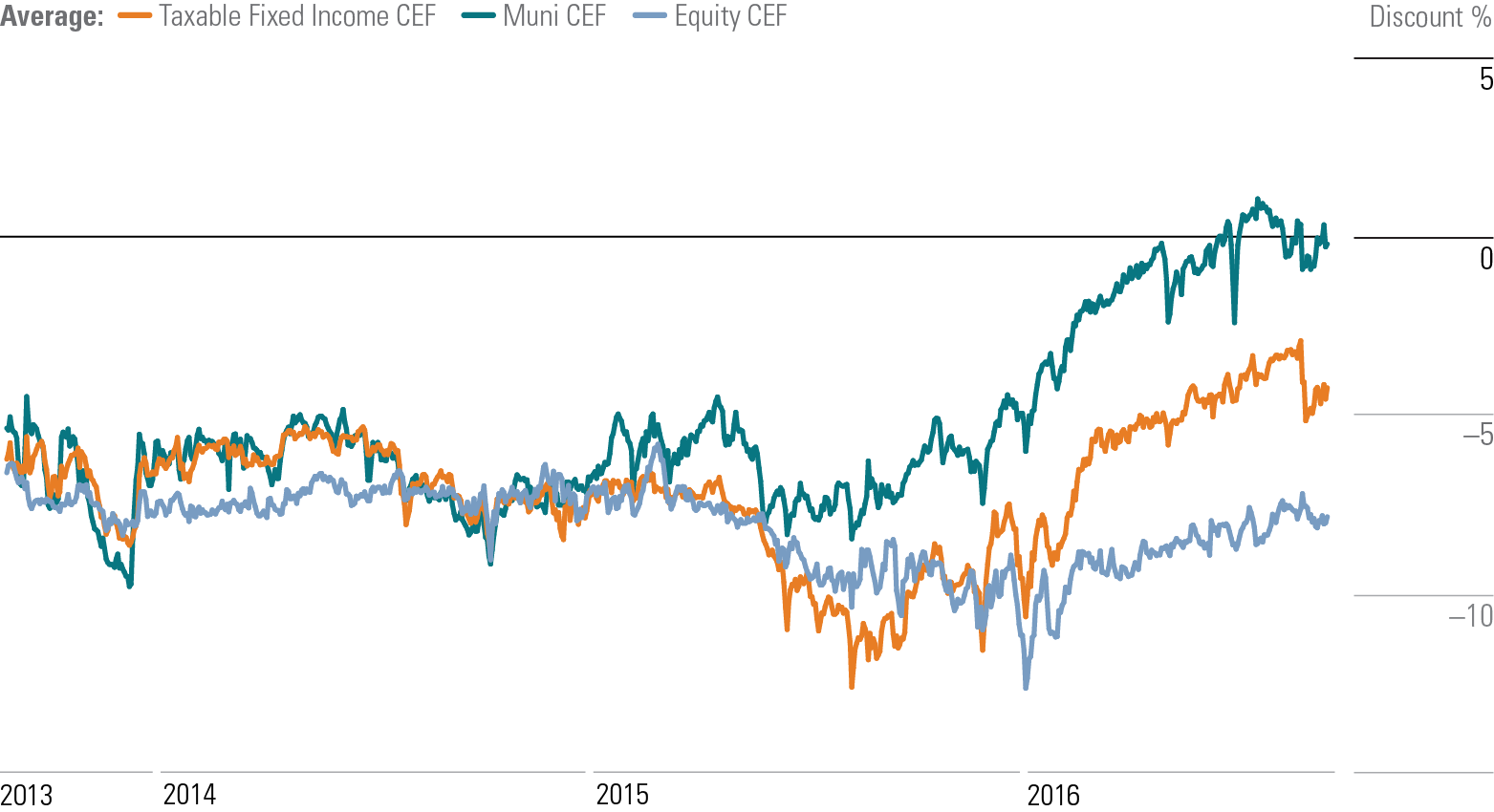
CEF Discount Trends Exhibit 2 below shows the average discounts for taxable fixed income, muni, and equity CEFs over the trailing three years.
- source: Morningstar Analysts
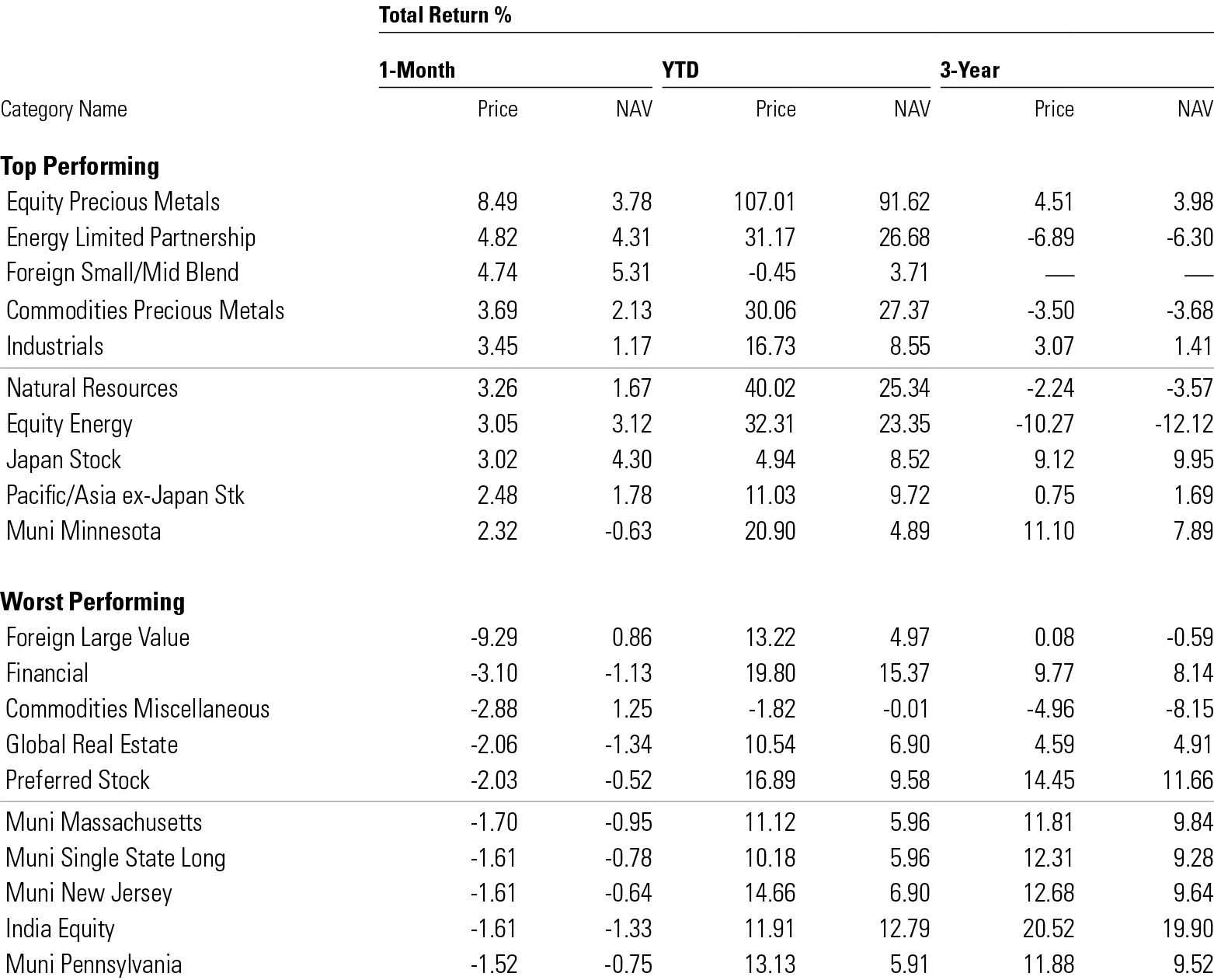
Reversing last month's move of widening average discounts for municipal CEFs, the average discount narrowed to 21 basis points from 47 at the end of August. For equity CEFs, the average discount ended the month slightly wider--7.9% versus 7.6% at the end of August; and for taxable-bond funds, the average discount widened to 4.3% from 3.2%. Each category has seen a significant narrowing in average discount in 2016: Equity CEFs started the year at an average discount of 9.4%, taxable bonds at 8.3%, and munis at 4.8%. Best- and Worst-Performing CEF Categories September was another good month for equity precious metals, which surged following the Federal Reserve's decision to hold off on raising the federal fund's rate. Equity precious metals have been a top performer for the year: The CEF category average year-to-date return through September was more than 100%. The energy limited partnership and equity energy categories both continued to gain as the price of oil stabilized at around $50 per barrel of crude. The price of a barrel was in the $20 range as recently as February. Exhibit 3 shows the best- and worst-performing categories in September ranked by share price return.
- source: Morningstar Analysts
Conclusion Investing in CEFs requires more analysis than investing in a typical open-end mutual fund or ETF because investors must also consider valuation before buying or selling. The whipsaw in share price of PGP over the past week should serve as a cautionary tale for investors enticed by high distribution rates and brand names.

 United States