
Why Janus Capital Is a Value Stock
Fund companies that don't sell cheap funds are struggling.

For Sale Earlier this week, the United Kingdom's Henderson Group announced that it was acquiring Denver's once-mighty Janus organization. Ironically, the company famed for its growth-style investment approach had itself become a value stock, as Henderson bought Janus for 16 times its trailing 12-month earnings--well below the average for the U.S. stock market. Henderson also paid less than the standard rule of thumb for fund-company acquisitions: 2% of assets under management.
Viewed conventionally, it's hard to understand why Janus would be priced as damaged goods. Most of Janus' assets are in equity funds, which are the most desirable of fund-company properties. What's more, many of those offerings have been very good. For example, among Janus' 12 largest funds,
If so, you would think wrong. Collectively, those four funds have enjoyed $1.8 billion in net sales during the past three years. That is less than what
Media reports of the Henderson-Janus deal have blamed this asymmetry on the unpopularity of active management. With U.S. investors so strongly favoring index funds, stated the articles, Janus has been fighting a sales headwind. This is correct, as far as it goes: All things being equal, U.S. fund investors prefer that their domestic stock funds be indexed. But it's only half the story.
Less Means More: Index Edition The other half is that active U.S. stock funds can sell their wares--if they are priced sufficiently low. When it comes to attracting and retaining assets, costs matter for mutual funds, across the board. They matter for index funds, and they matter for actively run funds.
Consider index funds. It's well known that low-cost U.S. stock index funds are attracting huge inflows. Less well-known is that there are several dozen U.S. stock index funds that do not offer low costs, and nobody is buying them--or ever did buy them. Even as cheap U.S. stock index funds are gobbling up new monies, those with expense ratios exceeding 0.50% are gradually leaking what few assets they hold.
The chart below tells the tale. It portrays the net inflows for U.S. equity index funds, during the trailing three years, sorted by expense buckets: 1) low-cost funds at 0.50% or less; 2) those between 0.51% and 0.75%; 3) those between 0.76% and 1.00%; and 4) high-cost funds that are at 1.01% or higher. Also shown is the percentage of funds that qualify for each bucket.
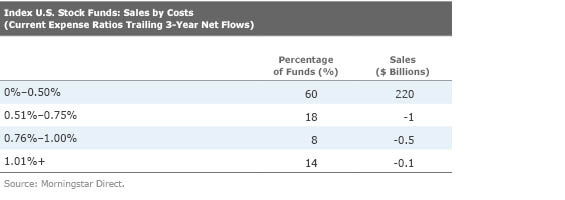
Note that while cheap funds account for more than 100% of total inflows--that bucket has received $220 billion, while the other three buckets have each been slightly negative--they are by no means 100% of the available funds. Only 60% of U.S. stock index mutual funds have expense ratios of 0.50% or less. The other 40% are higher, and they are all are wasting their time. Nobody wants them.
(These figures are for traditional mutual funds only; they do not include sales for exchange-traded funds. ETF data would just accentuate the argument. Many U.S. equity ETFs carry fairly high expense ratios, and their sales are poor. Conversely, the dominant ETFs are those that deliver the basics at extremely low costs.)
Less Means More: Active Edition Now on to active funds. As it turns out, their pattern is the same as that of index funds. Low-cost active funds have inflows, while all the rest are suffering outflows. The level of sales is below that of index funds, such that the bargain-priced active funds have not brought in as much money, and the noncheap active funds have bled much more heavily, but the story is unchanged. Truly cheap funds sell; everything else does not.
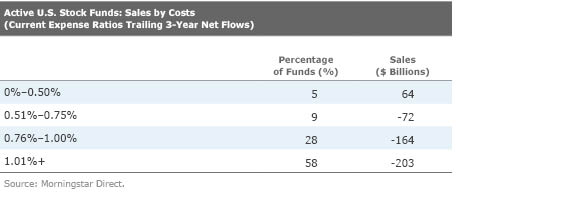
Which brings us to the column's headline: Why Janus Capital is a value stock. Five percent of actively managed U.S. stock funds have expense ratios of 0.50% or less. Those 5% is growing. The remaining 95% are not--indeed, they have lost a collective $440 billion to redemptions during the trailing three-year period. How much would you pay to purchase a collection of funds from the 95% group?
Not much, right? And that is where Janus lies. Of the company's 185 share classes of equity funds, including both domestic and international funds, exactly two have expense ratios of less than 0.50%. And both of those funds are undergoing redemptions. Price gets a fund in through the door, but performance seals the deal--and these two funds each land in the bottom quintile for total returns, relative to their peers, during the trailing three years.
The Future Is Sears? The landscape has changed rapidly for active U.S. fund managers. Most have lineups that are almost entirely unmarketable; the best that they can hope for is to retain what assets they have for as long as they can. Growth will come from acquisitions or market appreciation, not new sales. That won't change until active managers price their products much, much differently than what they are now doing.
A coworker summarized the matter pithily: "Either active-management firms will make a much more concerted effort to lower their fees, or they will be Sears." That sounds about right. Your choice, industry. Your choice.
John Rekenthaler has been researching the fund industry since 1988. He is now a columnist for Morningstar.com and a member of Morningstar's investment research department. John is quick to point out that while Morningstar typically agrees with the views of the Rekenthaler Report, his views are his own.
The opinions expressed here are the author’s. Morningstar values diversity of thought and publishes a broad range of viewpoints.

 United States