
Rising Oil Prices Stabilize Corporate Bond Markets
Apple comes to the market yet again.

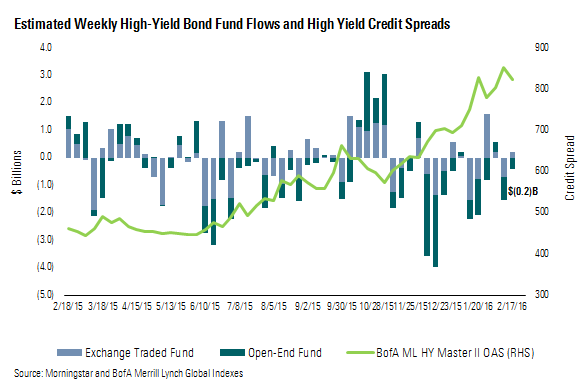
Two weeks ago, oil prices hit their lowest level since the financial crisis. Since then, news reports have surfaced that Russia and Saudi Arabia have agreed in principle to cap their production at current levels, and oil prices have risen. Last week, oil increased almost $2 to $32 per barrel, approximately $6 higher than its recent lows. As oil prices have risen, asset prices throughout the energy sector have also rebounded from their lows and moved the entire market higher. On a week-over-week basis, the average spread of the Morningstar Corporate Bond Index (our proxy for the investment-grade corporate bond market) tightened 4 basis points to +211. The spread of the Bank of America Merrill Lynch High Yield Master II Index tightened 41 basis points to +823. In the equity market, the S&P 500 rose 2.8%. Treasury bonds were largely unchanged. The yield on the 5-year Treasury rose 3 basis points to 1.23%, and the 10-year and 30-year bond yields were unchanged at 1.75% and 2.61%, respectively.
With the markets finally stabilized, issuers wasted no time in hitting the public debt markets immediately after the Presidents Day holiday. Apple AAPL (rating: AA-, narrow moat) lined up first, issuing $12 billion worth of bonds in a multitranche offering consisting of maturities spanning from 2 years to 30 years. This was Apple's third multitranche debt issuance over the past 12 months. The use of proceeds includes dividends and share repurchases. Over the past year, Apple has been one of the largest issuers of debt, having already raised $28 billion across two issues over the past year. Regarding the prodigious amount of debt that Apple has issued in such a short time frame, Morningstar senior credit analyst Michael Dimler wrote, "While cash flow and liquidity are far from concerning at Apple, we consider the company's gradual increase in leverage, particularly given the slowing pace of mobile device sales, as a negative." However, Dimler is not too concerned that the credit quality of the firm will deteriorate meaningfully; he expects that the firm will not issue so much debt as to either take on a net debt position or be in a position that it couldn't quickly pay off with a tax-efficient repatriation of its overseas cash reserves. Dimler further noted, "Since the end of calendar 2013, Apple's gross leverage has more than doubled while net leverage (reflecting an excess of cash over debt) has contracted by 0.7 turn."
Although credit spreads in the high-yield space tightened, fund flows remained negative as investors continued to withdraw assets from the sector; however, the pace of outflows decreased as high-yield mutual funds and exchange-traded funds dropped only $0.2 billion.

 United States