
Rally Loses Steam, Credit Spreads Roll Over
Diverging global monetary policy: U.S. considers tightening whereas rest of world is easing.

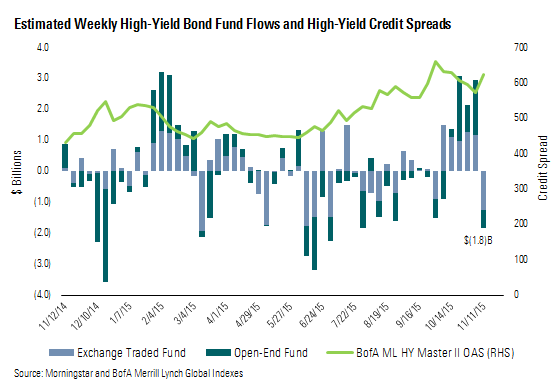
After tightening for the past six weeks, corporate credit spreads backed off as equity markets dropped and commodity prices fell. The average spread of the Morningstar Corporate Bond Index widened a modest 2 basis points to +158 bps over Treasuries, whereas the Bank of America Merrill Lynch High Yield Master Index was hit hard, suffering 42 bps of widening to end the week at +624 bps. After five weeks of strong inflows, high-yield mutual funds and exchange-traded funds endured $1.8 billion of outflows as investors looked to reduce exposure to high-risk assets.
In the commodity markets, the price of copper hit its lowest level since mid-2009. This is a particularly worrying sign to the markets. The metal is often referred to as Dr. Copper, since it is reputed to have a Ph.D. in economics. Because of copper's use across many facets of the economy, its price is considered to be highly correlated to economic activity. Oil prices also took it on the chin last week, falling to a $40 handle price. Oil fell below $40 earlier this year, but otherwise it too is at its lowest level since mid-2009. With the price of hard commodities falling, the credit spreads in the metals and mining and energy sectors weakened. In the investment-grade market, the credit spread in the metals and mining index widened 36 basis points to +370 and the spread in the energy sector widened 4 basis points to +210. As a comparison, the widest levels hit by these sectors earlier this year were +435 and +291, respectively. In the high-yield market, the credit spread in the metals and mining index widened 87 basis points to +1,324 and the spread in the energy sector widened 59 basis points to +1,055. As a comparison, the widest levels hit by these sectors earlier this year were +1,377 and +1,137, respectively.
Weakness was not limited to the commodity-related sectors. Retailers across several types of concepts reported weak sales. The equity prices for Macy's M (rating: BBB, no moat), Kohl's KSS (rating: BBB, no moat), Nordstrom JWN (rating: A-/UR-, narrow moat), and VF VFC (rating: A, wide moat) traded down last week to new 52-week lows. We placed our rating of Nordstrom under review with negative implications after its earnings report last week. Given the lower-than-expected earnings results and reduced expectations for forecast earnings, free cash flow generation through 2016 will be lower than our previous expectations. In addition, the retail sales report released last Friday revealed that overall sales rose less than expected in October and were revised lower for September. Considering that inventory levels among retailers are high, the lower sales growth is raising concerns that holiday sales this year may be pressured and that retailers will have to resort to deep markdowns to move merchandise and suffer from lower margins.
Diverging Global Monetary Policy: U.S. Considers Tightening Whereas Rest of World Is Easing According to a Wall Street Journal poll, about 92% of economists who responded expect that the Federal Reserve will raise the federal funds rate at its Dec. 15-16 policy meeting. The market-implied probability in the interest rate futures market that the Fed will raise the fed funds rate in December has been rising since Oct. 28 when the Fed released its statement after the Federal Open Market Committee meeting. After the stronger-than-expected employment report was released earlier this month, the probability of a rate increase in December jumped even higher, to over a 75% probability from approximately 50%.
While it is increasingly likely that the Fed will begin to tighten monetary policy in December, the European Central Bank intimated at its October meeting that it would evaluate easing monetary policy further at its December meeting, expanding its existing program. ECB President Mario Draghi said, "The degree of monetary policy accommodation will need to be re-examined at our December policy meeting." Currently, the ECB is about halfway into the quantitative easing program it began earlier this year. The program entails the purchase of an average EUR 60 billion of bonds every month for 18 months, which will result in a little over EUR 1 trillion of asset purchases. More recent commentary from Draghi suggests that the ECB is contemplating expanding the asset-purchase program as well as enacting other measures to further debase the euro.
In addition to potentially even easier monetary policy emanating from the eurozone, the People's Bank of China recently cut each of its benchmark lending and deposit rates by 25 basis points and reduced its reserve requirement ratio (the amount of capital that banks need to reserve against loans) by 50 basis points. Just before the rate cuts, China reported that third-quarter GDP growth had slowed to 6.9%. While that would be the envy of any developed economy, this is the slowest rate of increase in China since early 2009, and economic growth appears to be headed lower yet. Chinese President Xi Jinping warned that economic growth could fall as low as 6.5%. These rate cuts piled on top of the other easing steps the PBOC has taken over the past year. This reduction is the sixth time since last November that the PBOC has lowered its benchmark lending rate, and this is the fourth time the central bank has lowered the reserve requirement ratio. China is struggling with altering the composition of its economy from one spurred by investment in infrastructure spending to one more balanced with consumer spending.
European GDP Remains Mired in Low Growth GDP in the euro area remained mired in low-growth mode. Eurostat reported that seasonally adjusted GDP rose 0.3% in the euro area during the third quarter of 2015 compared with the previous quarter and 1.6% compared with the same quarter of the previous year. Quarterly growth in Germany and France rose in line with the overall eurozone at 0.3%, and growth in Italy slightly lagged at 0.2%. Economic growth in Spain slowed a bit from the prior quarter but continued to be the standout among the eurozone as GDP rose 0.8%.
While economic growth in Spain has been on the rebound over the prior year, loan growth has stagnated among Spanish banks. While many borrowers are taking out new loans to support business development, the loan growth has been offset by repayments from borrowers who overextended themselves before the global financial crisis and are using the economic rebound to reduce indebtedness.
Credit spreads on Spanish sovereign bonds were little changed last month; however, political risk may be rising. Lawmakers in the Catalonia region of Spain passed a resolution to increase their independence from Spain. Spain's constitutional court quickly issued an injunction to halt Catalonia from beginning any actions to implement the resolution. If it appears that Catalonia is gaining traction on seceding from Spain, it would probably pressure Spain's ability to manage its debt load. Catalonia accounts for a significant percentage of Spain's GDP and provides a disproportionate amount of tax revenue to the Spanish government compared with the amount it receives back. This in turn would spark worries about Spain's ability to service its debt. The dominoes may begin to fall as sovereign default fears would have significant negative implications for the Spanish banking system, which holds a significant amount of its assets in Spanish bonds. Between concerns regarding Spain's ability to manage its debt load and the resulting solvency of its banking system, this could instigate a replay of the European sovereign debt crisis in 2012.

 United States