
For Investors Who Can Get Beyond Headline Risk, Opportunity Beckons in Bonds
The fixed-income market holds appeal if you understand its nuances.


Bonds have faced serious headline risk in 2025. In April, it was “US Treasuries Sell Off as Trade War Calls Haven Status Into Question” and “Is the Tax-Exempt Status for Municipal Bonds at Risk?” Then came Moody’s US credit rating downgrade and “Trump’s Tax Bill Adds to Bond Market’s Woes.” Most recently, eyes have been on interest rates and “Why the Fed’s Independence Matters to Markets, the Economy, and Your Wallet.”
Despite all this, fixed income has performed well so far in 2025. The Morningstar US Core Bond Index is up 5% through the first eight months of the year. True, that lags the broad US stock market. But look how well fixed income held up when equities were selling off in March and April. Bonds have done their job as diversifiers and portfolio ballast in 2025.
Bonds Held Their Value While US Stocks Sold Off in 2025's First Half
It’s critical to remember, though, that fixed income isn’t a monolith. The Morningstar US Core Bond Index represents the investment-grade market—Treasuries, corporates, and mortgage-backed securities. But there are also more credit-sensitive areas, some of which have outperformed this year. As my colleague Christine Benz and her co-authors on the Morningstar Diversification Landscape Report have pointed out, correlations across fixed-income types vary.
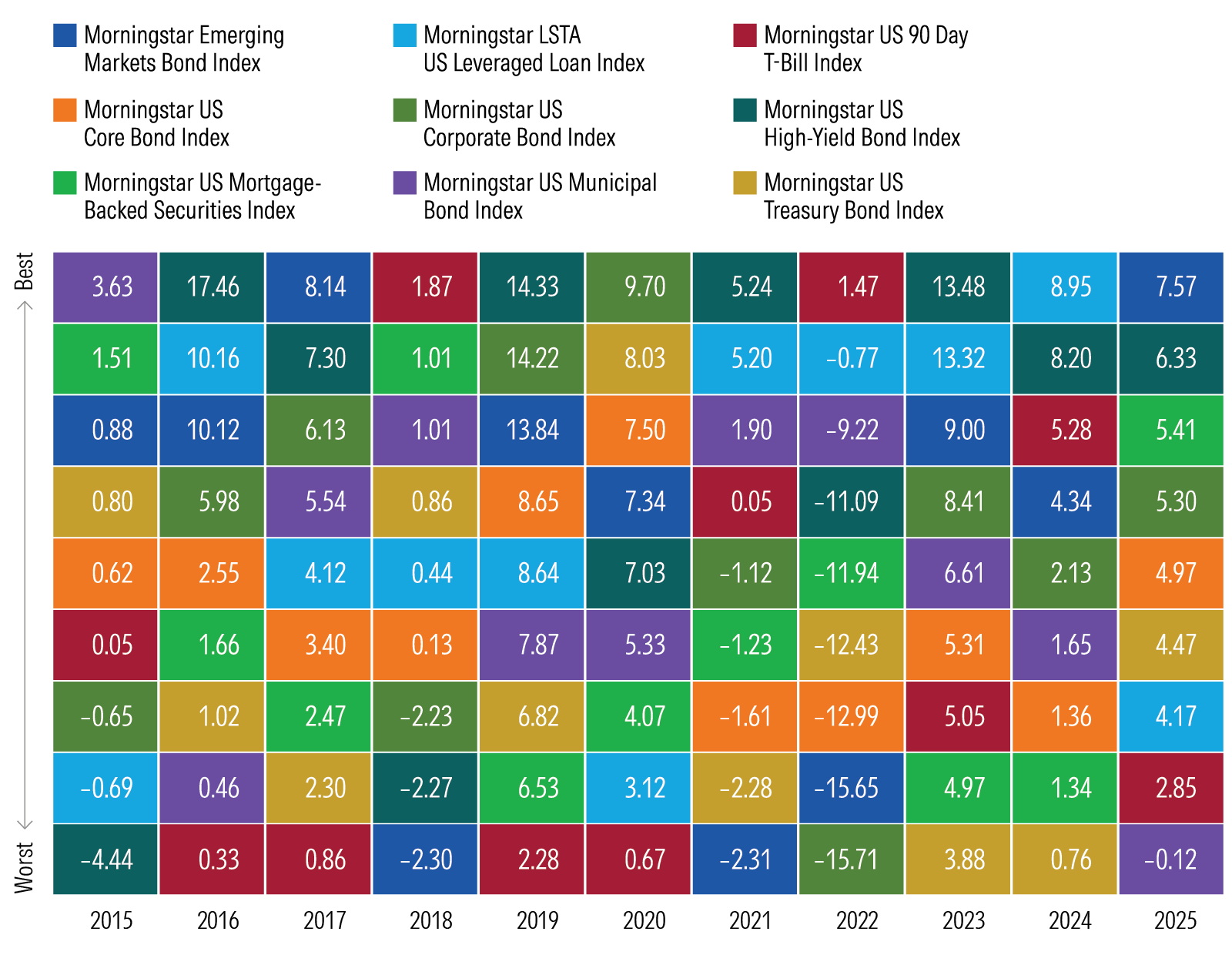
While I find correlation data useful, I’m also a big fan of so-called quilt charts that visualize calendar-year returns. Ten years of performance history for Morningstar’s fixed-income indexes can only capture so many different market conditions, but it’s enough to demonstrate how performance can diverge within the broad asset class. The table holds important lessons for investors, whether they’re turning to bonds for income, capital appreciation, or diversification.
Morningstar US Fixed-Income Index Returns
5 Lessons From Fixed-Income Index Returns
The first thing I notice in the table is that the margins are a lot narrower than they are on the stock side. I recently used a quilt chart to illustrate the performance of US equity factors and found that, in 2024, a whopping 27 percentage points separated the top- and bottom-performing factors. On the bond side, the gap between the 2024 champion Morningstar LSTA US Leveraged Loan Index and the Morningstar US Treasury Bond Index, which brought up the rear, was just 8 percentage points.
When I raised this to my colleague Katie Binns, Morningstar Indexes’ director of product management for fixed income, she responded: “For investors with low risk appetites, even 10 basis points can be seen as a massive difference.” Her comment reminded me of an old saying: “A bad year in the bond market is a bad day in the stock market.”
That wisdom was challenged in 2022, dubbed the “worst bond market ever.” Stubbornly high inflation prompted the US Federal Reserve to hike rates seven times by a total of 4.25 percentage points, sending prices on existing bonds plummeting. As seen in the table above, the Morningstar US Core Bond Index suffered a double-digit decline that year. So, too, did most fixed-income asset classes. Recession fears hurt more credit-sensitive areas.
My second takeaway from the table is that cash has done really well over the past few years. In 2022, the Morningstar US 90-Day T-Bill Index was actually in positive territory, benefiting from those higher short-term rates. A deeply inverted yield curve made cash a great place to be in 2023 and 2024 as well. “Cash has made a good case for itself,” according to Benz, reflecting on its low correlation to stocks compared with other types of bonds.
Don’t expect short-term paper to outperform the much longer-duration US core bond index regularly, though. You can see cash at the bottom of the return table in many years before 2022, and it has underperformed so far in 2025. But, as Benz notes, it makes sense for investors to “augment their bond holdings with cash investments to cover near-term expenditures.”
A third takeaway is that credit-sensitive fixed-income asset classes are volatile and cyclical. High-yield bond and leveraged loan underperformed in 2015 on fears of an economic slowdown but rebounded strongly in 2016, a more optimistic year. You’ll also see high-yield, leveraged loan, and emerging-markets bonds at the top of the table in 2023, when the economy surprised on the upside. Credit-sensitive asset classes are capable of big returns but also (relatively) big underperformance.
Loans, of course, are unique in possessing floating-rate coupons. Note their resilience in 2022 amid rising rates and their struggles during 2020’s rate cuts. True, loans can be more correlated with equities than most bond types. But my colleagues on Morningstar’s Manager Research team see the asset class as a nice diversifier within a broader fixed-income portfolio because loans benefit in an environment that’s usually difficult for bonds.
A fourth takeaway is that municipal bonds have acquitted themselves well across up and down markets in recent years. The Morningstar US Municipal Bond Index has shown itself to be a bit less sensitive to interest rate changes than its taxable counterparts, losing less than most in 2022 and underperforming the broad taxable market amid the pandemic rate cuts of 2020. In several years—notably 2015, 2017, 2021, and 2023—the municipal-bond index outperformed its taxable-bond counterpart. So far, 2025 has been a difficult year for municipals, owing to both fundamental and technical factors. As I wrote earlier this year, though, municipal bonds are worthy core holdings for tax-sensitive investors.
A final takeaway from the table: Betting on slices of fixed income is difficult. Leadership is highly changeable. In one year, mortgage-backed securities outperform the Morningstar US Core Bond Index; the next year, they’re lagging, and high-yield is on top. Most investors are best off forgoing tactical allocations and owning a broad market proxy.
The Case for Bonds Today
“Investors should embrace higher bond yields,” wrote Paul Olmsted of Morningstar’s Manager Research team. He points out that the income aspect of “fixed income” investing is appealing right now, both for Treasuries and more credit-sensitive bonds like high yield. The days of ZIRP, or zero interest rate policy, designed to combat deflation following the financial crisis, are firmly behind us.
Current bond yields are comfortably above the inflation rate. A yield to maturity of 4.4% for the Morningstar US Core Bond Index as of Aug. 31, 2025, provides a decent income level. The leveraged loan index’s 8.6% yield is even more impressive, though it comes with significantly more credit risk and volatility.
Current yields are a plus for both income and total return-focused investors. Falling interest rates should boost bonds further. When the Fed cut in response to the pandemic in 2020, some fixed-income index returns approached double digits. Gains like that are unusual, but so were the losses of 2022.
One lesson of 2022 is that periods of inflation and rising rates are bad for both stocks and bonds. Inflation remains a risk. So does recession, which could hurt credit-sensitive areas of fixed income.
Nevertheless, bonds and other debt instruments play an important portfolio role. Income, total return, and diversification are all benefits. The case for fixed income is both tactical and strategic.
Correction: This article was updated to correct the spelling of Paul Olmsted's name.
Editor’s Note: A version of this article appeared on June 5, 2025.
The author or authors do not own shares in any securities mentioned in this article. Find out about Morningstar’s editorial policies.
Morningstar, Inc., licenses indexes to financial institutions as the tracking indexes for investable products, such as exchange-traded funds, sponsored by the financial institution. The license fee for such use is paid by the sponsoring financial institution based mainly on the total assets of the investable product. A list of ETFs that track a Morningstar index is available via the Capabilities section at indexes.morningstar.com. A list of other investable products linked to a Morningstar index is available upon request. Morningstar, Inc., does not market, sell, or make any representations regarding the advisability of investing in any investable product that tracks a Morningstar index.

 United States