
Corporate Credit Spreads Recover on Even Easier Global Monetary Policy, Bouncing Oil Prices, and Strong Payrolls
BOE adds corporate bond purchase program to monetary policy.


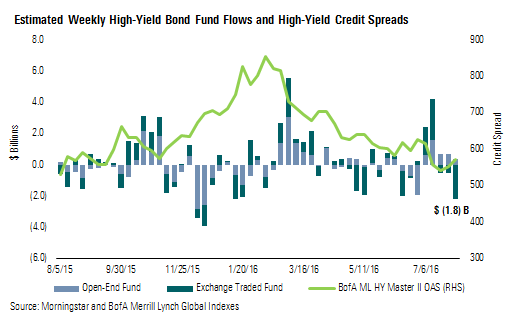
After a brief bout of shallow weakness earlier in the week, corporate credit spreads recovered by the close of last week. The combination of expanded global monetary policy easing, a bounce in oil prices, and a strong payroll report led to an increase in risk asset prices. The Bank of England greatly expanded its easy monetary policy to combat potential negative impacts from Brexit, which will add to the amount of quantitative easing already being implemented by other global central banks. Oil briefly fell below $40 a barrel midweek but trended higher Thursday and Friday, ending at $42 per barrel, a $0.50 increase for the week, potentially setting a near-term bottom. After several quarters of especially sluggish U.S. economic growth, the market took solace in the strong payrolls report and increase in wages, possibly indicating a stronger economic rebound in the third quarter. The average spread of the Morningstar Corporate Bond Index ended the week unchanged at +145. Higher-risk assets performed better, as the average spread of the Bank of America Merrill Lynch High Yield Master Index II tightened 15 basis points to +546, nearly matching its lowest spread level over the past year.
While risk assets rose, U.S. Treasury bond prices sank, sending interest rates higher as investors shifted asset allocations. However, considering that U.S. Treasury bonds are some of the last sovereign bonds in developed markets that trade at a positive yield, they remain attractive to foreign investors on a relative value basis. As such, the amount that interest rates will rise will be limited, and they will probably continue to trade in a relatively narrow range. While the payroll report was significantly stronger than expected, the market continues to price in only a small probability that the Federal Reserve will hike short-term rates in September. With GDP growth for the past few quarters running at an abnormally slow rate (even compared with the moribund growth since the Great Recession) and the impending presidential elections, it seems highly unlikely that the Fed would boost interest rates at its September meeting. The probability of a December hike interest rates rose at the end of the week but still remains below 50%.
If oil prices have bottomed out and stabilized, then the strong technical factors in the corporate credit markets should hold; however, if oil prices fall below $40 per barrel and remain below that level for a sustained period, the heightened credit risk in that sector is likely to put significant downward pressure on the overall corporate bond market. Barring a significant decline in the oil markets, we continue to think corporate bonds will hold their value. Foreign investors are finding value in dollar-denominated fixed-income securities, and with deposit rates negative in the European Union, the U.S. dollar is likely to continue to appreciate as against the euro over time. As global interest rates have sunk, corporate bonds have become increasingly more attractive on a relative value basis. With underlying interest rates as low as they are, the extra return provided by the credit spread on corporate bonds above the underlying benchmark bond has become an increasingly larger portion of total return.
BOE Follows in ECB's Footsteps, Adds Corporate Bond Purchase Program to Monetary Policy The Bank of England put the pedal to the metal and greatly eased its already easy monetary policy. It announced it would cut its short-term rate by 25 basis points to 0.25%, introduce a new bank term loan program, and expand its asset purchase of U.K. government bonds by GBP 60 billion, which will increase asset purchases to GBP 435 billion. In addition, following in the European Central Bank's footsteps, the BOE will also purchase GBP 10 billion of corporate bonds. After the announcement, U.K. sovereign bond prices rose, sending interest rates to new all-time lows, with the U.K. 10-year bond declining to as low as 0.63%. The corporate bond asset purchase program will probably provide another tailwind to push corporate credit spreads tighter and will result in even lower interest costs for debtors. However, while this program will provide a significant amount of additional liquidity to the markets, it remains to be seen if it actually promotes an increase in long-term sustainable economic growth.
This program does not seem to solve any problems in the financial markets that are limiting economic growth. Liquidity is already high (in fact, many investors report having a hard time finding enough bonds to buy to put money to work), credit spreads are already below long-term averages, and interest rates are at historic lows. The slight decrease in interest expense for corporations is unlikely to be the differentiating factor in whether a management team decides to borrow money to fund new capital expenditure programs. Lower interest expense may be able to pull forward some future demand, but that may only steal from the future as opposed to creating the virtuous cycle of enhancing long-term growth. With the amount of liquidity and new money already being created by global central banks, the program is akin to offering a glass of water to a drowning man.
The effect of the BOE’s corporate bond purchase program should be similar to the ECB’s corporate bond purchase program. As the BOE purchases corporate bonds, a significant amount of that new money will probably be reinvested in the fixed-income markets. Not only does the asset purchase program increase demand for fixed-income securities by creating new money that must be reinvested, but it also reduces the amount of outstanding supply, which exacerbates the market impact.
New Bond Issuance Soars Higher in Technology, Media, and Telecom Sectors According to Advantage Data, total U.S. dollar issuance of investment-grade corporate bonds for the year to date through Aug. 4 has reached $1.2 trillion, an increase of 34% from the same period last year. Of this amount, $129 billion was placed in the technology, media, and telecom sector, 28% above the sector volume for the same period last year. The pace of new issuance in this sector picked up markedly recently, as $56 billion has been issued just in the past six weeks.
A significant amount of the proceeds has been used to fund acquisitions. For example, Oracle ORCL (rating: AA-, wide moat) financed its acquisition of NetSuite, Microsoft MSFT (rating: AAA/UR-, wide moat) its impending purchase of LinkedIn LNKD (rating: NR, wide moat), and Verizon Communications VZ (rating: BBB, narrow moat) to fund Yahoo YHOO (rating: NR, no moat) and Fleetmatics. However, a substantial amount of issuance continues to go to support share-repurchase programs as companies work to offset cash that has built up overseas. These companies have drawn down domestic cash reserves and issued U.S. dollar-denominated debt. As a result, gross leverage has continued to rise for many issuers in the TMT sector while domestic liquidity has become much tighter, creating a net increase in credit risk.
About two thirds of technology issuance is represented by just six deals, led by Dell’s $20 billion placement of senior secured debt in May. Microsoft holds second place with its $19.8 billion deal completed last week. Oracle was third with its $14 billion issuance at the end of June. Apple AAPL (rating: AA-, narrow moat) holds two places in the top five with a $12 billion deal in February and its $7 billion issuance at the end of July. Cisco Systems’ CSCO (rating: AA, narrow moat) $7 billion issuance in February is tied with Apple for fifth place.
We’ve only seen $10 billion of issuance from AT&T T (rating: BBB, narrow moat) and Verizon this year, which is 43% below last year’s volume, while media companies led by Comcast CMCSA (rating: A-, wide moat) and Walt Disney DIS (rating: A+, wide moat) accounted for $16 billion, reflecting $10 billion more issuance this year.
Given the deluge of new issuance in the sector, in order to heighten investor interest in the deals, initial price talk has reflected wider-than-typical new issue concessions. With the strong demand for investment-grade corporate bonds, however, the amount of new issue concession quickly dissipated by the time the bonds were priced. For example, since April, the spread between initial price talk and final pricing has tightened 15-20 basis points. This represents a slightly wider gap from the pricing range earlier this year of 10-15 bps.
After the new issue concession evaporated, the bonds traded heavy in the secondary market. For example, over the five-day trading period after pricing, the credit spreads for benchmark-size 10-year bonds generally remained close to the initial pricing. This indicates that the bonds were priced without any new issue concession and there is little additional excess demand for paper in this sector. Exceptions include Verizon’s 2.63% notes due 2026, which widened out about 10 bps after issuance on July 27; to the upside, Oracle’s 2.65% notes due 2026 tightened 10 bps after their initial pricing June 29.

 United States